Question
All the $\mathrm{C}-\mathrm{O}$ bonds in carbonate ion $\left(\mathrm{CO}^{2-}{ }_3\right)$ are equal in length. Explain.

Answer


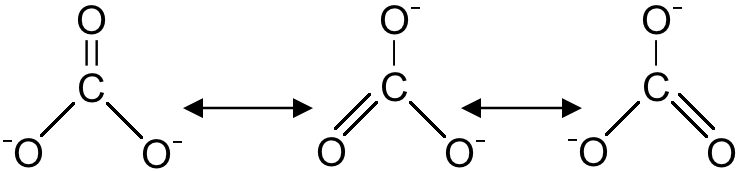
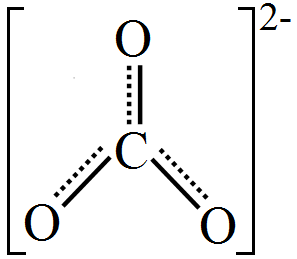
Carbonate ion is represented by resonating structures as given below:

Actual structure will be the mixture of all resonating structures, also called resonance hybrid structure.

Need a full question paper?

Generate a complete, print-ready paper with questions like this in minutes — across 16+ boards, with answer keys.
Start Generating Free

Similar questions

Arrange $HNO_3, NO, NH_4Cl N_2$​​​​​​​ in decreasing order of oxidation state of nitrogen.
What is the oxidation number of Fe in ${\left[\mathrm{Fe}(\mathrm{CO})_5\right]}$?
  1. The standard electrode potential of two metals 'A' and 'B' are -0.76V and +0.34V respectively. An electrochemical cell is formed using electrodes of these metals.
  1. Identify the cathode and anode.
  2. Write the direction of flow of electrons.
  1. $\mathrm{HNO}_3$ acts as oxidising agent while $\mathrm{HNO}_2$ can act as both oxidising as well as reducing agent, why?
Why are the atomic mass of most of the elements is fractional?
A reaction between ammonia and boron trifluoride is given below:
$
: NH_3+B F_3 \rightarrow H_3 N: BF_3
$
Identify the acid and base in this reaction. Which theory explains it? What is the hybridization of B and N in the reactants?
  1. Which of the following are isostructural species. Give their structures.
$\text{NO}^+_2,\text{BCl}_3,\text{CO}_2,\text{BeCl}_2$
  1. Which has most electronegativity of carbon? Why?
$\text{CH}_3-\text{CH}_3,\text{CH}=\text{CH}_2,\text{HC}\equiv\text{CH}$
A gas that follows Boyle’s law, Charle’s law and Avogadro’s law is called an ideal gas. Under what conditions a real gas would behave ideally?
Alkynes on reduction with sodium in liquid ammonia form trans alkenes. Will the butene thus formed on the reduction of the 2-butyne show the geometrical isomerism?
If one liter solution is made by dissolving 22.4 gm of $C _6 H _5 COOH$ and benzene, find formality of this solution.
Calculate the total entropy change, $\Delta \mathrm{S}_{\text {total }}$ and state if the process is spontaneous, when one mole of liquid mercury $\mathrm{Hg}(\mathrm{l})$ changes to mercury vapour, $\mathrm{Hg}(\mathrm{g})$ at 298 K . The molar entropy of vapourisation of Hg is $99 \mathrm{JK}^{-1} \mathrm{~mol}^{-1}$ and molar enthalpy of vapourisation is $59.1 \mathrm{k} \mathrm{J} \mathrm{mol}^{-1}$.