Allyl chloride is hydrolysed more readily than n-propyl chloride. Why?
Download our app for free and get started
Allyl chloride shows high reactivity because the carbocation formed by hydrolysis is stabilised by resonance while no such stabilisation of carbocation exists in the case of n-propyl chloride.


Download our appand get started for free
Experience the future of education. Simply download our apps or reach out to us for more information. Let's shape the future of learning together!No signup needed.*
Similar Questions
- 1View SolutionHow the following conversion can be carried out?
Benzene to 4-bromonitrobenzene. - 2Write the structure of the major organic product in each of the following reaction:View Solution
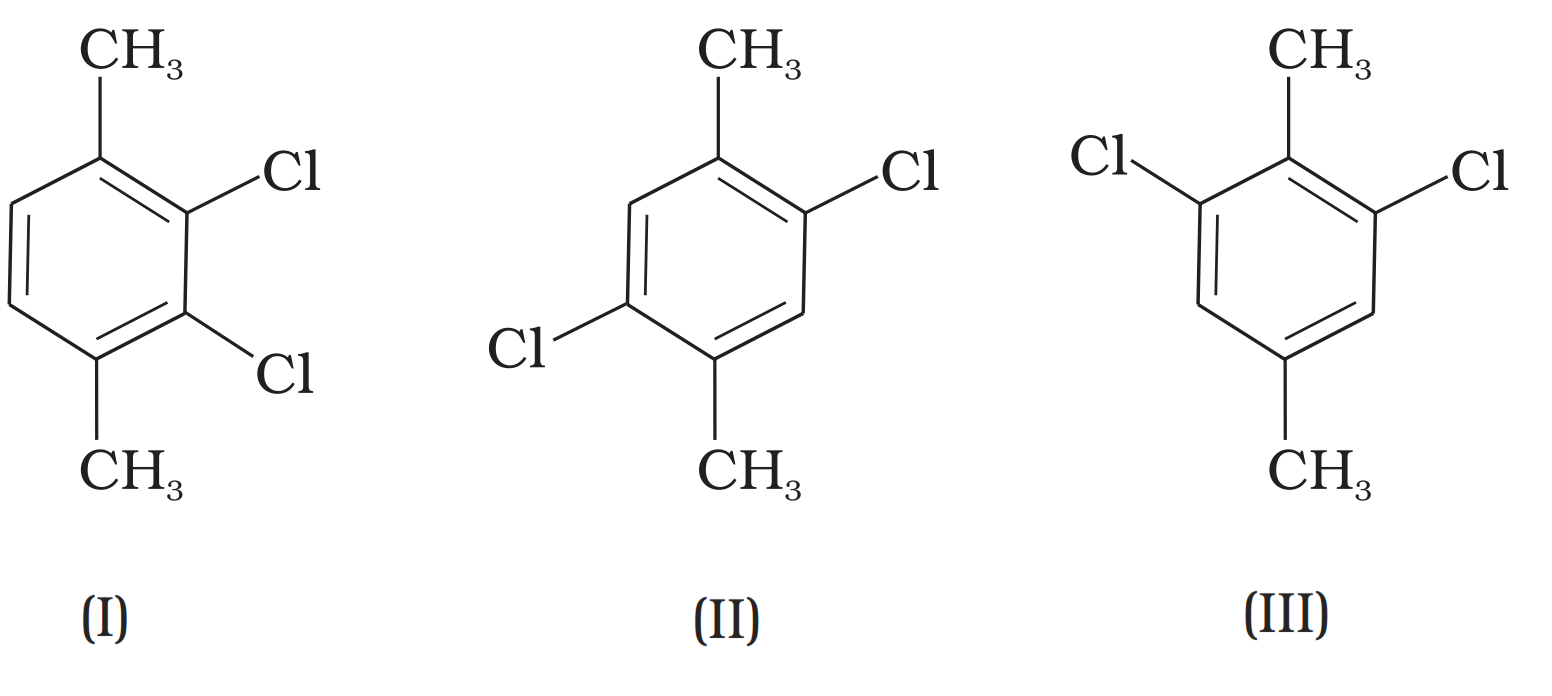
$\text{CH}_3\text{CH}_2\text{CH}_2\text{OH}+\text{SOCl}_2\xrightarrow{}$ - 3View SolutionWhich of the following compounds will have the highest melting point and why?
- 4View SolutionHow can you obtain iodoethane from ethanol when no other iodine containing reagent except NaI is available in the laboratory?
- 5Name the following halides according to $\text{IUPAC}$ system and classify them as alkyl, allyl, benzyl $($primary, secondary, tertiary$),$ vinyl or aryl halides:View Solution
$\ce{CH_3C(C_2H_5)_2CH_2Br}.$ - 6View SolutionWhat happens when:
n-butyl chloride is treated with alcoholic KOH. - 7Which of the compounds will react faster in $S_N1$ reaction with the $–OH$ ion?View Solution
$\text{CH}_3-\text{CH}_2-\text{Cl}$ or $\text{C}_6\text{H}_5-\text{CH}_2-\text{Cl}$ - 8Give the $\ce{IUPAC}$ names of the following compound: $\ce{(CH_3)_3CCH=ClC_6H_4I-p}.$View Solution
- 9View SolutionGive reasons for the following:
Chloroethane is insoluble in water. - 10Name the following halides according to $\text{IUPAC}$ system and classify them as alkyl, allyl, benzyl $($primary, secondary, tertiary$),$ vinyl or aryl halides: $\ce{CH_3CH(CH_3)CH(Br)CH_3}.$View Solution