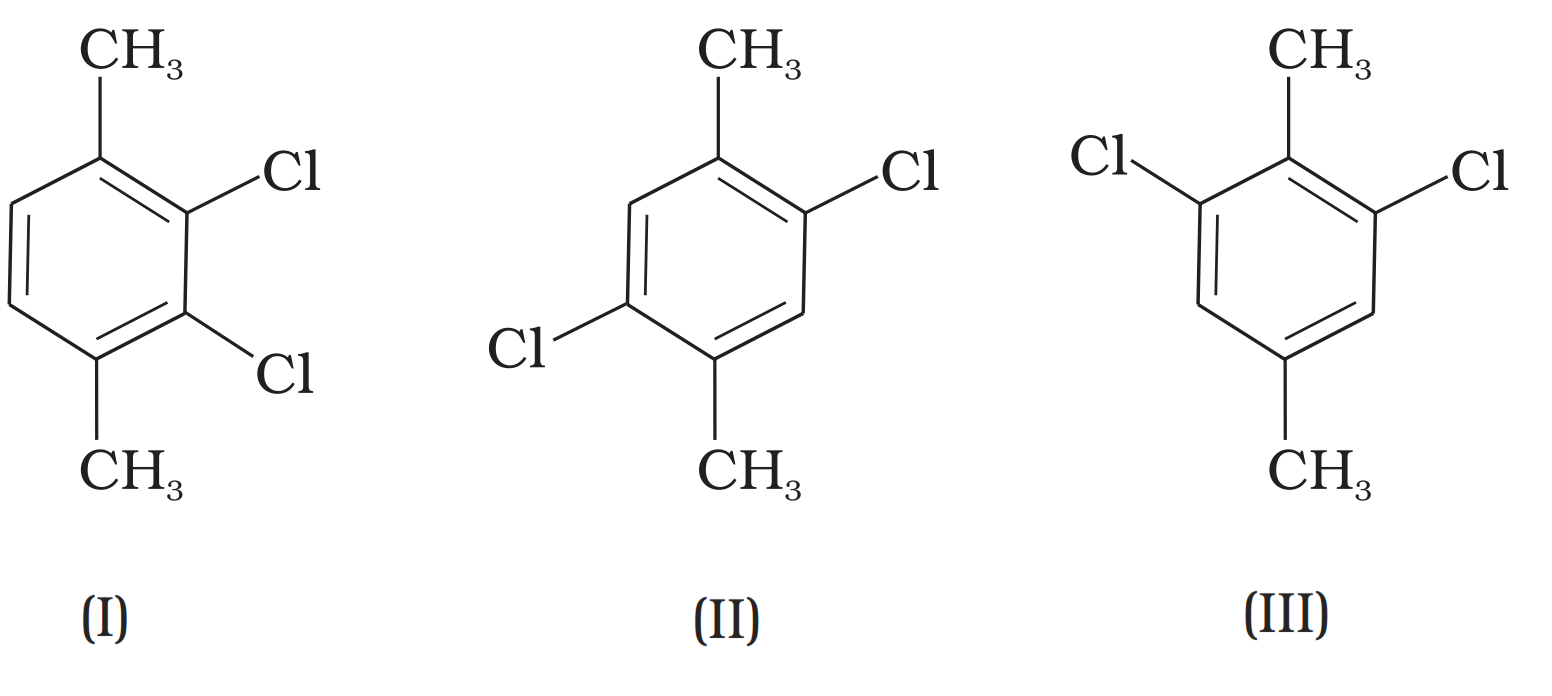
Which of the following compounds will have the highest melting point and why?
Download our app for free and get started
Compound $( II )$
Reason: The molecular structure of compound $(II)$ shows that both the substituents $($i.e. $CH_3$ and $Cl)$ are at para position.
The para $-$ isomers have higher melting points as compared to their ortho and meta $-$ isomers.
It is due to symmetry of para $-$ isomers thatfits in crystal lattice better as compared to ortho $-$ andmeta $-$ isomers.
Reason: The molecular structure of compound $(II)$ shows that both the substituents $($i.e. $CH_3$ and $Cl)$ are at para position.
The para $-$ isomers have higher melting points as compared to their ortho and meta $-$ isomers.
It is due to symmetry of para $-$ isomers thatfits in crystal lattice better as compared to ortho $-$ andmeta $-$ isomers.

Download our appand get started for free
Experience the future of education. Simply download our apps or reach out to us for more information. Let's shape the future of learning together!No signup needed.*
Similar Questions
- 1View SolutionExplain why,
alkyl halides, though polar, are immiscible with water? - 2Name the following halides according to $\text{IUPAC}$ system and classify them as alkyl, allyl, benzyl $($primary, secondary, tertiary$),$ vinyl or aryl halides: $\ce{CH_3CH(CH_3)CH(Br)CH_3}.$View Solution
- 3Write the isomers of the compound having formula $\ce{C_4H_9Br}.$View Solution
- 4View SolutionWrite structures of the following compounds:
1, 4-Dibromobut-2-ene. - 5View SolutionHow will you convert aniline to bromobenzene?
- 6View SolutionArrange each set of compound in order of increasing boiling points.
1-Chloropropane, Isopropyl chloride, 1-Chlorobutane. - 7View SolutionDiphenyls are potential threat to the environment. How are these produced from arylhalides?
- 8Draw the structures of major monohalo products in each of the following reaction:View Solution
$\text{CH}_3\text{CH}_2\text{Br}+\text{NaI}\rightarrow$ - 9View SolutionHow will you bring about the following conversion?
Benzene to biphenyl. - 10Name the following halides according to $\text{IUPAC}$ system and classify them as alkyl, allyl, benzyl $($primary, secondary, tertiary$),$ vinyl or aryl halides:View Solution
$\ce{CH_3CH=C(Cl)CH_2CH(CH_3)_2}.$