MCQ
$\alpha -D-$ Glucose and $\beta -D-$ Glucose are 
  • A
    Position isomer
  • Anomers
  • C
    Enantiomer
  • D
    Acetals

Answer

Correct option: B.
Anomers
b
$\alpha$-D-glucose and $\beta$-D-glucose is example of anomers An Anomer of a saccharide only differs in its structure at the anomeric carbon. Anomeric carbon being the functional group of the carbohydrate, which is usually the carboxyl group attached to it.Epimeres, differ at only one chiral center, not the anomeric carbon.

Need a full question paper?

Generate a complete, print-ready paper with questions like this in minutes — across 16+ boards, with answer keys.
Start Generating Free

Similar questions

During the electrolysis of molten sodium chloride, the time required to produce $0.10\, mol$ of chlorine gas using a current of $3$ amperes is .......... $\min.$
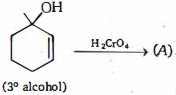
Product $(A)$ is
The $\left(\frac{\partial E }{\partial T }\right)_{ P }$ of different types of half cells are as follows :

$\text { A } \quad\quad\quad\quad\quad \text { B } \quad\quad\quad\text { C } \quad\quad\quad\quad\text { D }$

$1 \times 10^{-4} \quad 2 \times 10^{-4} \quad 0.1 \times 10^{-4} \quad 0.2 \times 10^{-4}$

(Where $E$ is the electromotive force)

Which of the above half cells would be preferred to be used as reference electrode?

The weight of ${H_2}{C_2}{O_4}.\,2{H_2}O$ required to prepare $500\,ml$ of $0.2\,N$ solution is .......... $g$
The negative $Zn$ pole of a Daniel cell, sending a constant current through a circuit, decreases in mass by $0.13\,g$ in $30$ minutes. If the electrochemical equivalent of $Zn$ and $Cu$ are $32.5$ and $31.5$ respectively, the increase in the mass of the positive $Cu$ pole in this time is .............. $\mathrm{g}$
The final product $(III)$ obtained in the reaction sequence 

$C{{H}_{3}}-C{{H}_{2}}-COOH\xrightarrow{PC{{l}_{3}}}I\xrightarrow{{{C}_{6}}{{H}_{6}}/AlC{{l}_{3}}}II\xrightarrow[\text{base/heat}]{N{{H}_{2}}-N{{H}_{2}}}III$

Strong electrolytes are those which
The initial rate for a first order reaction is $0.6932 \times10^{-2}\,mol\, L^{-1}\, \min^{-1}$ and the initial conc. of the reactant is $0.1\, M$. Then $t_{1/2}$ is equal to ...... $\min $
Which of the following are non-reducing sugar.

$(I)$ Glucose             

$(II)$ Fructose

$(III)$ Maltose

$(IV)$ Sucrose

$(V)$ Galactose

Which one of the following does not represent Arrhenius equation