MCQ
Alpha particles are
  • A
    $2$ free protons
  • doubly ionised helium atoms
  • C
    helium atoms
  • D
    singly ionised helium atoms

Answer

Correct option: B.
doubly ionised helium atoms
b

Need a full question paper?

Generate a complete, print-ready paper with questions like this in minutes — across 16+ boards, with answer keys.
Start Generating Free

Similar questions

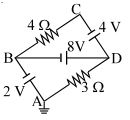
The figure shows a network of resistances in which the point $A$ is earthed. The point which has the least potential is
$STATEMENT$ $-1$ If the accelerating potential in an $\mathrm{X}$-ray tube is increased, the wavelengths of the characteristic $\mathrm{X}$-rays do not change. because

$STATEMENT$ $-2$ When an electron beam strikes the target in an $X$-ray tube, part of the kinetic energy is converted into $X$-ray energy.
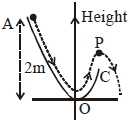
A particle $(\mathrm{m}=1\; \mathrm{kg})$ slides down a frictionless track $(AOC)$ starting from rest at a point $A$ (height $2\; \mathrm{m}$ ). After reaching $\mathrm{C}$, the particle continues to move freely in air as a projectile. When it reaching its highest point $P$ (height $1 \;\mathrm{m}$ ). the kinetic energy of the particle (in $\mathrm{J}$ ) is : (Figure drawn is schematic and not to scale; take $\left.g=10 \;\mathrm{ms}^{-2}\right)$
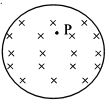
Figure shows auniform magnetic field $B$ confinedto a cylindrical volume and is increasing at a constant rate. The instantaneous acceleration experienced by an electron placed at $P$ is
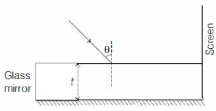
Back surface of a glass (refractive index $n$ and thickness $t$ ) is polished to work as a mirror as shown below. A laser beam falls on it and is partially reflected and refracted at the air-glass interface and fully reflected at the mirror surface, respectively. A pattern of discrete spots of light is observed on the screen. The spacing between the spots on the screen will be
The length of a telescope is $36\, cm$. The focal lengths of its lenses can be
A beaker full of hot water is kept in a room. If it cools from $80^{\circ} C$ to $75^{\circ} C$ in $t_1$, minutes, from $75^{\circ} C$ to $70^{\circ} C$ in $t_2$ minutes and from $70^{\circ} C$ to $65^{\circ} C$ in $t_3$ minutes, then
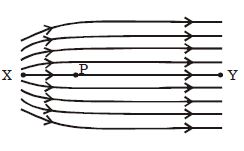
The diagram below shows electric field lines in a region of space. Which of the following diagrams best shows the variation with distance $d$ of the potential $V$ along the line $XY$ as we move from $X$ to $Y$ ?
Two infinitely long parallel conducting plates having surface charge densities $ + \sigma $ and $ - \sigma $ respectively, are separated by a small distance. The medium between the plates is vacuum. If ${\varepsilon _0}$ is the dielectric permittivity of vacuum, then the electric field in the region between the plates is
If the red light is replaced by blue light illuminating the object in a microscope the resolving power of the microscope