MCQ
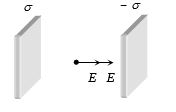
Two infinitely long parallel conducting plates having surface charge densities $ + \sigma $ and $ - \sigma $ respectively, are separated by a small distance. The medium between the plates is vacuum. If ${\varepsilon _0}$ is the dielectric permittivity of vacuum, then the electric field in the region between the plates is
  • A
    $0\,volts/meter$
  • B
    $\frac{\sigma }{{2{\varepsilon _o}}} volts/meter$
  • $\frac{\sigma }{{{\varepsilon _o}}} volts/meter$
  • D
    $\frac{{2\sigma }}{{{\varepsilon _o}}} volts/meter$
Answer

Correct option: C.
$\frac{\sigma }{{{\varepsilon _o}}} volts/meter$
c
(c) Electric field between the plates is
$ = \frac{\sigma }{{2{\varepsilon _0}}} - \frac{{( - \sigma )}}{{2{\varepsilon _0}}}$
$ = \frac{\sigma }{{{\varepsilon _0}}}\,volt/meter$

Need a full question paper?

Generate a complete, print-ready paper with questions like this in minutes — across 16+ boards, with answer keys.

Start Generating Free

Similar questions

A movie projector forms an image $3.5m$ long of an object $35 mm$. Supposing there is negligible absorption of light by aperture then illuminance on slide and screen will be in the ratio of
Five resistors of given values are connected together as shown in the figure. The current in the arm $BD$ will be
For a triode $\pi = 64$ and $gm =1600 \pi \, mho$. It is used as an amplifier and an input signal of $1V (rms)$ is applied. The signal power in the load of $40 k$ $\Omega$ will be......$mW$
Two resistors of resistances $R_1 = (300 \pm 3) \,\Omega $ and $R_2 = (500 \pm 4)$ are connected in series. The equivalent resistance of the series combination is
A circular plate of uniform thickness has diameter $56\ cm$. A circular part of diameter $42\ cm$ is removed from one edge. What is the position of the centre of mass of the remaining part ........ $cm$.
Two water pipes $P$ and $Q$ having diameter $2 \times 10^{-2} \,m$ and $4 \times 10^{-2} \,m$ respectively are joined in series with the main supply line of water. The velocity of water flowing in pipe $P$ is ........
An observer is moving towards the stationary source of sound, then
The meter bridge shown is in balanced position with $\frac{\mathrm{P}}{\mathrm{Q}}=\frac{\mathrm{l}_{1}}{\mathrm{l}_{2}}$. If we now litterchange the positions of gavanometer and cell, will the bridge work? If yes, what will be balance condition?
The maximum current that can be measured by a galvanometer of resistance $40 \,\Omega$ is $10\, mA$. It is converted into a voltmeter that can read upto $50\, V$. The resistance to be connected in series with the galvanometer is ... (in $ohm$)
A plot of the number of neutrons $(N)$ against the number of protons ( $P$ )of stable nuclei exhibits upward deviation from linearity for atomic number, $Z>20$. For an unstable nucleus having $N / P$ ratio less than $1$ , the possible mode($s$) of decay is(are)

($A$) $\beta^{-}$-decay ( $\beta$ emission)

($B$) orbital or $K$-electron sasture

($C$) neutron emission

($D$) $\beta^{+}$-decay (positron emission)