MCQ
Alpha rays emitted from a radioactive substance are
  • A
    Negatively charged particles
  • B
    Ionised hydrogen nuclei
  • Doubly ionised helium atom
  • D
    Uncharged particles having the mass equal to proton

Answer

Correct option: C.
Doubly ionised helium atom
c
(c)

Need a full question paper?

Generate a complete, print-ready paper with questions like this in minutes — across 16+ boards, with answer keys.
Start Generating Free

Similar questions

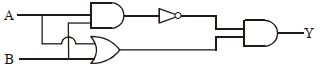
Which one of the following will be the output of the given circuit?
The angular speed of a body changes from ${\omega _1}$ to ${\omega _2}$ without applying a torque but due to changes in moment of inertia. The ratio of radii of gyration in two cases is
$0.056 \,kg$ of Nitrogen is enclosed in a vessel at a temperature of $127\,^{\circ} C$. The amount of heat required to double the speed of its molecules is k cal. (Take $R =2$ $cal \,mole$ $^{-1} K ^{-1}$ )
An electron in a hydrogen atom makes a transition from $n_1$ to $n_2$. If the time period of electron in the initial state is eight times that in the final state then
A magnet is placed in iron powder and then taken out, then maximum iron powder is at
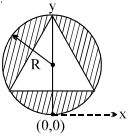
From a uniform disc of radius $R$, an equilateral triangle of side $\sqrt 3 \,R$ is cut as shown. The new position of centre of mass is :
Two capacitors of capacitances $C$ and $2\, C$ are charged to potential differences $V$ and $2\, V$, respectively. These are then connected in parallel in such a manner that the positive terminal of one is connected to the negative terminal of the other. The final energy of this configuration is$.....CV^2$
Consider a finite insulated, uncharged conductor placed near a finite positively charged conductor. The uncharged body must have a potential
Assume that the displacement$(s)$ of air is proportional to the pressure difference $(\Delta p)$ created by a sound wave. Displacement$(s)$ further depends on the speed of sound $(v),$ density of air $(\rho)$ and the frequency $(f)$ If $\Delta p \approx 10\, Pa , v  \approx 300\, m / s , p  \approx 1\, kg / m ^{3}$ and $f \approx  1000 \,Hz$, then $s$ will be the order of

(take multiplicative constant to be $1$ )

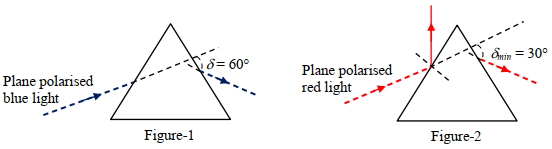
A plane polarized blue light ray is incident on a prism such that there is no reflection from the surface of the prism. The angle of deviation of the emergent ray is $\delta=60^{\circ}$ (see Figure-$1$). The angle of minimum deviation for red light from the same prism is $\delta_{\text {min }}=30^{\circ}$ (see Figure-$2$). The refractive index of the prism material for blue light is $\sqrt{3}$. Which of the following statement($s$) is(are) correct?

($A$) The blue light is polarized in the plane of incidence.

($B$) The angle of the prism is $45^{\circ}$.

($C$) The refractive index of the material of the prism for red light is $\sqrt{2}$.

($D$) The angle of refraction for blue light in air at the exit plane of the prism is $60^{\circ}$.