MCQ
Aluminium $(III)$ chloride forms a dimer because
  • Higher coordination number can be achieved by aluminium
  • B
    Aluminium has high ionization energy
  • C
    Aluminium belongs to $III$ group
  • D
    It cannot form a trimer

Answer

Correct option: A.
Higher coordination number can be achieved by aluminium
a
$AlCl _3$ can form dimer and exists as $Al _2 Cl _6$, aluminium has vacant $d$-orbitals which can accommodate electron from chlorine atom. $AlCl _3$ is an electron deficient compound in $Al$ (octet incomplete) thus behaves as Lewis acid and $Al$ completes it by taking electron pair from $Cl$-atom as shown in figure.

Need a full question paper?

Generate a complete, print-ready paper with questions like this in minutes — across 16+ boards, with answer keys.

Start Generating Free

Similar questions

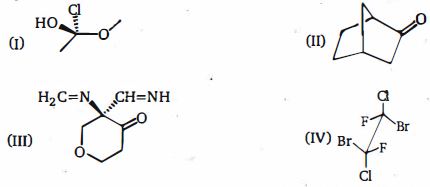
What is the absolute configuration of the following molecules ? ($NS =$ the  molecule has no center) Note : For the purpose of this question only, the order of  stereocenters is not specified ; i.e., $R, S = S, R.$

$I$   ||   $II$   ||   $III$   ||   $IV$

Which type of compounds show high melting and boiling points
The correct $IUPAC$ name of $2-$ethyl$-3-$pentyne is :
For the precipitation reaction of $A{g^ \oplus }$ ions with $NaCl,$ which of the following statements is true ?
Given below are two statements:

Statement $(I)$ : The $4 \mathrm{f}$ and $5 \mathrm{f}$ - series of elements are placed separately in the Periodic table to preserve the principle of classification.

Statement $(II)$ :$S$-block elements can be found in pure form in nature. In the light of the above statements, choose the most appropriate answer from the options given below :

The total pressure of a gaseous mixture is equalto the sum of the partial pressures is:
A base dissolved, in water, yields a solution with a hydroxyl ion concentration of $0.05\,mol\,litr{e^{ - 1}}$. The solution is
Rearrange the following in the increasing order of acidic strength.
$(i)$ benzoic acid $(ii)\, p$ -methoxybenzoic acid $(iii)\, o$ -methyoxybenzoic acid
The correct statement/s about Hydrogen bonding is/are:

$A$. Hydrogen bonding exists when $\mathrm{H}$ is covalently bonded to the highly electro negative atom.

$B$. Intermolecular $\mathrm{H}$ bonding is present in o-nitro phenol

$C$. Intramolecular $\mathrm{H}$ bonding is present in $\mathrm{HF}$.

$D$. The magnitude of $\mathrm{H}$ bonding depends on the physical state of the compound.

$E$. H-bonding has powerful effect on the structure and properties of compounds.

Choose the correct answer from the options given below :

Which quantum number is not related with Schrodinger equation