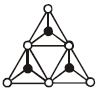
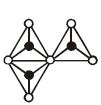
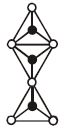
MCQ 11 Mark
Match List$-I$ with List$-II$.
| List$-I$ |
List$-II$ |
| $A$ Coke |
$I$ Carbon atoms are $sp ^3$ hybridised |
| $B$ Diamond |
$II$ Used as a dry lubricant |
| $C$ Fullerene |
$III$ Used as a reducing agent |
| $D$ Graphite |
$IV$ Cage like molecules |
Choose the correct answer from the options given below :
- A
$A-III, B-IV, C-I, D-II$
- B
$A-II, B-IV, C-I, D-III$
- C
$A-IV, B-I, C-II, D-III$
- ✓
$A-III, B-I, C-IV, D-II$
AnswerCorrect option: D. $A-III, B-I, C-IV, D-II$
d
Coke is largely used as a reducing agent in metallurgy.
In diamond, each carbon atom undergoes $sp ^3$ hybridisation and linked to four other carbon atoms by using hybridised orbitals in tetrahedral fashion.
Buckminsterfullerene contains six membered and five membered rings and hence is a cage like molecule.
Graphite is very soft and slippery. Hence, it is used as a dry lubricant in machines running at high temperature.
View full question & answer→MCQ 21 Mark
Taking stability as the factor, which one of the following represents correct relationship?
AnswerCorrect option: A. $TlI > TlI _3$
a
$T l^{+}$ and $I ^{-}$ > $T l^{+3}$ and $3 I ^{-}$
due to inert pair effect $Tl^{+}$is more stable than $Tl^{+3}$.
View full question & answer→MCQ 31 Mark
Which of the following statement is not correct about diborane?
- A
The four terminal $B-H$ bonds are two centre two electron bonds.
- B
The four terminal Hydrogen atoms and the two Boron atoms lie in one plane.
- ✓
Both the Boron atoms are $s p^{2}$ hybridised.
- D
There are two $3-$centre$-2-$electron bonds.
AnswerCorrect option: C. Both the Boron atoms are $s p^{2}$ hybridised.
c
$B$ has $sp ^{3}$ Hybridisation
Non- planar
View full question & answer→MCQ 41 Mark
Choose the correct statement:
AnswerCorrect option: B. Diamond is $s p^{3}$ hybridised and graphite is $s p^{2}$ hybridized.
b
In diamond each carbon is bonded with four other carbon atoms. So hybridisation of carbon atom is $sp ^{3}$.
In graphite each carbon is bonded with three other carbon atoms. So hybridisation of carbon atom is $sp ^{2}$.
View full question & answer→MCQ 51 Mark
Which one of the following reactions does not come under hydrolysis type reaction?
- A
$P _{4} O _{10( s )}+6 H _{2} O _{( I )} \rightarrow 4 H _{3} PO _{4( aq )}$
- B
$SiCl _{4( l )}+2 H _{2} O _{( I )} \rightarrow SiO _{2( s )}+4 HCl _{( aq )}$
- C
$Li _{3} N _{( s )}+3 H _{2} O _{( i )} \rightarrow NH _{3( g )}+3 LiOH _{( aq )}$
- ✓
$2 F _{2( g )}+2 H _{2} O _{( l )} \rightarrow 4 HF _{( aq )}+ O _{2( g )}$
AnswerCorrect option: D. $2 F _{2( g )}+2 H _{2} O _{( l )} \rightarrow 4 HF _{( aq )}+ O _{2( g )}$
d
Reaction of $F _{2}$ with $H _{2} O$ gives $HF ( aq )$ and $O _{2}( g )$ as products in which fluorine oxidises water into oxygen which does not come under hydrolysis type reaction
View full question & answer→MCQ 61 Mark
The liquified gas that is used in dry cleaning along with a suitable detergent is
AnswerCorrect option: D. $CO_2$
View full question & answer→MCQ 71 Mark
Which of the following is incorrect statement ?
- ✓
$PbF_4$ is covalent in nature
- B
$SiCl_4$ is easily hydrolysed
- C
$GeX_4\; (X = F, Cl, Br, I)$ is more stable than $GeX_2$
- D
$SnF_4$ is ionic in nature
AnswerCorrect option: A. $PbF_4$ is covalent in nature
a
$PbF_4$ is an ionic compound due to large size of cation and small size of anion. Rest all are correct options
View full question & answer→MCQ 81 Mark
Which of the following compounds is used in cosmetic surgery?
Answerc
Silicones are used as sealant, greases,electrical insulators and for water proofing of fabrics. Being biocompatible they are also used in surgical and cosmetic plants.
View full question & answer→MCQ 91 Mark
Which one of the following elements is unable to form $MF_{6}^{3-}$ ion?
Answerc
$\mathrm{MF}_{6}^{-3}$
Boron belongs to $2^{\text {nd }}$ period and it does not have vacant $d-$orbital.
View full question & answer→MCQ 101 Mark
The correct order of atomic radii in group $13$ elements is
- A
$\mathrm{B} < \mathrm{Al} < \mathrm{In} < \mathrm{Ga} < \mathrm{Tl}$
- B
$\mathrm{B} < \mathrm{Al} < \mathrm{Ga} < \mathrm{In} < \mathrm{T}$
- C
$\mathrm{B} < \mathrm{Ga} < \mathrm{Al} < \mathrm{T}) < \mathrm{In}$
- ✓
$\mathrm{B} < \mathrm{Ga} < \mathrm{Al} < \mathrm{In} < \mathrm{Tl}$
AnswerCorrect option: D. $\mathrm{B} < \mathrm{Ga} < \mathrm{Al} < \mathrm{In} < \mathrm{Tl}$
d
In group $13$ due to transition contraction $[Al > Ga]$
View full question & answer→MCQ 111 Mark
The species, having bond angles of $120^o $ is
- A
$ClF_3$
- B
$NCl_3$
- ✓
$BCl_3$
- D
$PH_3$
AnswerCorrect option: C. $BCl_3$
c

View full question & answer→MCQ 121 Mark
It is because of inability of $ns^2$ electrons of the valence shell to participate in bonding that
- A
$Sn^{2+}$ is oxidising while $Pb^{4+}$ is reducing
- B
$Sn^{2+}$ and $Pb^{2+}$ are both oxidising and reducing
- C
$Sn^{4+}$ is reducing while $Pb^{4+}$ is oxidising
- ✓
$Sn^{2+}$ is reducing while $Pb^{4+}$ is oxidising.
AnswerCorrect option: D. $Sn^{2+}$ is reducing while $Pb^{4+}$ is oxidising.
d
Inability of $n s^{2}$ electrons of the valence shell to participate in bonding on moving down the group in heavier p-block elements is called inert pair effect
As a result, $Pb(II)$ is more stable than $Pb(IV)$
$\mathrm{Sn}(\mathrm{IV})$ is more stable than $\mathrm{Sn}(\mathrm{II})$
$\mathrm{Pb}(\mathrm{IV})$ is easily reduced to $\mathrm{Pb}(\mathrm{II})$
$\mathrm{Pb}(\mathrm{IV})$ is oxidizing agent
$\mathrm{Sn}(\mathrm{II})$ is easily oxidized to $\mathrm{Sn}(\mathrm{IV})$
$\mathrm{Sn}(\mathrm{II})$ is reducing agent
View full question & answer→MCQ 131 Mark
The tendency to form monovalent compounds among the Group $13$ elements is correctly exhibited in :
AnswerCorrect option: A. $B < Al < Ga < In < Tl$
a
$B < Al < Ga < In < Tl$
View full question & answer→MCQ 141 Mark
Boric acid is an acid because its molecule
AnswerCorrect option: C. accepts $OH^-$ from water releasing proton.
c
Boric acid is an acid because its molecule accepts $\mathrm{OH}^{-}$ from water releasing proton
$\mathrm{B}(\mathrm{OH})_{3}+\mathrm{H}_{2} \mathrm{O} \longrightarrow\left[\mathrm{B}(\mathrm{OH})_{4}\right]^{(-)}(\mathrm{aq})+\mathrm{H}^{(-)}(\mathrm{aq})$
View full question & answer→MCQ 151 Mark
$AlF_3$ is soluble in $HF$ only in presence of $KF.$ It is due to the formation of
- A
$K_3[AlF_3H_3]$
- ✓
$K_3[AlF_6]$
- C
$AlH_3$
- D
$K[AlF_3H]$
AnswerCorrect option: B. $K_3[AlF_6]$
b
$\mathrm{AIF}_{3}+\mathrm{KF} \stackrel{H F}{\longrightarrow} \mathrm{K}_{3}\left[\mathrm{AIF}_{6}\right]$
maximum $C.N.$ of $A l^{+3}$ is six so it forms $AlF_{6}^{3-}$
View full question & answer→MCQ 161 Mark
Which of these is not a monomer for a high molecular mass silicone polymer ?
- ✓
$Me_3SiCl$
- B
$PhSiCl_3$
- C
$MeSiCl_3$
- D
$Me_2SiCl_2$
AnswerCorrect option: A. $Me_3SiCl$
a
$Me_3SiCl$ is not a monomer for a high molecular mass silicone polymer because it generates $Me_3SiOH$ when subjected to hydrolysis which contains only one reacting site. Hence, the polymerization reaction stops just after first step.
$\begin{array}{*{20}{c}}
{Me} \\
| \\
{Me - Si - OH} \\
| \\
{Me}
\end{array}$ $+$ $\begin{array}{*{20}{c}}
{Me} \\
| \\
{HO - Si - Me} \\
| \\
{Me}
\end{array}$ $\xrightarrow[{ - {H_2}O}]{}$ $\mathop {\begin{array}{*{20}{c}}
{\,\,Me\,\,\,\,\,\,\,\,\,\,\,\,\,Me} \\
{|\,\,\,\,\,\,\,\,\,\,\,\,\,\,\,\,\,\,\,\,|} \\
{Me - Si - O - Si - Me} \\
{|\,\,\,\,\,\,\,\,\,\,\,\,\,\,\,\,\,\,\,\,|} \\
{\,\,Me\,\,\,\,\,\,\,\,\,\,\,\,\,Me}
\end{array}}\limits_{Final\,product\,(\dim er)} $
View full question & answer→MCQ 171 Mark
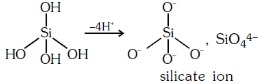
The basic structural unit of silicates is
- A
$SiO_3^{2-}$
- B
$SiO_4^{2-}$
- C
$SiO^-$
- ✓
$SiO_4^{-4}$
AnswerCorrect option: D. $SiO_4^{-4}$
d
Silicates - Salt of silicic acid $H_{4} S i O_{4}$
View full question & answer→MCQ 181 Mark
Which statement is wrong ?
AnswerCorrect option: D. Feldspars are not aluminosilicates.
d
Oomycetes (egg fungus) include water moulds, white rusts and downy mildews. In these, female gamete is smaller and motile, whereas male gamete is larger and non-motile. Isogametes are found in algae like Ultrix, Chlamydornonas, Spirogyra, etc., which are similar in structure, function and behavior. An isogametes are found in Chlamydornonas in which one gamete is larger and non-motile and the other one is motile and smaller. Oogamy is the fusion of non-motile egg with motile sperm. The gametes, differ both morphologically as well as physiologically. It occurs in Chlamydomonas, Fucus Chara, Volvox, etc.
View full question & answer→MCQ 191 Mark
Which of the following structure is similar to graphite ?
- A
$B_4C$
- B
$B_2H_6$
- ✓
$BN$
- D
$B$
Answerc
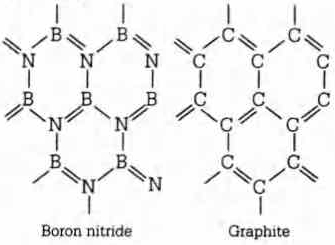
Boron nitride $(B N)_{x}$ resembles with graphite in structure as
View full question & answer→MCQ 201 Mark
Which of the following statements about the interstitial compounds is incorrect?
- A
They are much harder than the pure metal.
- B
They have higher melting points than the pure metal.
- C
They retain metallic conductivity.
- ✓
They are chemically reactive.
AnswerCorrect option: D. They are chemically reactive.
d
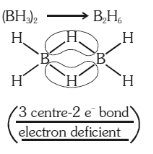
Interstitial compounds are obtained when small atoms like $H, B, C,N,$ etc, fit into the interstitial space of lattice metals.
These retain metallic conductivity. These resemble the parent metal in chemical properties (reactivity) but differ in physical properties like hardness, melting point, etc.
View full question & answer→MCQ 211 Mark
Which of the following compounds of boron does not exist in the free form
- A
$BC{l_3}$
- B
$B{F_3}$
- C
$BB{r_3}$
- ✓
$B{H_3}$
AnswerCorrect option: D. $B{H_3}$
d
(d) Hydride of boron does not exist in $B{H_3}$ form. It is stable as its dimer di borane $({B_2}{H_6})$.
View full question & answer→MCQ 221 Mark
The type of hybridisation of boron in diborane is
- A
$sp$ - hybridisation
- B
$s{p^2}{\rm{ - }}$ hybridisation
- ✓
$s{p^3}{\rm{ - }}$ hybridisation
- D
$s{p^3}{d^2}{\rm{ - }}$ hybridisation
AnswerCorrect option: C. $s{p^3}{\rm{ - }}$ hybridisation
c
Boron has three valence electrons, so it is supposed to make $3$ bonds in a molecule with hybridization, $sp ^2$ as only s and two $p$ orbitals are used in hybridization and last $p$ orbitalis vacant.
But diborane, $B _2 H _6$ contains two electrons each, three centred bonds. Each Boron atom is in a link with four hydrogen atoms. This makes tetrahedral geometry.
Hence, each Boron atom is $sp ^3$ - hybridized.
View full question & answer→MCQ 231 Mark
Identify the statement that is not correct as far as structure of diborane is concerned
AnswerCorrect option: D. All $B - H$ bonds in diborane are similar
d
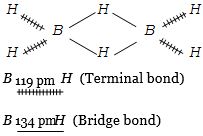
(d) ${B_2}{H_6}$ has two types of $B - H$ bonds
View full question & answer→MCQ 241 Mark
Soft heavy metal melts at ${30\,^o}C$ and is used in making heat sensitive thermometers the metal is
Answera
Gallium is a silvery, glass-like, soft metal. Its properties are close to the nonmetals in the periodic table and its metallic properties are not as metallic as most other metals. Solid gallium is brittle and is a poorer electrical conductor than lead. Gallium has the second largest liquid range of any element and is one of the few metals that is liquid near room temperature (m.pt. $29.76$), melting in the hand. So it is used in thermometer.
View full question & answer→MCQ 251 Mark
Which of the following is formed when aluminium oxide and carbon is strongly heated in dry chlorine gas
- A
- B
Hydrate aluminium chloride
- ✓
Anhydrous aluminium chloride
- D
AnswerCorrect option: C. Anhydrous aluminium chloride
c
When aluminum oxide and carbon are strongly heated in dry chlorine gas anhydrous aluminum chloride is formed.
View full question & answer→MCQ 261 Mark
Which metal burn in air at high temperature with the evolution of much heat
Answerd
Aluminium has high boiling point and melting point. At high temperature only, it burns in air and in turn, as it is a metal, it evolutes much heat.
View full question & answer→MCQ 271 Mark
Aluminium hydroxide is soluble in excess of sodium hydroxide forming the ion
- A
$Al{{(O)}_{2}}^{+3}$
- B
$AlO_2^{ - 3}$
- ✓
$AlO_2^ - $
- D
$AlO_3^ - $
AnswerCorrect option: C. $AlO_2^ - $
c
Alluminium hydroxide reacts with excess of $NaOH$ and forms $AlO _2^{-}$.
$Al ( OH )_3+ NaOH \rightarrow NaAlO _2+2 H _2 O$
So the $NaAlO _2$ forms $AlO _2^{-}$.
View full question & answer→MCQ 281 Mark
Boron form covalent compound due to
AnswerCorrect option: D. Both $(a)$ and $(c)$
d
Boron forms covalent bonds due to small size of boron. Also because of its size the sum of its first three ionization enthalpies is very high. This prevents it to form $+3$ ions and forces it to form only covalent compounds.
View full question & answer→MCQ 291 Mark
Which of the following is known as inorganic benzene
- ✓
- B
- C
$p$ - dichlorobenzene
- D
Answera
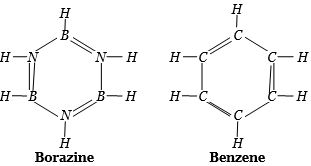
(a) Borazine ${B_3}{N_3}{H_6}$, is isoelectronic to benzene and hence, is called inorganic benzene some physical properties of benzene and borazine are also similar.
View full question & answer→MCQ 301 Mark
Which of the following does not exist in free form
- A
$B{F_3}$
- B
$BC{l_3}$
- C
$BB{r_3}$
- ✓
$B{H_3}$
AnswerCorrect option: D. $B{H_3}$
d
(d) Boron form different hydride of general formula ${B_n}{H_{n + 4}}$ and ${B_n}{H_{n + 6}}$ but $B{H_3}$ is unknown.
View full question & answer→MCQ 311 Mark
Anhydrous $AlC{l_3}$ cannot be obtained from which of the following reactions
- ✓
Heating $AlC{l_3}.6{H_2}O$
- B
By passing dry $HCl$ over hot aluminium powder
- C
By passing dry $C{l_2}$ over hot aluminium powder
- D
By passing dry $C{l_2}$ over a hot mixture of alumina and coke
AnswerCorrect option: A. Heating $AlC{l_3}.6{H_2}O$
a
(a) $AlC{l_3}.6{H_2}O\xrightarrow{\Delta }Al{(OH)_3} + 3HCl + 3{H_2}O$
Thus $AlC{l_3}$ can not be obtained by this method
View full question & answer→MCQ 321 Mark
Anhydrous $AlC{l_3}$ is obtained from
AnswerCorrect option: C. Hydrogen chloride gas and aluminium metal
c
(c) $2Al + 6HCl \to 2AlC{l_3} + 3{H_2}$
View full question & answer→MCQ 331 Mark
Aluminium is more reactive than iron. But aluminium is less easily corroded than iron because
- A
Aluminium is a noble metal
- ✓
Oxygen forms a protective oxide layer
- C
Iron undergoes reaction easily with water
- D
Iron forms mono and divalent ions
AnswerCorrect option: B. Oxygen forms a protective oxide layer
b
Corrosion resistance of aluminium is due to formation of thin layer of aluminium oxide that forms when metal is exposed to air and prevents further oxidation. It is called as protective passivation.
View full question & answer→MCQ 341 Mark
Aluminium vessels should not be washed with materials containing washing soda since
- A
Washing soda is expensive
- B
Washing soda is easily decomposed
- ✓
Washing soda reacts with aluminium to form soluble aluminate
- D
Washing soda reacts with aluminium to form insoluble aluminium oxide
AnswerCorrect option: C. Washing soda reacts with aluminium to form soluble aluminate
c
(c) $N{a_2}C{O_3} + {H_2}O \to 2NaOH + C{O_2}$
$2NaOH + 2Al + 6{H_2}O \to 2Na[Al{(OH)_4}] + 3{H_2}$
View full question & answer→MCQ 351 Mark
In Goldschmidt aluminothermic process, thermite contains
- A
$3$ parts of $A{l_2}{O_3}$ and $4$ parts of $Al$
- B
$3$ parts of $F{e_2}{O_3}$ and $2$ parts of $Al$
- ✓
$3$ parts of $F{e_2}{O_3}$ and $1$ part of $Al$
- D
$1$ part of $F{e_2}{O_3}$ and $1$ part of $Al$
AnswerCorrect option: C. $3$ parts of $F{e_2}{O_3}$ and $1$ part of $Al$
c
(c) In Goldschmidt aluminothermic process, thermite contains $3$ parts of $F{e_2}{O_3}$ and $1$ part of $Al$.
View full question & answer→MCQ 361 Mark
In the purification of bauxite by Hall's process
- A
Bauxite ore is heated with $NaOH$ solution at ${50\,^o}C$
- ✓
Bauxite ore is fused with $N{a_2}C{O_3}$
- C
Bauxite ore is fused with coke and heated at ${1800\,^o}C$ in a current of nitrogen
- D
Bauxite ore is heated with $NaHC{O_3}$
AnswerCorrect option: B. Bauxite ore is fused with $N{a_2}C{O_3}$
b
(b)In Hall’s process
$A{l_2}{O_3}.2{H_2}O + N{a_2}C{O_3} \to 2NaAl{O_2} + C{O_2} + 2{H_2}O$
$2NaAl{O_2} + 3{H_2}O + C{O_2}\xrightarrow{{333\,K}}$ $2Al{(OH)_3} \downarrow + N{a_2}C{O_3}$
$2Al{(OH)_3}\xrightarrow{{1473\,K}}A{l_2}{O_3} + 3{H_2}O$
View full question & answer→MCQ 371 Mark
- A
Reducing $A{l_2}{O_3}$ with coke
- ✓
Electrolysing $A{l_2}{O_3}$ dissolved in $N{a_3}Al{F_6}$
- C
Reducing $A{l_2}{O_3}$ with chromium
- D
Heating alumina and cryolite
AnswerCorrect option: B. Electrolysing $A{l_2}{O_3}$ dissolved in $N{a_3}Al{F_6}$
b
Aluminium is obtained by electrolising alumina dissolved in cryolite $\left( Na _3 AlF _6\right)$
$4 Na _3 AlF _6 \leftrightharpoons 12 Na ^{+}+4 Al ^{3+}+12 F ^{-}$
$4 Al ^{3+}+12 e ^{-} \rightarrow 4 Al \text { (at cathode) }$
$12 F ^{-} \rightarrow 6 F _2+12 e ^{-} \text {(at anode) }$
$2 Al _2 O _3+6 F _2 \rightarrow AlF _3+3 O _2$
View full question & answer→MCQ 381 Mark
For the electrolytic production of aluminium, $(i)$ the cathode and $(ii)$ the anode are made of
- A
$(i)$ Platinum and $(ii)$ Iron
- B
$(i)$ Copper and $(ii)$ Iron
- C
$(i)$ Copper and $(ii)$ Carbon
- ✓
$(i)$ Carbon and $(ii)$ Carbon
AnswerCorrect option: D. $(i)$ Carbon and $(ii)$ Carbon
d
For the electrolytic production of aluminium $(i)$ the cathode and $(ii)$ the anode are both made of graphite.
View full question & answer→MCQ 391 Mark
During metallurgy of aluminium bauxite is dissolved in cryolite because
- A
Bauxite is non-electrolyte
- B
- ✓
Cryolite acts as an electrolyte
- D
AnswerCorrect option: C. Cryolite acts as an electrolyte
View full question & answer→MCQ 401 Mark
For the electrolytic refining of aluminium, the three fused layers consist of
|
Bottom Layer
|
Middle Layer
|
Upper Layer
|
- A
|
Cathode of pure $Al$
|
Cryolite and fluorspar
|
Anode of $Al$ and $Cu$ alloy
|
- B
|
Cathode of $Al$ and $Cu$ alloy
|
Bauxite and cryolite
|
Anode of pure $Al$
|
- ✓
|
Anode of $Al$ and $Cu$ alloy
|
Cryolite and barium fluoride
|
Cathode of pure $Al$
|
- D
|
Anode of impure $Al$
|
Bauxite, cryolite and fluorspar
|
Cathode of pure $Al$
|
AnswerCorrect option: C.
|
Anode of $Al$ and $Cu$ alloy
|
Cryolite and barium fluoride
|
Cathode of pure $Al$
|
View full question & answer→MCQ 411 Mark
Acedic strength of Boron trihalide are in order of
- ✓
$B{F_3} < BC{l_3} < BB{r_3} < B{I_3}$
- B
$B{I_3} < BB{r_3} < BC{l_3} < B{F_3}$
- C
$BB{r_3} < BC{l_3} < B{F_3} < B{I_3}$
- D
$B{F_3} < B{I_3} < BC{l_3} < BB{r_3}$
AnswerCorrect option: A. $B{F_3} < BC{l_3} < BB{r_3} < B{I_3}$
a
(a) Concentration of Lewis acid of boron tri halides is increased in following order.
$B{F_3} < BC{l_3} < BB{r_3} < B{I_3}$.
View full question & answer→MCQ 421 Mark
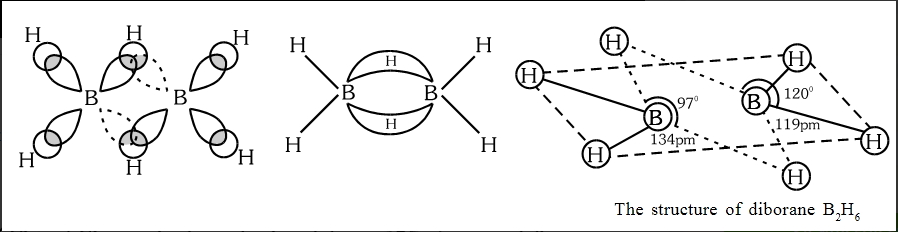
The structure of diborane contains :-
- A
Four $2C -2e^-$ bonds & two $2C -3e^-$ bonds
- B
Two $(2C -2e^-)$ bonds & four $3C -2e^-$ bonds
- ✓
Four $2C -2e^-$ bonds & two $3C -2e^-$ bonds
- D
Two $2C -2e^-$ bonds & two $3C -2e^-$ bonds
AnswerCorrect option: C. Four $2C -2e^-$ bonds & two $3C -2e^-$ bonds
c
As seen from the image, diborane contains four $\left(2 C-2 e^{-}\right)$ bonds and two $\left(3 C-2 e^{-}\right)$ bonds.
View full question & answer→MCQ 431 Mark
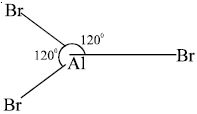
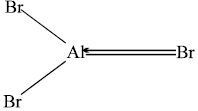
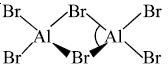
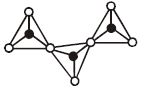
The structure of aluminium bromide is best represented as :
MCQ 441 Mark
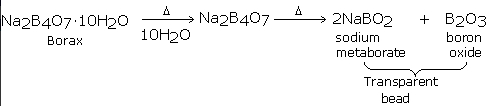
Borax on heating strongly above its melting point melts to a liquid, then solidifies to a transparent mass commonly known as Borax Bead. The transparent glassy mass consists of :
- A
- B
- C
- ✓
mixture of sodium metaborate and boric anhydride
AnswerCorrect option: D. mixture of sodium metaborate and boric anhydride
d
Borax on heating strongly above its melting point melts to a liquid, which then solidifies to a transparent mass commonly known as borax-bead.
The transparent glassy mass consists of boric anhydride and sodium metaborate. Boron trioxide is also formed instead of boric anhydride.
Option (D) is correct.
View full question & answer→MCQ 451 Mark
Aluminium chloride exists as dimer, $Al_2Cl_6$ in solid state as well as in soluiton of non-polar solvents such as $C_6H_6.$ When dissolved in water it gives :
- A
$Al_2O_3 + 6HCl$
- B
$[Al(H_2O)_6]+ 3Cl^-$
- ✓
$[Al(OH)_6]^{3-} + 3HCl$
- D
$Al^{3+} + 3Cl^-$
AnswerCorrect option: C. $[Al(OH)_6]^{3-} + 3HCl$
c
Aluminium chloride exists as dimer $\left(\mathrm{Al}_{2} \mathrm{Cl}_{6}\right)$ in a solid state as well as in solution of non-polar solvents such as benzene. When dissolved in water, it gives
$\left[\mathrm{Al}(\mathrm{OH})_{6}\right]^{3-}+3 \mathrm{HCl}$
$\mathrm{Al}_{2} \mathrm{Cl}_{6}+12 \mathrm{H}_{2} \mathrm{O} \rightarrow 2\left[\mathrm{Al}(\mathrm{OH})_{6}\right]^{3-}+12 \mathrm{HCl}$
Thus aluminum chloride is hydrolyzed to form the complex ion containing s hydroxide groups.
View full question & answer→MCQ 461 Mark
Heating an aqueous solution of aluminium chloride to dryness will give:
- A
$AlCl_3$
- B
$Al_2Cl_6$
- ✓
$Al_2O_3$
- D
$Al(OH)Cl_2$
AnswerCorrect option: C. $Al_2O_3$
c
Aqueous solution of $\mathrm{AlCl}_{3}$ is acidic as it gives $\mathrm{HCL}$ on hydrolysis.
$\mathrm{AlCl}_{3}+3 \mathrm{H}_{2} \mathrm{O} \rightarrow \mathrm{Al}(\mathrm{OH})_{3}+\mathrm{HCl}$
On strongly heating $\mathrm{Al}(\mathrm{OH})_{3}$ is converted into $\mathrm{Al}_{2} \mathrm{O}_{3}$
$\mathrm{Al}(\mathrm{OH})_{3} \rightarrow \mathrm{Al}_{2} \mathrm{O}_{3}+3 \mathrm{H}_{2} \mathrm{O}$
$\mathrm{AlCl}_{3}$ on heating gives $\mathrm{Al}_{2} \mathrm{O}_{3}$
View full question & answer→MCQ 471 Mark
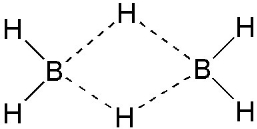
The structure of diborane contains:
- ✓
Four $2C-2e$ bonds and two $3C-2e$ bonds
- B
Two $2C-2e$ bonds and two $3C-2e$ bonds
- C
Two $2C-2e$ bonds and two $3C-3e$ bonds
- D
Four $2C-2e$ bonds and two $3C-3e$ bonds
AnswerCorrect option: A. Four $2C-2e$ bonds and two $3C-2e$ bonds
a
This is the structure of $B _2 H _6$
Four hydrogen are connected to $B$ atoms by covalent bonds. So there are four $2$ centered$- 2$ electron bonds
$2$ hydrogen atoms are connected by bridge and it is connected to $2$ boron atoms . So, there are $3$ -centred-$2$- electron bonds
$( H - B ) \rightarrow 2\quad C -2 e$ bonds
$(B-H-B) \rightarrow 3\quad C-2e$ bonds
View full question & answer→MCQ 481 Mark
- A
Ordinary form of borax $:$ $Na_2B_4O_7 · 5H_2O$
- ✓
Colemanite $:$ $Ca_2B_6O_{11}·5H_2O$
- C
Boronatrocalcite $:$ $2Mg_3B_8O_{15}·MgCl_2$
- D
Octahedral form of borac $:$ $Na_2B_4O_7·10H_2O$
AnswerCorrect option: B. Colemanite $:$ $Ca_2B_6O_{11}·5H_2O$
b
(A) Incorrect. Ordinary form of Borax $= Na _2 B _4 O _7 \cdot 10 H _2 O$
(B) Correct: Colemanite $= Ca _2 B _6 O _{11} \cdot 5 H _2 O$
(c) Incorrect: Bernarocalcite $= CaB _4 O _7 \cdot NaBO _2 \cdot 8 H _2 O$
(D) Correct: Octahedral form of borax $= Na _2\left[ B _4 O _5( OH )_4\right] \cdot 8 H _2 O$
View full question & answer→MCQ 491 Mark
A layer of coke is spread over bauxite during electrolytic reduction of alumina by Hall-Heroult process. This layer acts as a/an:
- A
- B
slag to remove impurities
- C
- ✓
insulation and does not allow heat to escape
AnswerCorrect option: D. insulation and does not allow heat to escape
d
the correct option is (D)
explanation:
A layer of coke is spread over bauxite during electrolytic reduction of alumina by Hall Heroult process. This layer acts as as insulation by preventing it from corrosion, coke powder is kept at the top which also prevents escape of heat.
View full question & answer→MCQ 501 Mark
Aluminium chloride exists as a dimer, $Al_2Cl_6,$ in solid state as well as in solution of non-polar solvents such as benzene. When dissolved in water, it gives:
AnswerCorrect option: B. $[Al(H_2 O)_6 ]^{3+} + 3Cl^-$
b
$\mathrm{AlCl}_{3}$ is covalent but in water, it becomes ionic due to large hydration energy of $\mathrm{Al}^{3+}$.
$\mathrm{AlCl}_{3}+6 \mathrm{H}_{2} \mathrm{O} \quad \rightarrow \quad\left[\mathrm{Al}\left(\mathrm{H}_{2} \mathrm{O}_{6}\right)\right]^{3+}+3 \mathrm{Cl}^{-}$
Hence, option $\mathrm{B}$ is correct.
View full question & answer→MCQ 511 Mark
$H_3BO_3$ $\xrightarrow{{{T_1}}}X\xrightarrow{{{T_2}}}Y\xrightarrow{{red\,hot}}$ $B_2O_3$
if $T_1 < T_2$ then $X$ and $Y$ respectively are
- ✓
$X =$ Metaboric acid and $Y =$ Tetraboric acid
- B
$X =$ Tetraboric acid and $Y =$ Metaboric acid
- C
$X =$ Borax and $Y =$ Metaboric acid
- D
$X =$ Tetraboric acid and $Y =$ Borax
AnswerCorrect option: A. $X =$ Metaboric acid and $Y =$ Tetraboric acid
a
Effect of temperature at $100^{\circ} C , H _3 BO _3$ losses water and convert into metaboric acid.
$H _3 BO _3 \stackrel{100^{\circ} C }{\longrightarrow} HBO _2+ H _2 O$
metaboric acid form tetraboric acid on heating at $160^{\circ} C$
$4 HBO _2 \stackrel{160^{\circ} C }{\longrightarrow} H _2 B _4 O _7+ H _2 O$
On strong heating, $B _2 O _3$ is produced
$H _2 B _4 O _7 \rightarrow 2 B _2 O _3+ H _2 O$
View full question & answer→MCQ 521 Mark
Boron forms $BX_3$ type of halides. The correct increasing order of Lewis-acid strength of these halides is
- A
$BF_3 > BCl_3 > BBr_3 > BI_3$
- ✓
$BI_3 > BBr_3 > BCl_3 > BF_3$
- C
$BF_3 > BI_3 > BCl_3 > BBr_3$
- D
$BF_3 > BCl_3 > BI_3 > BBr_3$
AnswerCorrect option: B. $BI_3 > BBr_3 > BCl_3 > BF_3$
b
The decreasing order of the Lewis acidity of boron halides is $\mathrm{BI}_{3}>\mathrm{BBr}_{3}>\mathrm{BCl}_{3}>\mathrm{BF}_{3}$
This order is due to the relative tendency of the halogen atom to back donate its unutilized electrons to the vacant p-orbitals of boron atom.
Due to the back donation of electrons from fluorine to boron, the electron deficiency of boron is reduced and hence, Lewis acidity is decreased.
The tendency for the formation of back bonding is maximum in boron trifluoride and decreases very rapidly from boron trifluoride to boron triodide.
View full question & answer→MCQ 531 Mark
The solubility of anhydrous $AlCl_3$ and hydrous $AlCl_3$ in diethyl ether are $S_1$ and $S_2$ respectively. Then
AnswerCorrect option: B. $S_1 > S_2$
b
Anhydrous AlCl3 will dissolve the diethyl ether because anhydrous AlCl3 is a good lewis acid.
It is electron deficient. The lone pairs of diethyl ether will be donated to the anhydrous AlCI3 due to which it is soluble.
On the other hand, hydrous AlCl3 have the water molecules which make it poor lewis acid.
$\mathrm{So}, \mathrm{S}_{1}>\mathrm{S}_{2}$
View full question & answer→MCQ 541 Mark
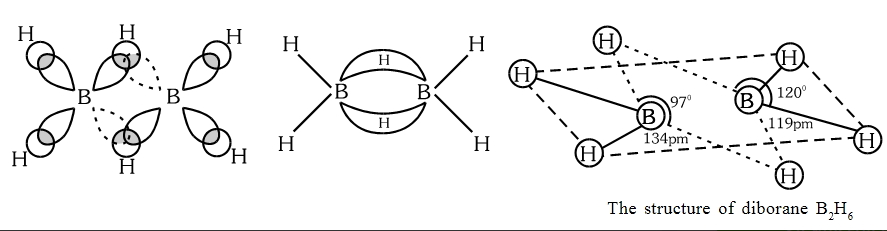
Which one of the following statements is not true regarding diborane ?
AnswerCorrect option: D. All the $B-H$ bond distances are equal.
d
All the B-H bond distances are not equal,
it can be seen from figure
View full question & answer→MCQ 551 Mark
Choose the Incorrect statement/ reaction
- ✓
$BC{l_3} + N{H_3}\left( g \right) \to BC{l_2}\left( {N{H_2}} \right) + HCl$
- B
$AlCl_3$ in aqueous solutions forms octahedral, $[Al(H_2O)_6]^{3+}$ ions.
- C
The conjugated base in aqueous solution of $H_3BO_3$ is $[B(OH)_4]^{-1}$.
- D
Aqueous solution of borax , $Na_2B_4O_7. 10H_2O$, which is a buffer system forms basic solution.
AnswerCorrect option: A. $BC{l_3} + N{H_3}\left( g \right) \to BC{l_2}\left( {N{H_2}} \right) + HCl$
a
$(1)$ $\mathrm{BCl}_{3}$ with gaseous ammonia forms an adduct, $\mathrm{BCl}_{3} . \mathrm{NH}_{3}$ not a substitution product.
$(2)$ $\mathrm{H}_{3} \mathrm{BO}_{3}$ is weak, non-protonic, lewis acid
$(3)$ $\mathrm{H}_{3} \mathrm{BO}_{3}+\mathrm{Na}\left(\mathrm{B}(\mathrm{OH})_{4}\right) \rightarrow$ equimolar amounts are produced and $\mathrm{pH}=\mathrm{pKa}\left(\mathrm{H}_{3} \mathrm{BO}_{3}\right)=9.25,$ lies in basic range.
View full question & answer→MCQ 561 Mark
$2B{F_3} + 6NaH\xrightarrow{{450\,K}}{X_{\left( g \right)}} + 6Y$ Which of the following statement is Incorrect for $X$
- A
$'X'$ is readily hydrolysed by water to give weak mono basic acid
- ✓
Back bonding is present in $'X'$
- C
In $'X'$ maximum number of atoms in one plane is $'6'$
- D
$'X'$ burn with $O_2$ and gives sesqui oxide
AnswerCorrect option: B. Back bonding is present in $'X'$
View full question & answer→MCQ 571 Mark
Anhydrous $AlCl_3$ is formed in
- A
$AlC{l_3}.6{H_2}O\xrightarrow{\Delta }$
- B
$Al\left( {\operatorname{Re} d\,hot} \right) + HCl\left( {Moist} \right)\xrightarrow{\Delta }$
- ✓
$A{l_2}{O_3} + C + C{l_2}\left( {dry} \right)\xrightarrow{\Delta }$
- D
AnswerCorrect option: C. $A{l_2}{O_3} + C + C{l_2}\left( {dry} \right)\xrightarrow{\Delta }$
c
Hydrated aluminium chloride is formed in $(1)$ and $(2)$
View full question & answer→MCQ 581 Mark
Which base among the following reacts with diborane to cleave it unsymmetrically ?
- A
$T.H.F.$
- B
$Me_3N$
- C
$C_5H_5N$
- ✓
$MeNH_2$
AnswerCorrect option: D. $MeNH_2$
d
$T.H.F. , Me_3N , C_5H_5N$ give symmetrical cleavage.
View full question & answer→MCQ 591 Mark
Colour of the bead in borax bead test is mainly due to the formation of
Answerc
Information (Borax bead: $NaBO_2 + B_2O_3$ )
View full question & answer→MCQ 601 Mark
$B{X_3} + N{H_3}\ \xrightarrow {R.T}\ B{X_3}.N{H_3} +$ Heat of adduct formation $\left( {\Delta H} \right)$ The numerical value of $\Delta H$ is found to be maximum for
- A
$BF_3$
- B
$BCl_3$
- C
$BBr_3$
- ✓
$BI_3$
AnswerCorrect option: D. $BI_3$
d
$\mathrm{BX}_{3} \cdot \mathrm{NH}_{3}$
Adduct form $^{\mathrm{n}}$ order $\mathrm{BI}_{3}>\mathrm{BBr}_{3}>\mathrm{BCl}_{3}>\mathrm{BF}_{3}$
As in $\mathrm{BF}_{3}$ strong back bonding occur. So adduct form $^{\mathrm{n}}$ decreases. Back bonding $\alpha \frac{1}{\text { adduct }}$ form $^{\text {n }}$
View full question & answer→MCQ 611 Mark
Which is correct statement about Borax
MCQ 621 Mark
Consider the following reaction
$(a)\, B_2H_6 + 6H_2O \to$
$(b)\, B_2H_6 + 6CH_3OH \to$
$(c)\, B_2H_6 + 3Cl_2 \to$
$(d)\, BR_3 + 3CH_3COOH \to$
Identify incorrect statement about product $(s)$
- ✓
$H_2$ is common product in all the reactions
- B
Reaction $(d)$ forms alkane
- C
Product of reaction $(a)$ has $H-$ bond in solid state
- D
one of the product of reaction $(c)$ is used for dissolving noble metals along with $HNO_3$ (conc.)
AnswerCorrect option: A. $H_2$ is common product in all the reactions
View full question & answer→MCQ 631 Mark
Which of the following is correct
AnswerCorrect option: D. Borazine has zero dipole moment
d
$B_3N_3H_6$ $\vec \mu \,\, = \,\,0$
View full question & answer→MCQ 641 Mark
$B_2H_6 + 2NaH \to$ compound $'P'$ Identify the hybridisation of Boron in compound $'P'$
- A
$sp^2$
- ✓
$sp^3$
- C
$sp^3d$
- D
$sp$
AnswerCorrect option: B. $sp^3$
b
$Na[BH_4]\,sp^3$
View full question & answer→MCQ 651 Mark
$BF_3$ on hydrolysis forms
- A
$H_3BO_3$
- B
$HBF_4$
- ✓
both $(A)$ and $(B)$
- D
AnswerCorrect option: C. both $(A)$ and $(B)$
c
$\mathrm{BF}_{3}$ Partial hydrolysis.
$\mathrm{BF}_{3}+3 \mathrm{H}_{2} \mathrm{O} \rightarrow \mathrm{B}(\mathrm{OH})_{3}+3 \mathrm{HF}$
$3 \mathrm{HF}+3 \mathrm{BF}_{3} \rightarrow 3 \mathrm{H}\left[\mathrm{BF}_{4}\right]$
$\_\_\_\_\_\_\_\_\_\_\_\_\_\_\_\_\_\_\_\_\_\_\_\_\_\_\_\_\_\_\_\_\_\_\_\_\_$
$4 \mathrm{BF}_{3}+3 \mathrm{H}_{2} \mathrm{O} \rightarrow \mathrm{B}(\mathrm{OH})_{3}+3 \mathrm{H}\left[\mathrm{BF}_{4}\right]$
View full question & answer→MCQ 661 Mark
In $B_2H_6$
AnswerCorrect option: D. boron atoms are linked through hydrogen bridges
d
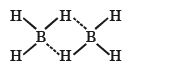
View full question & answer→MCQ 671 Mark
The Lewis acid nature of $BX_3$ follows the order
- A
$BF_3 > BCl_3 > BBr_3 > BI_3$
- ✓
$BF_3 < BCl_3 < BBr_3 < BI_3$
- C
$BCl_3 > BF_3 > BBr_3 > BI_3$
- D
$BF_3 < BBr_3 < BCl_3 < BI_3$
AnswerCorrect option: B. $BF_3 < BCl_3 < BBr_3 < BI_3$
View full question & answer→MCQ 681 Mark
Correct order of Lewis Acidic strength?
- ✓
$BF_3 < BCl_3 < BBr_3 < BI_3$
- B
$BF_3 > BCl_3 > BBr_3 > BI_3$
- C
$BF_3 = BCl_3 = BBr_3 = BI_3$
- D
$BF_3 > BCl_3 < BBr_3 > BI_3$
AnswerCorrect option: A. $BF_3 < BCl_3 < BBr_3 < BI_3$
a
(i) On the basis of back bonding, smaller be the halide atom, more effective be the back bonding and show less tendency to accept a pair of electrons.
(ii) Size of halides increase down the group, hence the ability of back bonding decreases making the molecule more acidic.
Hence, correct order of Lewis acid for boron-halides is $\mathrm{Bl}_{3}>\mathrm{BBr}_{3}>\mathrm{BCl}_{3}>\mathrm{BF}_{3}$
View full question & answer→MCQ 691 Mark
In which of the following reaction, the hybridisation of the central atom changes from $sp^2$ to $sp^3$ ?
- A
$N{H_3} + {H^ + } \to NH_4^ + $
- B
$Al{F_3} + 3{F^ - } \to AlF_6^{3 - }$
- ✓
$B{F_3} + {F^ - } \to BF_4^ - $
- D
${H_2}O + {H^ + } \to {H_3}{O^ + }$
AnswerCorrect option: C. $B{F_3} + {F^ - } \to BF_4^ - $
c
$\mathop {\mathop {B{F_3} + {F^ - }}\limits_{s{p^2}} \to \mathop {BF_4^ - }\limits_{s{p^3}} }\limits_{\,\,\,\,\,\,\,\,\,\,\,\,\,\,\,\,\,\,\,\,\,\,\,\,\,\,\,\,\,\,\,\,\,\,\,\,\,\,\,\,\,\,\,\,\,\,\,\,\,\,\,\,\,\,\,\,} $
View full question & answer→MCQ 701 Mark
When $AlCl_3·6H_2O$ is strongly heated, then it forms
- ✓
$Al_2O_3$
- B
$AlCl_3$
- C
$Al(OH)_3$
- D
AnswerCorrect option: A. $Al_2O_3$
a
$AlC{l_3} \cdot 6{H_2}O\xrightarrow[{Strongly}]{\Delta }A{l_2}{O_3}$
View full question & answer→MCQ 711 Mark
Correct Lewis acidity order of $BX_3$ is
- ✓
$BF_3 < BCl_3 < BBr_3 < BI_3$
- B
$BF_3 > BCl_3 > BBr_3 > BI_3$
- C
$BCl_3< BBr_3 < BI_3 < BF_3$
- D
$BF_3 < BI_3 < BBr_3 < BCl_3$
AnswerCorrect option: A. $BF_3 < BCl_3 < BBr_3 < BI_3$
a
(i) On the basis of back bonding, smaller be the halide atom, more effective be the back bonding and show less tendency to accept a pair of electrons.
(ii) Size of halides increase down the group, hence the ability of back bonding decreases making the molecule more acidic.
Hence, correct order of Lewis acid for boron-halides is $\mathrm{Bl}_{3}>\mathrm{BBr}_{3}>\mathrm{BCl}_{3}>\mathrm{BF}_{3}$
View full question & answer→MCQ 721 Mark
Which of the following doesn't exist
- ✓
$BF_6^{3-}$
- B
$AlF_6^{3-}$
- C
$SiF_6^{2-}$
- D
$GeCl_6^{2-}$
AnswerCorrect option: A. $BF_6^{3-}$
View full question & answer→MCQ 731 Mark
$N{a_2}{B_4}{O_7}\xrightarrow{x}{H_3}B{O_3}\xrightarrow{\Delta }{B_2}{O_3}\xrightarrow{y}B$
Here $X, Y$ are respectively
View full question & answer→MCQ 741 Mark
Group $13$ elements show $+1$ and $+3$ oxidation states. Relative stability of $+3$ oxidation state may be given as
- A
$Tl^{3+} > In^{3+} > Ga^{3+} > Al^{3+} > B^{3+}$
- ✓
$B^{3+} > Al^{3+} > Ga^{3+} > In^{3+} > Tl^{3+}$
- C
$Al^{3+} > Ga^{3+} > Tl^{3+} > In^{3+} > B^{3+}$
- D
$Al^{3+} > B^{3+} > Ga^{3+} > Tl^{3+} > In^{3+}$
AnswerCorrect option: B. $B^{3+} > Al^{3+} > Ga^{3+} > In^{3+} > Tl^{3+}$
b
On moving down the group stability of lower oxidation state increases and higher oxidation state decreases
View full question & answer→MCQ 751 Mark
$(BN)_n$ exists in
View full question & answer→MCQ 761 Mark
What is not true about borax ?
AnswerCorrect option: C. It hydrolyses to give an acidic solution
c
$N{a_2}{B_4}{O_7}.10{H_2}O\,\,\overset{HOH}{\rightarrow}\,\mathop {NaOH\,}\limits_{SB} + \,\mathop {{H_3}B{O_3}}\limits_{WA} $
View full question & answer→MCQ 771 Mark
When $B_2H_6 + NH_3(excess)$ at very high temperature $(> 200\,^oC$) is formed
AnswerCorrect option: B. $(BN)_x$
View full question & answer→MCQ 781 Mark
Which is not obtained when metal carbides react with $H_2O$ ?
- ✓
$A{l_4}{C_3} + {H_2}O \longrightarrow CH \equiv CH$
- B
$CaC_2 + H_2O \longrightarrow CH \equiv CH$
- C
$Mg_4C_3 + H_2O \longrightarrow C{H_3}C \equiv CH$
- D
$Be_2C + H_2O \longrightarrow CH_4$
AnswerCorrect option: A. $A{l_4}{C_3} + {H_2}O \longrightarrow CH \equiv CH$
a
$\mathrm{Al}_{4} \mathrm{C}_{3}+\mathrm{H}_{2} \mathrm{O} \rightarrow 4 \mathrm{Al}(\mathrm{OH})_{3}+\mathrm{CH}_{4}$
Thus alkane is formed instead of acetylene.
View full question & answer→MCQ 791 Mark
Which of the following compound does not show the amphoteric behaviour
- A
$Zn(OH)_2$
- B
$BeO$
- C
$Al_2O_3$
- ✓
Answerd
Oxides and hydroxide of $Zn, Al, Sn, Be, Pb$ are amphoteric
View full question & answer→MCQ 801 Mark
Which does not show inert pair effect ?
Answera
Inert pair effect means that the $2 s$-electrons of the valence shell of heavier pblock elements form an inert pair and do not participate in bond formation. Inert pair effect occurs due to the poor shielding effect of $d$ and $f$ orbitals. Hence, due to small size and absence of $d$ and $f$ orbitals, Aluminium does not show inert pair effect.
View full question & answer→MCQ 811 Mark
Which of the following equation is not correctly matched
- ✓
$H_3BO_3$ is a weak mono basic acid as it liberates hydroges ions as
$H_3BO_3 \longrightarrow H^+ + H_2BO_3^-$
- B
${H_3}B{O_3}\xrightarrow{\Delta }\mathop {HB{O_2}\xrightarrow{{\operatorname{Re} d\,hot}}}\limits_{{\text{Meta Boric}}} \mathop {{B_2}{O_3}}\limits_{{\text{Boric oxide}}} $
- C
$2BN + 6H_2O \longrightarrow 2H_3BO_3 + 2NH_3$
- D
$Na_2B_4O_7.10H_2O + 2HCl \longrightarrow 2NaCl + 4H_3BO_3 + 5H_2O$
AnswerCorrect option: A. $H_3BO_3$ is a weak mono basic acid as it liberates hydroges ions as
$H_3BO_3 \longrightarrow H^+ + H_2BO_3^-$
a
$H_3BO_3 + HOH \longrightarrow [B(OH)_4]^-+ H^+$
View full question & answer→MCQ 821 Mark
Which of the following compounds is formed by addition of mineral acid to an aqueous solution of borax?
Answerb
Addition of mineral acid to an aqueous solution of Borax, orthoboric acid is formed.
$\mathrm{Na}_{2} \mathrm{B}_{4} \mathrm{O}_{7}+2 \mathrm{HCl}+5 \mathrm{H}_{2} \mathrm{O} \rightarrow 4 \mathrm{H}_{3} \mathrm{BO}_{3}+2 \mathrm{NaCl}$
Hence, the correct answer is option B.
View full question & answer→MCQ 831 Mark
Alumina is insoluble in water because
AnswerCorrect option: B. It has high lattice energy and low heat of hydration
View full question & answer→MCQ 841 Mark
Which of the following is an electron deficient molecule?
- A
$LiH$
- ✓
$B_2H_6$
- C
$LiBH_4$
- D
$B_3N_3H_6$
AnswerCorrect option: B. $B_2H_6$
b
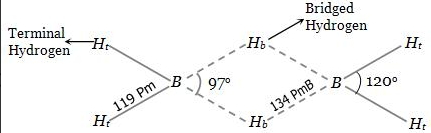
$\mathrm{B}_{2} \mathrm{H}_{6}$ is electron deficient molecule because boron atom has three half-filled orbitals in an excited state.
The structure of $\mathrm{B}_{2} \mathrm{H}_{6}$ is represented as follows:
In it, two electrons of $\mathrm{B}$ -H bond are involved in the formation of three centre bond, these bonds are represented by a dotted line.
Hence, option A is correct.
View full question & answer→MCQ 851 Mark
Anhydrous aluminium chloride fumes in moist air owing to the formation of
- A
gaseous aluminium chloride
- B
- C
- ✓
Answerd
White fumes are due to the presence of HCl gas.
Anhydrous aluminium chloride is hydrolysed partially with the moisture in the atmosphere to give HCl gas.
This HCI combines with the moisture in the air and appears white in colour.
$\mathrm{AlCl}_{3}+3 \mathrm{H}_{2} \mathrm{O} \longrightarrow \mathrm{Al}(\mathrm{OH})_{3}+3 \mathrm{HCl}(\text { white fumes })$
Hence, the correct answer is option D.
View full question & answer→MCQ 861 Mark
Colour of the bead in borax bead test is mainly due to the formation of
Answerc
Correct option $(\mathrm{C})$ metal metaborates
Explanation:
Borax on strong heating loses its water of crystallization and then shrinks forming a transparent glassy bead of sodium metaborate and boric anhydride. Boric anhydride, being non-volatile displaces more volatile acidic oxides and combine with basic oxides present to form metaborates which are identified through their characteristic colours
View full question & answer→MCQ 871 Mark
Which of the following properties describes the diagooal relalionship between boron and silicon?
AnswerCorrect option: D. Silicide and boride salts are hydrolysed by water
View full question & answer→MCQ 881 Mark
The incorrect statement regarding $'X'$ in given reaction is $B{F_3} + LiAl{H_4}\xrightarrow{{Ether}}\left( X \right) + LiF + Al{F_3}$
AnswerCorrect option: D. $X$ does not react with $NH_3$
d
$B{F_3} + LiAl{H_4}\xrightarrow{{Ether}}\mathop {{B_2}{H_6}}\limits_{(x)} + LiF + Al{F_3}$
$NH_3$ can react with $B_2H_6,$
${B_2}{H_6} + 2N{H_3}\xrightarrow{{warm}}{[B{H_2}.2N{H_3}]^ + }.{[B{H_4}]^ - }$ $\xrightarrow{{200{\,^o}C}}{B_3}{N_3}{H_6}$ (Inorganic benzene)
View full question & answer→MCQ 891 Mark
The incorrect stability order of $+3$ and $+1$ states of $13^{th}$ group elements (boron family) is
AnswerCorrect option: A. $Ga^{3+} < In^{3+} < Tl^{3+}$
a
stability is depend upon the stomic size in block top to bottam
View full question & answer→MCQ 901 Mark
${H_3}B{O_3}\,\xrightarrow{{{T_1}}}X\,\xrightarrow{{{T_2}}}Y\,\xrightarrow{{\operatorname{Re} d\,\,\,hot}}{B_2}{O_3}$
if $T_1 < T_2$ then $X$ and $Y$ respectively are
- ✓
$X =$ Metaboric Acid, $Y =$ Tetraboric acid
- B
$X =$ Tetraboric Acid, $Y =$ Metaboric acid
- C
$X =$ Borax, $Y =$ Metaboric acid
- D
$X =$ Tetraboric Acid, $Y =$ Borax
AnswerCorrect option: A. $X =$ Metaboric Acid, $Y =$ Tetraboric acid
a
$H _3 BO _3 \stackrel{100^{\circ} C }{\longrightarrow} HBO _2 \stackrel{160^{\circ} C }{\longrightarrow} H _2 B _4 O _7 \stackrel{\text { red hot }}{\longrightarrow} B _2 O _3$
$X$ is $HBO _2$ which is metaboric acid and $Y$ is $H _2 B _4 O _7$ which is tetraboric acid.
View full question & answer→MCQ 911 Mark
The incorrect stability order of $+3$ and $+1$ states of $13^{th}$ group elements (boron family) is
AnswerCorrect option: A. $Ga^{3+} < ln^{3+} < Tl^{3+}$
View full question & answer→MCQ 921 Mark
Which of the following is responsible for cleansing action of Borax
Answerb
When borax is dissolved in water it ionizes and hydrolysis of borate ion gives $OH$ (the hydroxyl ion) and boric acid. Since boric acid is a weak acid and $NaOH$ is strong a alkali an aqueous solution of borax is alkaline in nature.
View full question & answer→MCQ 931 Mark
Which reactions can be used to prepare diborane
$I.\,\,NaBH_4 + BF_3$ (in ether) $\to $
$II.\,\, NaBH_4 + I_2 \to $
$III.\,\, BF_3 + NaH \to $
- A
$I, \,III$
- B
$I, \,II$
- C
$II, \,III$
- ✓
$I, \,II$ and $III$
AnswerCorrect option: D. $I, \,II$ and $III$
View full question & answer→MCQ 941 Mark
Correct Lewis acidity order of $BX_3$ is
- ✓
$BF_3 < BCl_3 < BBr_3 < BI_3$
- B
$BF_3 > BCl_3 > BBr_3 > BI_3$
- C
$BCl_3< BBr_3 < BI_3 < BF_3$
- D
$BF_3 < BI_3 < BBr_3 < BCl_3$
AnswerCorrect option: A. $BF_3 < BCl_3 < BBr_3 < BI_3$
a
$BF _3\,< \,BCl _3\,<\, BBr _3$
View full question & answer→MCQ 951 Mark
Which of the following is correct
AnswerCorrect option: D. Borazine has zero dipole moment
d
Basicity of phosphorous acid $= 2 (H_3PO_3)$
Perchloric acid has no peroxy linkage $(HClO_4)$
Solid $SO_3$ have cyclic structure.
$B_3N_3H_6$ $\left( {\mu = 0} \right)$ Borazine
View full question & answer→MCQ 961 Mark
Which of the following have $3C-2e^-$ bond
$I.$ $Al_2Cl_6$ $II.$ $B_2H_6$
$III.$ $Fe_2Cl_6$ $IV.$ $Si_2H_6$
- A
$I, II$
- B
$II, IV$
- ✓
Only $II$
- D
$I, III, IV$
AnswerCorrect option: C. Only $II$
c
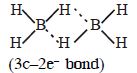
View full question & answer→MCQ 971 Mark
Which of the following statement is correct with respect to the property of elements with an increase in atomic number in the carbon family (group $14$)
AnswerCorrect option: D. Stability of $+2$ oxidation state increase
d
(d) As we go down the group inertness of $n{s^2}$ pair increase hence tendency to exhibit $+2$ oxidation state increases and that of $+4$ oxidation state decreases.
View full question & answer→MCQ 981 Mark
Silicon dioxide is formed by the reaction of
- ✓
$SiC{l_4} + 2{H_2}O$
- B
${N_2}$
- C
$Si{O_2} + NaOH$
- D
$SiC{l_4} + NaOH$
AnswerCorrect option: A. $SiC{l_4} + 2{H_2}O$
a
Silicon dioxide is formed by the reaction of Silicon Tetrachloride and Water.
View full question & answer→MCQ 991 Mark
In laboratory silicon can be prepared by the reaction
- ✓
- B
By heating carbon in electric furnace
- C
By heating potassium fluosilicate with potassium
- D
Answera
(a) $Si{O_2} + 2Mg \to Si + 2MgO$.
View full question & answer→MCQ 1001 Mark
Which of the following is insoluble in water
- A
$N{a_2}C{O_3}$
- B
$CaC{O_3}$
- C
$ZnC{O_3}$
- ✓
$A{l_2}{(C{O_3})_3}$
AnswerCorrect option: D. $A{l_2}{(C{O_3})_3}$
d
(d)$A{l_2}{(C{O_3})_3}$ is less soluble in water than $N{a_2}C{O_{3,}}$$ZnC{O_3}$.
View full question & answer→MCQ 1011 Mark
Sodium oxalate on heating with conc. ${H_2}S{O_4}$ gives
- A
$CO$ only
- B
$C{O_2}$ only
- ✓
$CO$ and $C{O_2}$
- D
$S{O_2}$ and $S{O_3}$
AnswerCorrect option: C. $CO$ and $C{O_2}$
c
(c) Sodium oxalate react with conc. ${H_2}S{O_4}$ to form $CO$ and $C{O_2}$ gas.
View full question & answer→MCQ 1021 Mark
${H_3}P{O_3}$ gets hydrolysed giving .......
- A
$Si{O_2}$
- B
$Si{(OH)_2}{F_2}$
- C
${H_2}Si{F_6}$
- ✓
$Si{(OH)_4}$
AnswerCorrect option: D. $Si{(OH)_4}$
d
(d) It is hydrolysed with water to form a $Si{(OH)_4}$.
View full question & answer→MCQ 1031 Mark
Which of the following has most density
Answerd
(d) $Pb$ $⇒$ $11.34\, g/ml$ Heaviest
View full question & answer→MCQ 1041 Mark
Quartz is a crystalline variety of
Answerc
(c) Quartz is a crystalline variety of silica.
View full question & answer→MCQ 1051 Mark
Mark the oxide which is amphoteric in character
- A
$C{O_2}$
- B
$Si{O_2}$
- ✓
$Sn{O_2}$
- D
$Ca{O_{}}$
AnswerCorrect option: C. $Sn{O_2}$
c
(c) $Sn{O_2} + 2NaOH \to N{a_2}Sn{O_3} + {H_2}O$
$Sn{O_2} + 4HCl \to SnC{l_4} + 2{H_2}O$
View full question & answer→MCQ 1061 Mark
The oxide, which cannot act as a reducing agent, is
- A
$N{O_2}$
- B
$S{O_2}$
- ✓
$C{O_2}$
- D
$Cl{O_2}$
AnswerCorrect option: C. $C{O_2}$
c
(c) Reduction is accompanied by an increase in oxidation number of the reducing agent. $C$ belong to $IVA$ so the max - $O.N.$ is $+4$. In $C{O_2}$ the oxidation number of $C$ is $+4$, which cannot be further increased. Hence, $C{O_2}$ can not act as reducing agent.
View full question & answer→MCQ 1071 Mark
Which of the following product is formed when $Si{F_4}$ reacts with water
- A
$Si{F_3}$
- ✓
${H_4}Si{O_4}$
- C
${H_2}S{O_4}$
- D
${H_2}Si{F_4}$
AnswerCorrect option: B. ${H_4}Si{O_4}$
b
(b) When silicon tetra fluoride reacts with water ${H_2}Si{F_6}$ and ${H_4}Si{O_6}$ are formed
$\mathop {3Si{F_4}}\limits_{{\rm{Silicon\, \,tetrafluoride}}} + \mathop {4{H_2}O}\limits_{{\rm{Water}}} \to 2{H_2}Si{F_6} + \mathop {{H_4}Si{O_4}}\limits_{{\rm{White\, silicic\, acid}}} $
View full question & answer→MCQ 1081 Mark
Which of the following carbide will produce propyne on hydrolysis ?
- A
$CaC_2$
- B
$Al_4C_3$
- ✓
$Mg_2C_3$
- D
$Be_2C$
AnswerCorrect option: C. $Mg_2C_3$
c
Propyne can be prepared by the hydrolysis of a magnesium carbide. $\mathrm{Mg}_{2} \mathrm{C}_{3}+4 \mathrm{H}_{2} \mathrm{O} \rightarrow \mathrm{CH}_{3} \mathrm{C} \equiv \mathrm{CH}+2 \mathrm{Mg}(\mathrm{OH})_{2}$
Conclusion: hence the answer option (C) is correct.
View full question & answer→MCQ 1091 Mark
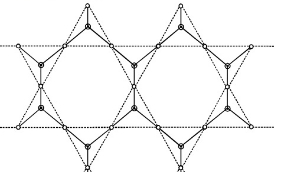
The name of structure of silicates in which three oxygen atoms of $[SiO_4]^{4-}$ are shared is :-
Answerb
Two dimensioanl sheet silicates: In such silicates, three oxygen atoms of each tetrahedral are shared with adjacent $\mathrm{SiO}_{4}^{4-}$ tetrahedral, such sharing forms two dimensional sheet strtucre with general formula $\left(\mathrm{Si}_{2} \mathrm{O}_{5}\right)_{\mathrm{n}}^{2 \mathrm{n}-}$
$\mathrm{Ex} .$ Talc $\mathrm{Mg}\left(\mathrm{Si}_{2} \mathrm{O}_{5}\right)_{2} \mathrm{Mg}(\mathrm{OH})_{2}$
The structure of silicates has been found with the help of X-ray diffraction techniques.
Hence,option B is correct.
View full question & answer→MCQ 1101 Mark
Carbon mono-oxide is neutral oxide of carbon but it act as very strong field ligand and associated with metal to form complex compounds, these complex compounds are very useful compounds and uses for metallergical process.Water gas is a mixture of
- A
$H_2 + CO_2$
- ✓
$CO + H_2$
- C
$H_2O + CO_2$
- D
$CO + CO_2$
AnswerCorrect option: B. $CO + H_2$
View full question & answer→MCQ 1111 Mark
Which allotrpic form of carbon does not have hexagonal rings in its structure
Answera
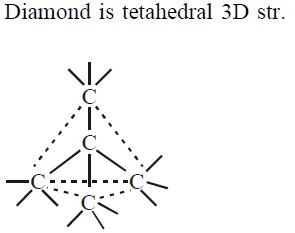
View full question & answer→MCQ 1121 Mark
Which of the following form cyclic silicones on hydrolysis
- ✓
$R_2SiCl_2$
- B
$R_3SiCl$
- C
$RSiCl_3$
- D
AnswerCorrect option: A. $R_2SiCl_2$
View full question & answer→MCQ 1131 Mark
Which of the following does not changes the density of $SiC$ solid
- A
By substitution of some $Si$ atoms by some carbon atoms
- B
- C
By substitution of $"Si"$ or $"C"$ by $"Ge"$
- ✓
By interchanging position of $Si$ and $C -atoms$
AnswerCorrect option: D. By interchanging position of $Si$ and $C -atoms$
View full question & answer→MCQ 1141 Mark
In the reaction $SnCl_2(excess)+HgCl_2\ \rightarrow\ A+SnCl_4$, '$A$' is
- A
$Hg_2Cl_2$
- ✓
$Hg$
- C
$HgCl$
- D
$HgCl_3$
Answerb
$SnCl _2+ HgCl _2 \rightarrow Hg + SnCl _4$
Here $A$ is $Hg$.
View full question & answer→MCQ 1151 Mark
An inorganic compound $(A)$ made of two most occuring elements into the earth crust, having a polymeric tetra-headral network structure. With carbon, compound $(A)$ produces a poisonous gas $(B)$ which is the most stable diatomic molecule. Compounds $(A)$ and $(B)$ will be
- A
$SiO_2, CO_2$
- ✓
$SiO_2, CO$
- C
$SiC,CO$
- D
$SiO_2, N_2$
AnswerCorrect option: B. $SiO_2, CO$
b
$\mathrm{SiO}_{2}+2 \mathrm{C} \rightarrow \mathrm{Si}+2 \mathrm{CO}$
Compound A is silica (SiO $_{2}$ ) made of Si and $\mathrm{O}_{2}$, two most occuring elements into the earth crust, having a polymeric tetraheadral network structure. Compound B is C O, a poisonous gas which is the most stable diatomic molecule.
View full question & answer→MCQ 1161 Mark
When oxalic acid reacts with cone. $H_2SO_4,$ two gases produced are of neutral and acidic in nature respectively. Potassium hydroxide absorbs one of the two gases. The product formed during this absorption and the gas which gets absorbed are respectively
- ✓
$K_2CO_3$ and $CO_2$
- B
$KHCO_3$ and $CO_2$
- C
$K_2CO_3$ and $CO$
- D
$KHCO_3$ and $CO$
AnswerCorrect option: A. $K_2CO_3$ and $CO_2$
a
$(\mathrm{COOH})_{2} \stackrel{\text { conc. } \mathrm{H}_{2} \mathrm{SO}_{4}, \text { heat }}{\longrightarrow} \mathrm{CO}+\mathrm{CO}_{2}+\mathrm{H}_{2} \mathrm{O}$
CO is neutral and $\mathrm{CO}_{2}$ is acidic in nature.
$2 \mathrm{KOH}+\mathrm{CO}_{2} \rightarrow \mathrm{K}_{2} \mathrm{CO}_{3}+\mathrm{H}_{2} \mathrm{O}$
View full question & answer→MCQ 1171 Mark
A red coloured mixed oxide $(X)$ on treatment with cone. $HNO_3$ gives a compound $(Y).$ $(Y)$ with $HCl ,$ produces a chloride compound $(Z)$ which can also be produced by treating $(X)$ with cone. $HCl.$ Compounds $(X) , (Y),$ and $(Z)$ will be
- A
$Mn_3O_4, MnO_2, MnCl_2$
- ✓
$Pb_3O_4, PbO_2, PbCl_2$
- C
$Fe_3O_4, Fe_2O_3, FeCl_2$
- D
$Fe_3O_4, Fe_2O_3, FeCl_3$
AnswerCorrect option: B. $Pb_3O_4, PbO_2, PbCl_2$
b
$\mathrm{Pb}_{3} \mathrm{O}_{4}+4 \mathrm{HN} \mathrm{O}_{3} \rightarrow 2 \mathrm{Pb}\left(\mathrm{NO}_{3}\right)_{2}+\mathrm{P} \mathrm{bO}_{2}+2 \mathrm{H}_{2} \mathrm{O}$
$\mathrm{PbO}_{2}+\mathrm{HCl} \rightarrow \mathrm{PbCl}_{2}+\mathrm{H}_{2} \mathrm{O}+\mathrm{Cl}_{2}$
$\mathrm{P} \mathrm{b}_{3} \mathrm{O}_{4}+8 \mathrm{HCl} \rightarrow 4 \mathrm{H}_{2} \mathrm{O}+3 \mathrm{P} \mathrm{bCl}_{2}+\mathrm{Cl}_{2}$
$\mathrm{X}, \mathrm{Y}$ and $\mathrm{Z}$ are $\mathrm{Pb}_{3} \mathrm{O}_{4}, \mathrm{P} \mathrm{bO}_{2}, \mathrm{P} \mathrm{bCl}_{2}$ respectively.
View full question & answer→MCQ 1181 Mark
Choose correct statement about silicones
- A
Silicones are used as antifoaming agent in sewage disposal, beer making and in cooking oil used to prepare potato chips
- B
In preparation of $R_2SiCl_2$ from $'Si'$ , copper powder is used as catalyst
- C
Using $R_3SiCl$ in a certain proportion we can control the chain length of the polymer
- ✓
View full question & answer→MCQ 1191 Mark
The formula of $3$ membered discrete chain silicate is
- A
$Si_3O_9^{6-}$
- ✓
$Si_3O_{10}^{8-}$
- C
$Si_3O_6^{3-}$
- D
$Si_3O_{12}^{12-}$
AnswerCorrect option: B. $Si_3O_{10}^{8-}$
View full question & answer→MCQ 1201 Mark
The distance between two adjuscent carbonn atoms is maximum in
Answera
Bond order in the four cases is $1, 1.33, 1.5$ and $2$ respectively.
View full question & answer→MCQ 1211 Mark
$Pbl_4$ does not exist because
- A
- B
$Pb(IV)$ is oxidizing and $I^-$ is strong reducing agent
- ✓
$Pb(IV)$ is less stable than $Pb (II)$
- D
$Pb^{4+}$ is not easily formed
AnswerCorrect option: C. $Pb(IV)$ is less stable than $Pb (II)$
c
Inert pair effect makes $+2$ as more stable than $+4$ oxidation state
View full question & answer→MCQ 1221 Mark
Which of the following is a molecular solid
MCQ 1231 Mark
Match List $I$ (Fuels) with List $II$ (composition) and select the correct answer using the codes given below the lists
| List $I$ (Fuels) |
List $II$ (Composition) |
| $A.$ Water gas |
$i.$ A mixture of $CO$ and $N_2$ |
| $B.$ Producer gas |
$ii.$ Methane |
| $C.$ Coal gas |
$iii.$ A mixture of $CO$ and $H_2$ |
| $D.$ Natural gas |
$iv.$ A mixture of $CO$, $H_2$, $CH_4$ and $CO_2$ |
$A\,-\,B\,-\,C\,-\,D$ Respectively
- ✓
$iii\,-\,i\,-\,iv\,-\,ii$
- B
$iii\,-\,i\,-\,ii\,-\,iv$
- C
$i\,-\,iii\,-\,iv\,-\,ii$
- D
$iii\,-\,ii\,-\,iv\,-\,i$
AnswerCorrect option: A. $iii\,-\,i\,-\,iv\,-\,ii$
View full question & answer→MCQ 1241 Mark
Silicon has a strong tendency to form polymers like silicones. The chain length of silicone polymer can be controlled by adding :-
- A
$RSiCl_3$
- ✓
$R_3SiCl$
- C
$RSiCl_2$
- D
$R_4Si$
AnswerCorrect option: B. $R_3SiCl$
View full question & answer→MCQ 1251 Mark
Consider the following reaction
${R_2}SiC{l_2} + {H_2}O \to (1)\xrightarrow{{polymerisation}}(2)$
Compound $(2)$ in above reaction is
View full question & answer→MCQ 1261 Mark
Which of the following unit is used to form cross linked silicone ?
- ✓
$RSiCl_3$
- B
$R_2SiCl_2$
- C
$R_3SiCl$
- D
AnswerCorrect option: A. $RSiCl_3$
a
$\mathrm{R} \mathrm{SiCl}_{3}=$ Cross linked
$\mathrm{R}_{2} \mathrm{SiCl}_{2}=$ Chain polymer
$\mathrm{R}_{3} \mathrm{SiCl}_{3}=$ Dimer
View full question & answer→MCQ 1271 Mark
- A
$Mg_2\,C_3,Be_2\,C, Al_4\,C_3$ and $CaC_2$
- B
$Mg_2\,C_3, Be_2\,C$ and $Al_4\,C_3$
- C
$Be_2\,C, Al_4\,C_3$ and $CaC_2$
- ✓
$Be_2\,C$ and $Al_4\,C_3$
AnswerCorrect option: D. $Be_2\,C$ and $Al_4\,C_3$
d
$C^{-4}$ ions in $Be_2C, Al_4C_3$
View full question & answer→MCQ 1281 Mark
When $PbO_2$ reacts with conc. $HNO_3$ the gas evolved may be
- A
$NO_2$
- ✓
$O_2$
- C
$N_2$
- D
$N_2O$
Answerb
$PbO_2 + conc.\,\,\,HNO_3$
View full question & answer→MCQ 1291 Mark
View full question & answer→MCQ 1301 Mark
The species that do not contain peroxide linkage are :-
- ✓
$PbO_2$
- B
$H_2O_2$
- C
$SrO_2$
- D
$BaO_2$
AnswerCorrect option: A. $PbO_2$
a
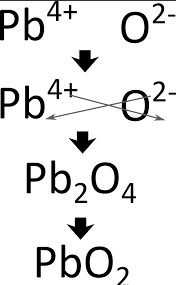
Metallic oxides which on treatment with dilute acids produce hydrogen peroxide are called peroxides. All peroxides contain a peroxide ion $\left(\mathrm{O}_{2}\right)^{2-}$ having the structure $-\mathrm{O}-\mathrm{O}-. \mathrm{PbO}_{2}$ does not contain a peroxide ion $\left(\mathrm{O}_{2}\right)^{2-}$ and it can not be called as peroxides.
$\mathrm{PbO}_{2}$ contains $\mathrm{O}^{2-}$ ions and Option $(\mathrm{A}) \mathrm{Pb}$ is $+4,$ whereas $(\mathrm{B}),(\mathrm{C})$ and (D) contains $[\mathrm{O}-\mathrm{O}]^{2-}$ ions (peroxide ions).
Thus Option A is correct.
View full question & answer→MCQ 1311 Mark
When Conc. $H_2SO_4$ is added to charcoal :-
AnswerCorrect option: C. $SO_2$ and $CO_2$ are evolved
c
To a piece of charcoal sulfuric acid is added. Then $\mathrm{CO}_{2}$ and $\mathrm{SO}_{2}$ are evolved.
$\mathrm{C}+2 \mathrm{H}_{2} \mathrm{SO}_{4} \rightarrow \mathrm{CO}_{2} \uparrow+2 \mathrm{SO}_{2} \uparrow+2 \mathrm{H}_{2} \mathrm{O}$
$\mathrm{H}_{2} \mathrm{SO}_{4}$ is reduced to $\mathrm{SO}_{2}$ and $\mathrm{C}$ is oxidised to $\mathrm{CO}_{2}$
View full question & answer→MCQ 1321 Mark
Name the type of the structure of silicate in which one oxygen atom of $[SiO_4]^{4-}$ is shared?
- A
- B
- ✓
- D
Three dimensional silicate
View full question & answer→MCQ 1331 Mark
Which one of the following bonds has the highest bond energy ?
- ✓
$C-C$
- B
$Si-Si$
- C
$Ge-Ge$
- D
$Sn-Sn$
View full question & answer→MCQ 1341 Mark
Which of the following have $3C-2e^-$ bond
$I.\, Al_2Cl_6\,\,\, II.\, B_2H_6\,\,\, III.\, Fe_2Cl_6\,\,\, IV.\, Si_2H_6$
- A
$I,\, II$
- B
$II,\, IV$
- ✓
Only $II$
- D
$I,\, III,\, IV$
AnswerCorrect option: C. Only $II$
c
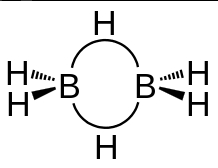
The $2 \mathrm{B}-\mathrm{H}-\mathrm{B}$ banana bonds in $\mathrm{B}_{2} \mathrm{H}_{6}$ are $3 \mathrm{c}$ - 2e bonds.
View full question & answer→MCQ 1351 Mark
Silicon has a strong tendency to form polymers like silicones. The chain length of silicones polymer can be controlled by adding
- A
$MeSiCl_3$
- B
$Me_2SiCl$
- ✓
$Me_3SiCl$
- D
$Me_4Si$
AnswerCorrect option: C. $Me_3SiCl$
c
$\mathrm{Me}_{3} \mathrm{SiCl}$
The chain length of Silicone polymer can be controlled by adding $\left(\mathrm{CH}_{3}\right)_{3} \mathrm{SiCl}$, which blocks the ends as shown below:
$\left(\mathrm{CH}_{3}\right)_{3} \mathrm{SiCl} \frac{\mathrm{H}_{2} \mathrm{O}}{-\mathrm{HCl}}\left(\mathrm{CH}_{3}\right)_{3} \mathrm{SiOH}$
View full question & answer→MCQ 1361 Mark
The silicates which contain $Si_2O_7^{-6}$ units are called
Answerc
$SiO_{3.5}^{ - 3}$ pyro sillicate
View full question & answer→MCQ 1371 Mark
$'CH_4'$ gas is obtained in :-
$(a)$ Hydrolysis of $Al_4C_3$
$(b)$ Hydrolysis of $Be_2C$
$(c)$ Hydrolysis of $Mg_2C_3$
$(d)$ Hydrolysis of $CaC_2$
- A
only $a, b, c$
- ✓
only $a, b$
- C
only $a, c$
- D
only $b, c, d$
AnswerCorrect option: B. only $a, b$
b
$A{l_4}{C_3} + 12H - OH \to 4Al{(OH)_3} + 3C{H_4}$
$B{e_2}C + 4H - OH \to 2Be{(OH)_2} + C{H_4}$
View full question & answer→MCQ 1381 Mark
- A
$Me_3SiCl -$ Dimer of silicon's
- B
$Me_2SiCl_2 -$ Linear chain silicon's
- ✓
$Ph_2SiCl_3 -$ Cross linked silicon's
- D
$MeSiCl_3 -$ Cross linked silicon's
AnswerCorrect option: C. $Ph_2SiCl_3 -$ Cross linked silicon's
View full question & answer→MCQ 1391 Mark
Which is not monomer for a high molecular mass silicone polymer
- A
$PhSiCl_3$
- B
$MeSiCl_3$
- C
$Me_2SiCl_2$
- ✓
$Me_3SiCl$
AnswerCorrect option: D. $Me_3SiCl$
d
$\mathrm{MeSiCl}_{3}, \mathrm{Me}_{2} \mathrm{SiCl}_{2}$ and $\mathrm{PhSiCl}_{3}$ are monomers for a high molecular mass silicone polymer.
However, Me $_{3} \mathrm{SiCl}$ is not a monomer for a high molecular mass silicone polymer as it contains only one Cl atom and at best, it can form a dimer.
Hence, the correct answer is option D.
View full question & answer→MCQ 1401 Mark
In graphite $C -C$ bond length $(141.5\, pm)$ found to be shorter than normal $C -C$ bond length $(154 \, pm)$ this anomaly occurs due to
- ✓
There is $p\pi -p\pi $ bond delocalised within layer
- B
In Hexagonal layer structure $C$ atom bonded more compactly
- C
Hexagonal layers have weak van der Waal forces among them
- D
$sp^3$ hybridisation of each carbon atom
AnswerCorrect option: A. There is $p\pi -p\pi $ bond delocalised within layer
View full question & answer→MCQ 1411 Mark
If oxalic acid is treated with conc. $H_2SO_4$ , then gases formed will be
- A
$SO_2$ and $SO_3$
- B
$CO$ and $SO_2$
- ✓
$CO$ and $CO_2$
- D
$O_2$ and $N_2$
AnswerCorrect option: C. $CO$ and $CO_2$
c
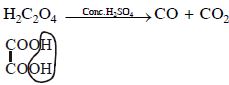
View full question & answer→MCQ 1421 Mark
Which of the following is least stable ?
- A
$CI_4$
- B
$SnI_4$
- C
$GeI_4$
- ✓
$PbI_4$
AnswerCorrect option: D. $PbI_4$
d
As we go down the group the stability of halides will decrease due to increase in size of halogen atom, because of this reason the halogens easily disassociates from the compound,so lead iodide is least stable among the halides of $14^{th}$ group elements.
Non existance of $PbI _4$ can be explained on the basis of strong oxidising nature of $Pb_ 4^{+}$
$Pb ^{4+}+2 I ^{-} \rightarrow Pb ^{2+}+ I _2$
View full question & answer→MCQ 1431 Mark
Correct order of electron affinity for $C, Si$ and $Ge$ is
- A
$C > Si > Ge$
- ✓
$C < Si > Ge$
- C
$C > Ge > Si$
- D
$Ge > Si < C$
AnswerCorrect option: B. $C < Si > Ge$
View full question & answer→MCQ 1441 Mark
Tetrahalides of group $14$ elements (except that of carbon) act as
Answerb
The tetrahalides are covalent and have tetrahedral geometry. Their thermal stability decreases down the group and the tetrahalides of group $14$ except that of carbon are readily hydrolysed. In carbon there is no vacant d-orbitals so it cannot increase its valency beyond four. The halides of carbon do not act as lewis acids.
View full question & answer→MCQ 1451 Mark
In diamond crystal each carbon atom is linked with other carbon atoms. The number of carbon atoms in diamond unit cell is
Answerc
Diamond has fcc unit cell structure made up of atoms. This accounts for $8 \times \frac{1}{8}+6 \times \frac{1}{2}=1+3=4 \mathrm{C}$ atoms
C atoms are also present in one half of the tetrahedral voids. There are 8 tetrahedral voids in fcc structure.
This accounts for remaining $8 \times \frac{1}{2}=4 \mathrm{C}$ atoms
Thus, total $4+4=8 \mathrm{C}$ atoms are present per unit cell of diamond.
View full question & answer→MCQ 1461 Mark
- A
$SiO_2\,^{2 - }$
- B
$SiO_4\,^{2 - }$
- C
$S{i_2}O_6\,^{7 - }$
- ✓
$S{i_2}O_7\,^{6 - }$
AnswerCorrect option: D. $S{i_2}O_7\,^{6 - }$
d
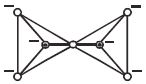
View full question & answer→MCQ 1471 Mark
Which of the following compound forms silicones on hydrolysis ?
- ✓
$(CH_3)_2SiCl_2$
- B
$(SiH_3)_3N$
- C
$SiCl_4$
- D
AnswerCorrect option: A. $(CH_3)_2SiCl_2$
a
Silicones are a group of organosilicon polymers, which have $\left(-\mathrm{R}_{2} \mathrm{SiO}-\right)$ as a repeating unit.
The starting materials for the manufacture of silicones are alkyl or aryl substituted silicon chlorides, $\mathrm{R}_{\mathrm{n}} \mathrm{SiCl}_{(4-\mathrm{n})}$, where $\mathrm{R}$ is alkyl or aryl group.
On hydrolysis of this alkyl or aryl substituted silicon chlorides the silicones are formed.
Among given options, option A is the only alkyl substituted silicone chloride and hence it is correct answer.
View full question & answer→MCQ 1481 Mark
In extraction of $Al$ chemical used in serpeck's process is
- A
$NaOH$
- ✓
$C + N_2$
- C
$CaC_2 + CaCl_2$
- D
$Na_2CO_3$
AnswerCorrect option: B. $C + N_2$
View full question & answer→MCQ 1491 Mark
Consider following statements
$(a)$ $R_2SiO$ is repeating unit of linear silicones
$(b)$ $RSiCl_3$ on hydrolysis followed by dehydration gives linear silicones
$(c)$ Silicones can be used as heat insulator
$(d)$ Silica is soluble in $HF$
The correct statement$(s)$ is/are
- A
$a, b, c$ and $d$
- ✓
$a, c$ and $d$
- C
$a, b$ and $d$
- D
$a$ and $c$
AnswerCorrect option: B. $a, c$ and $d$
View full question & answer→MCQ 1501 Mark
Which of the following compound formed silicones on hydrolysis
- ✓
$(CH_3)SiCl_2$
- B
$(SiH_3)_3N$
- C
$SiCl_4$
- D
AnswerCorrect option: A. $(CH_3)SiCl_2$
a
Silicones are a group of organosilicon polymers, which have $\left(- R _2 SiO ^{-}\right)$ as a repeating unit. The starting materials for the manufacture of silicones are alkyl or aryl substituted silicon chlorides, $R _{ n } SiCl _{(4-n)}$, where $R$ is alkyl or aryl group. On hydrolysis of this alkyl or aryl substituted silicon chlorides the silicones are formed.
Among given options, option $A$ is the only alkyl substituted silicone chloride and hence it is correct answer.
View full question & answer→MCQ 1511 Mark
Silicate having one monovalent corner oxygen atom in each tetrahedron unit is
Answera
The general formula of Sheet or Phyllo silicates is $\left(\mathrm{Si}_{2} \mathrm{O}_{5}\right) \mathrm{n}^{2 \mathrm{n}-}$. Each $\mathrm{SiO}_{4}$ tetrahedron shares three oxygen atoms with others and thus by forming two-dimensional sheets.
These silicates can be cleaved easily just like graphite.
Hence, the correct option is $\mathrm{A}$
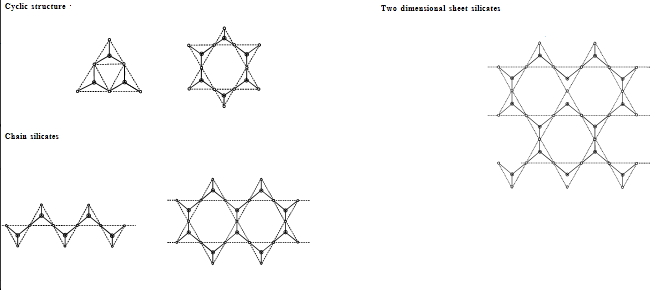
View full question & answer→MCQ 1521 Mark
Which of the following structural features of graphite best accounts for its use as a lubricant?
- A
- B
Strong covalent bonds between carbon atoms
- ✓
vander Waals' forces between layers
- D
limited three covalency of carbon
AnswerCorrect option: C. vander Waals' forces between layers
c
Graphite is used as a lubricant due to its slippery nature. Graphite has layers of carbon atoms, with van der waals weak forces, residing in between its layers because of which it is quite slippery.
View full question & answer→MCQ 1531 Mark
Which of the following is sparingly soluble in cold water and fairly soluble in hot water ?
- A
$Pb(NO_3)_2$
- ✓
$PbCl_2$
- C
$PbSO_4$
- D
$PbCrO_4$
AnswerCorrect option: B. $PbCl_2$
b
$Pb \left( NO _3\right)_2$ is sparingly soluble in cold water and fairly soluble in hot water. It's an experimental observation.
View full question & answer→MCQ 1541 Mark
Silicon dissolves in excess of $HF$ due to formation of
- A
$SiF_4$
- B
$SiH_4$
- ✓
$H_2SiF_6$
- D
$H_2SiF_4$
AnswerCorrect option: C. $H_2SiF_6$
c
HF is a very strong acid and can also react with silicon and corrode its lattice
$\mathrm{Si}+4 \mathrm{HF} \rightarrow \mathrm{SiF}_{4}+4 \mathrm{H}^{+}$
$\begin{array}{l}\downarrow \mathrm{HF} \\\mathrm{H}_{2} \mathrm{SiF}_{6}\end{array}$
View full question & answer→MCQ 1551 Mark
Which of the Following halides dose not hydrolyse at room temperature ?
- A
$PbCl_4$
- B
$SiCl_4$
- ✓
$CCl_4$
- D
$SnCl_4$
AnswerCorrect option: C. $CCl_4$
c
since carbon has no d-orbital, hence it cannot extend its coordination number beyond four, thus its hatides are not attacked (hydrolysed) by water.
View full question & answer→MCQ 1561 Mark
$SiCl_4$ on hydrolysis gives
Answerb
$\mathrm{SiCl}_{4}$ on hydrolysis gives silicic acid.
The reaction is as follows:
$\mathrm{SiCl}_{4}+4 \mathrm{H}_{2} \mathrm{O} \rightarrow \mathrm{Si}(\mathrm{OH})_{4}+4 \mathrm{HCl}$
Hence, silicic acid is formed when $\mathrm{SiCl}_{4}$ undergoes hydrolysis.
View full question & answer→MCQ 1571 Mark
Which substance is having molecular solid
- A
- ✓
$C_{60}$
- C
- D
$Ca_3(PO_4)_2$
AnswerCorrect option: B. $C_{60}$
b
Buckminsterfullerene is a type of fullerene with the formula $C_{60}$. It has a cagelike fused-ring structure that resembles a soccer ball, made of twenty hexagons and twelve pentagons. Each carbon atom has three bonds. It is a black solid that dissolves in hydrocarbon solvents to produce a violet solution.
View full question & answer→MCQ 1581 Mark
A cyclic skeleton of silicon and oxygen can constructed by the silicate ion composition
- A
$Si_2O_7^{4-}$
- B
$Si_2O_5^{2-}$
- ✓
$SiO_3^{2-}$
- D
$SiO_4^{4-}$
AnswerCorrect option: C. $SiO_3^{2-}$
c
Cyclic silicates contain $\left( SiO _3\right)_{ n }^{2 n -}$ ions which are formed by linking three or more tetrahedral $SiO _4^{4-}$ units cyclically. Each unit shares two oxygen atoms with other units.
View full question & answer→MCQ 1591 Mark
Which of the following is an organo silicon polymer?
Answerb
Silicone is a polymeric organo silicon compound which is chemically inert and thermally stable.
View full question & answer→MCQ 1601 Mark
$SnCl_2$ acts as a reducing agent
- A
$SnCl_2$ can accept electrons readily
- B
$Sn^{2+}$ is more stable than $Sn^{4+}$
- ✓
$Sn^{4+}$ is more stable than $Sn^{2+}$
- D
$Sn^{2+}$ can be easily converted to metallic tin
AnswerCorrect option: C. $Sn^{4+}$ is more stable than $Sn^{2+}$
c
$\mathrm{SnCl}_{2}$ acts as a reducing agent because there is high tendency of $\operatorname{Sn}(\mathrm{II})$ ions to convert into $\mathrm{Sn}(\mathrm{IV})$ as $\mathrm{Sn}^{4+}$ is more stable than $\mathrm{Sn}^{2+}$
Hence, option $\mathrm{C}$ is the correct answer.
View full question & answer→MCQ 1611 Mark
The correct order of decreasing ionic nature of lead dihalides is
- ✓
$Pb{F_2} > PbC{l_2} > PbB{r_2} > Pb{I_2}$
- B
$Pb{F_2} > PbB{r_2} > PbC{l_2} > Pb{I_2}$
- C
$Pb{F_2} < PbC{l_2} > PbB{r_2} < Pb{I_2}$
- D
$Pb{I_2} < PbB{r_2} < PbC{l_2} < Pb{F_2}$
AnswerCorrect option: A. $Pb{F_2} > PbC{l_2} > PbB{r_2} > Pb{I_2}$
a
Larger anions are more easily deformed to produce covalent nature. Also note decreasing ionic nature and not increasing
$PbF _2\,<\, PbCl _2\,>\, PbBr _2\,<\, PbI _2$
View full question & answer→MCQ 1621 Mark
$Si_2O_7^{-6}$ anion is obtained when
- A
no oxygen of a $SiO_4$ tetrahedron is shared with another $SiO_4$ tetrahedron
- ✓
one oxygen of a $SiO_4$ tetrahedron is shared with another $SiO_4$ tetrahedron
- C
two oxygen of a $SiO_4$ tetrahedron are shared with another $SiO_4$ tetrahedron
- D
three or all four oxygen of a tetrahedron are shared with other $SiO_4$ tetrahedron
AnswerCorrect option: B. one oxygen of a $SiO_4$ tetrahedron is shared with another $SiO_4$ tetrahedron
b
$Si _2 O _7^{6-}$ anion is obtained when one oxygen of a $SiO _4$ tetrahedron is shared with another $SiO _4$ tetrahedron.
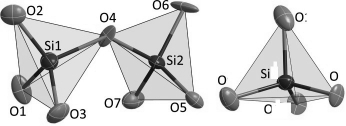
View full question & answer→MCQ 1631 Mark
Choose the correct order of $C - C$ bond length in the given compounds
- A
$Acetylene < ethylene < graphite < benzene < ethane$
- ✓
$Acetylene < ethylene < benzene < graphite < ethane$
- C
$Acetylene < graphite < ethylene < benzene < ethane$
- D
$Acetylene < benzene < graphite < ethylene < ethane$
AnswerCorrect option: B. $Acetylene < ethylene < benzene < graphite < ethane$
View full question & answer→MCQ 1641 Mark
Silicate having one monovalent comer oxygen atom in each tetrahedron unit is
Answera
The general formula of Sheet or Phyllo silicates is $\left( Si _2 O _5\right) n ^{2 n-}$. Each $SiO _4$ tetrahedron shares three oxygen atoms with others and thus by forming twodimensional sheets. These silicates can be cleaved easily just like graphite.
View full question & answer→MCQ 1651 Mark
Monomer unit of silicone's
- A
$R_2SiO_2$
- B
$R_3SiO$
- C
$RSiO_2$
- ✓
$R_2SiO$
AnswerCorrect option: D. $R_2SiO$
View full question & answer→MCQ 1661 Mark
Graphite is used as dry lubricant because of its
- ✓
- B
$sp^3$ hybridisation
- C
presence of dangling bonds
- D
presence of two types of bond lengths
View full question & answer→MCQ 1671 Mark
Compare $\pi -$ bond strength between $B$ and $N$ given in two compounds
$(I)$ $\begin{array}{*{20}{c}}
{{{(C{H_3})}_3}Si - NB{H_2}} \\
{\,\,\,\,\,\,\,\,\,\,\,\,\,\,\,\,\,\,|} \\
{\,\,\,\,\,\,\,\,\,\,\,\,\,\,\,\,\,\,\,\,\,\,\,\,\,\,\,\,\,\,\,\,\,\,Si{{(C{H_3})}_3}}
\end{array}$ $(II)$ $\begin{array}{*{20}{c}}
{{{(C{H_3})}_3}C - NB{H_2}} \\
{\,\,\,\,\,\,\,\,\,\,\,\,\,\,\,\,\,|} \\
{\,\,\,\,\,\,\,\,\,\,\,\,\,\,\,\,\,\,\,\,\,\,\,\,\,\,\,\,\,\,\,\,\,\,\,C{{(C{H_3})}_3}}
\end{array}$
AnswerCorrect option: D. $II > I$
View full question & answer→MCQ 1681 Mark
$C-C$ bond length is maximum in ?
Answera
The carbon-carbon $(C-C)$ bond length in diamond is $154 \,pm$, which is also the largest bond length that exists for ordinary carbon covalent bonds.
View full question & answer→MCQ 1691 Mark
One of the hydrolysed product of the following compound does not react with silica of glass vessel
- ✓
$BF_3$
- B
$ClF_5$
- C
$XeF_2$
- D
$SF_4$
AnswerCorrect option: A. $BF_3$
a
$HF$ is funned as one of the hydrolysed product of $CIF_5,\,XeF_2,\,SF_4$ and $HF$ react with silica of glass vessel. While in case of hydrolysis of $BF_3$
$4B{{F}_{3}}+3{{H}_{2}}O\xrightarrow{R.T}{{H}_{3}}B{{O}_{3}}+\underbrace{3H[B{{F}_{4}}]}_{\begin{smallmatrix}
does\,not\,reaect \\
with\,\,silica\,\,(Si{{O}_{2}})\,
\end{smallmatrix}}$
View full question & answer→MCQ 1701 Mark
$Pb\,+\,Dil.\,HN{{O}_{3}}\,\xrightarrow{Warm}\,P+Q\uparrow \,+\,{{H}_{2}}O$
Incorrect statement for $Q$ is
AnswerCorrect option: C. It combines with $Fe_2(SO_4)_3$
View full question & answer→MCQ 1711 Mark
Tetrahalides of group $14$ elements (except that of carbon) act as
Answerb
The tetrahalides are covalent and have tetrahedral geometry. Their thermal stability decreases down the group and the tetrahalides of group $14$ except that of carbon are readily hydrolysed. In carbon there is no vacant d-orbitals so it cannot increase its valency beyond four. The halides of carbon do not act as lewis acids.
View full question & answer→MCQ 1721 Mark
In which compound peroxide bond is present
- A
$Pb_2O_3$
- B
$SiO_2$
- ✓
$BaO_2$
- D
$PbO_2$
AnswerCorrect option: C. $BaO_2$
c
$BaO$ is normal oxide while $BaO_2$ is peroxide
View full question & answer→MCQ 1731 Mark
Repeating unit of organosilicon polymers is
- A
${\rlap{-} ({R_2}Si\rlap{-} )_n}$
- B
${\rlap{-} ({R_2}Si-O_2\rlap{-} )_n}$
- ✓
${\rlap{-} ({R_2}SiO\rlap{-} )_n}$
- D
AnswerCorrect option: C. ${\rlap{-} ({R_2}SiO\rlap{-} )_n}$
View full question & answer→MCQ 1741 Mark
Tetrahalides of group $14$ elements (except that of carbon) act as
Answerb
The tetrahalides are covalent and have tetrahedral geometry. Their thermal stability decreases down the group and the tetrahalides of group $14$ except that of carbon are readily hydrolysed. In carbon there is no vacant $d$-orbitals so it cannot increase its valency beyond four. The halides of carbon do not act as lewis acids.
View full question & answer→MCQ 1751 Mark
Pick out the correct statement
- A
$SiC$ is a covalent carbide, on hydrolysis it's give $Si(OH)_4$ and $O_2$
- B
$Al_4C_3$ is a ionic carbide, on hydrolysis it's give $C_3H_4$
- ✓
$Be_2C$ is a ionic carbide, on hydrolysis it's give methane gas
- D
$(B)$ and $(C)$ both
AnswerCorrect option: C. $Be_2C$ is a ionic carbide, on hydrolysis it's give methane gas
View full question & answer→MCQ 1761 Mark
The silicates which contain $Si_2O_7^{-6}$ units are called
Answerc
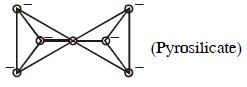
View full question & answer→MCQ 1771 Mark
Consider following statements
$(a)$ $R_2SiO$ is repeating unit of linear silicones
$(b)$ $R$ $SiCl_3$ on hydrolysis followed by dehydration gives linear silicones
$(c)$ Silicones can be used as heat insulator
$(d)$ Silica is soluble in $HF$
The correct statement$(s)$ is/are
- A
$a, b, c$ and $d$
- ✓
$a, c$ and $d$
- C
$a, b$ and $d$
- D
$a$ and $c$
AnswerCorrect option: B. $a, c$ and $d$
b
$a \rightarrow$ true
$(b) \rightarrow$ fabe
for linear silicones $R_2 SiCl _2$ is used
$(c) \rightarrow$ true
$(d) \rightarrow SiO _2+ HF \rightarrow H_2 SiF _6$
$a, c$ and $d$
View full question & answer→MCQ 1781 Mark
The product obtained when silica reacts with hydrogen fluoride is
- A
$SiF_4$
- ✓
$H_2SiF_6$
- C
$H_2SiF_4$
- D
$H_2SiF_3$
AnswerCorrect option: B. $H_2SiF_6$
b
The final product formed when silica $\left(\mathrm{SiO}_{2}\right)$ reacts with hydrogen fluoride $(\mathrm{HF})$ is $\mathrm{H}_{2} \mathrm{SiF}_{6} .$
The reactions are as follows:
$\mathrm{SiO}_{2}+4 \mathrm{HF} \rightarrow \mathrm{SiF}_{4}+2 \mathrm{H}_{2} \mathrm{O}$
$3 \mathrm{SiF}_{4}+4 \mathrm{H}_{2} \mathrm{O} \rightarrow 2 \mathrm{H}_{2} \mathrm{SiF}_{6}+\mathrm{H}_{4} \mathrm{SiO}_{4}$
View full question & answer→MCQ 1791 Mark
Which of the following compound formed silicones on hydrolysis
- ✓
$(CH_3)SiCl_2$
- B
$(SiH_3)_3N$
- C
$SiCl_4$
- D
AnswerCorrect option: A. $(CH_3)SiCl_2$
a
Silicones are a group of organosilicon polymers, which have $\left(- R _2 SiO -\right)$ as a repeating unit. The starting materials for the manufacture of silicones are alkyl or aryl substituted silicon chlorides, $R _{ n } SiCl _{(4-n)}$, where $R$ is alkyl or aryl group. On hydrolysis of this alkyl or aryl substituted silicon chlorides the silicones are formed.
Among given options, option $A$ is the only alkyl substituted silicone chloride and hence it is correct answer.
View full question & answer→MCQ 1801 Mark
Which of the following order is correct ?
- A
$Si-Si > C-C > Ge-Ge$ (Bond energy)
- B
$H-H > F-F > C-C$ (Bond energy)
- C
$Ge < Sn < Pb$ (ability of $ns^2e^-$ to participate in bonding)
- ✓
$SiH_4 > SnH_4 > PbH_4 > CH_4$ (easy of hydrolysis)
AnswerCorrect option: D. $SiH_4 > SnH_4 > PbH_4 > CH_4$ (easy of hydrolysis)
View full question & answer→MCQ 1811 Mark
Which gas formation takes places by the oxidation of carbon with conc. $H_2SO_4$ ?
- A
only $CO_2$
- B
only $SO_2$
- C
$SO_3$ and $CO_2$ both
- ✓
$SO_2$ and $CO_2$ both
AnswerCorrect option: D. $SO_2$ and $CO_2$ both
d
$C + {H_2}S{O_{4\left( {conc.} \right)}} \longrightarrow SO_2 + CO_2 + H_2O$
View full question & answer→MCQ 1821 Mark
Given below are two statements :
Statement $I$: In group $13$, the stability of $+1$ oxidation state increases down the group.
Statement $II$: The atomic size of gallium is greater than that of aluminium.
In the light of the above statements, choose the most appropriate answer from the options given below:
- A
Statement $I$ is incorrect but Statement $II$ is correct
- B
Both Statement $I$ and Statement $II$ are correct
- C
Both Statement $I$ and Statement $II$ are incorrect
- ✓
Statement $I$ is correct but Statement $II$ is incorrect
AnswerCorrect option: D. Statement $I$ is correct but Statement $II$ is incorrect
d
Statement $I$ : Number of $d$ & f electrons, increases down the group and due to poor shielding of $d$ & $f$ $\mathrm{e}^{-}$, stability of lower oxidation states increases down the group
Statement $II$ : The atomic size of aluminum is greater than that of gallium.
View full question & answer→MCQ 1831 Mark
The number of neutrons present in the more abundant isotope of boron is ' $\mathrm{x}$ '. Amorphous boron upon heating with air forms a product, in which the oxidation state of boron is ' $y$ '. The value of $x+y$ is ...
Answerd
$\text { More abundant isotope }=\mathrm{B}^{11}$
${[\text { Number of neutrons }=6]}$
$\mathrm{x}=6$
$\mathrm{~B}+\mathrm{O}_2 \rightarrow \mathrm{B}_2 \mathrm{O}_3$
Oxidation state of $\mathrm{B}$ in $\mathrm{B}_2 \mathrm{O}_3=+3$
So, $\mathrm{y}=3$
Hence $x+y=9$
View full question & answer→MCQ 1841 Mark
The correct statements from the following are :
$(A)$ The decreasing order of atomic radii of group $13$ elements is $\mathrm{Tl}>\mathrm{In}>\mathrm{Ga}>\mathrm{Al}>\mathrm{B}$.
$(B)$ Down the group $13$ electronegativity decreases from top to bottom.
$(C)$ $\mathrm{Al}$ dissolves in dil. $\mathrm{HCl}$ and liberate $\mathrm{H}_2$ but conc. $\mathrm{HNO}_3$ renders Al passive by forming a protective oxide layer on the surface.
$(D)$ All elements of group 13 exhibits highly stable +1 oxidation state.
$(E)$ Hybridisation of $\mathrm{Al}$ in $\left[\mathrm{Al}\left(\mathrm{H}_2 \mathrm{O}\right)_6\right]^{3+}$ ion is $\mathrm{sp}^3 \mathrm{~d}^2$.
Choose the correct answer from the options given below:
- ✓
$(C)$ and $(E)$ only
- B
$(A)$, $(C)$ and $(E)$ only
- C
$(A)$, $(B)$, $(C)$ and $(E)$ only
- D
$(A)$ and $(C)$ only
AnswerCorrect option: A. $(C)$ and $(E)$ only
a
$A$. size order $\mathrm{T} \ell>\mathrm{In}>\mathrm{Al}>\mathrm{Ga}>\mathrm{B}$
$B$. Electronegativity order $\mathrm{B}>\mathrm{Al}<\mathrm{Ga}<\operatorname{In}<\mathrm{T} \ell$
$D$. $\mathrm{B}, \mathrm{Al}$ are more stable in $+3$ oxidation state
So, only $C, E$ statements are correct.
View full question & answer→MCQ 1851 Mark
Given below are two statements :
Statement $I$ : Gallium is used in the manufacturing of thermometers.
Statement $II$ : A thermometer containing gallium is useful for measuring the freezing point ( $256 \mathrm{~K}$ ) of brine solution.
In the light of the above statement, choose the correct answer from the options given below :
- A
Both Statement $I$ and Statement $II$ are false.
- B
Statement $I$ is false but Statement $II$ is true.
- C
Both Statement $I$ and Statement $II$ are true.
- ✓
Statement $I$ is true but Statement $II$ is false.
AnswerCorrect option: D. Statement $I$ is true but Statement $II$ is false.
d
Statement - $I$ $\Rightarrow$ Correct
Statement - $II$ $\Rightarrow$ False
$\mathrm{Ga}$ is used to measure high temperature
View full question & answer→MCQ 1861 Mark
Given below are two statements: One is labelled as Assertion $A$ and the other is labelled as Reason $R$:
Assertion $A$ : The stability order of +$1$ oxidation state of $\mathrm{Ga}$, In and $\mathrm{Tl}$ is $\mathrm{Ga}<\mathrm{In}<\mathrm{Tl}$.
Reason $R$ : The inert pair effect stabilizes the lower oxidation state down the group.
In the light of the above statements, choose the correct answer from the options given below :
- ✓
Both $A$ and $R$ are true and $R$ is the correct explanation of $A$.
- B
$A$ is true but $R$ is false.
- C
Both $A$ and $R$ are true but $R$ is $NOT$ the correct explanation of $A$.
- D
$A$ is false but $R$ is true.
AnswerCorrect option: A. Both $A$ and $R$ are true and $R$ is the correct explanation of $A$.
a
The relative stability of +$1$ oxidation state progressively increases for heavier elements due to inert pair effect.
$\therefore$ Stability of $A \ell^{+1}<\mathrm{Ga}^{+1}<\mathrm{In}^{+1}<\mathrm{T} \ell^{+1}$
View full question & answer→MCQ 1871 Mark
Match List $I$ with List $II$. Choose the correct answer from the options given below:
| List $-I$ |
List $-II$ |
|
$A.$ Melting point $[\mathrm{K}]$
|
$I.$ $\mathrm{Tl}>\mathrm{In}>\mathrm{Ga}>\mathrm{Al}>\mathrm{B}$ |
|
$B.$ Ionic Radius $\left[\mathrm{M}^{+3} / \mathrm{pm}\right]$
|
$II.$ $\mathrm{B}>\mathrm{Tl}>\mathrm{Al} \approx \mathrm{Ga}>\mathrm{In}$ |
| $C.$ $\Delta_{\mathrm{i}} \mathrm{H}_1 $ $ [\mathrm{~kJ} \mathrm{~mol}^{-1}]$ |
$III.$ $\mathrm{Tl}>\mathrm{In}>\mathrm{Al}>\mathrm{Ga}>\mathrm{B}$ |
| $D.$ Atomic Radius $[pm]$ |
$IV.$ $\mathrm{B}>\mathrm{Al}>\mathrm{Tl}>\mathrm{In}>\mathrm{Ga}$ |
AnswerCorrect option: C. $ A-IV, B-I, C-II, D-III$
c
Melting point : $\mathrm{B}>\mathrm{A} \ell>\mathrm{T} \ell>\mathrm{In}>\mathrm{Ga}$
Ionic radius $\left(\mathrm{M}^{+3} / \mathrm{pm}\right): \mathrm{T} \ell>\mathrm{In}>\mathrm{Ga}>\mathrm{A} \ell>\mathrm{B}$
$\left(\Delta_{\mathrm{IE}} \mathrm{H}\right)_1\left[\frac{\mathrm{kJ}}{\mathrm{mol}}\right]: \mathrm{B}>\mathrm{T} \ell>\mathrm{A} \ell \approx \mathrm{Ga}>\mathrm{In}$
Atomic radius (in $\mathrm{pm}$ ) : $\mathrm{T} \ell>\mathrm{In}>\mathrm{A} \ell>\mathrm{Ga}>\mathrm{B}$
View full question & answer→MCQ 1881 Mark
Which of the following material is not a semiconductor.
MCQ 1891 Mark
The number of ions from the following that are expected to behave as oxidising agent is:
$\mathrm{Sn}^{4+}, \mathrm{Sn}^{2+}, \mathrm{Pb}^{2+}, \mathrm{Tl}^{3+}, \mathrm{Pb}^{4+}, \mathrm{Tl}^{+}$
Answerd
Due to inert pair effect; $\mathrm{T}^{+3}$ and $\mathrm{Pb}^{-4}$ can behave as oxidising agents.
View full question & answer→MCQ 1901 Mark
Evaluate the following statements related to group $14$ elements for their correctness.
$(A)$Covalent radius decreases down the group from $\mathrm{C}$ to $\mathrm{Pb}$ in a regular manner.
$(B)$ Electronegativity decreases from $\mathrm{C}$ to $\mathrm{Pb}$ down the group gradually.
$(C)$ Maximum covalence of $\mathrm{C}$ is $4$ whereas other elements can expand their covalence due to presence of $d$ orbitals.
$(D)$ Heavier elements do not form $\mathrm{p} \pi-p \pi$ bonds.
$(E)$ Carbon can exhibit negative oxidation states.
Choose the correct answer from the options given below:
- ✓
$(C), (D)$ and $(E)$ Only
- B
$(A)$ and $(B)$ Only
- C
$(A), (B)$ and $(C)$ Only
- D
$(C)$ and $(D)$ Only
AnswerCorrect option: A. $(C), (D)$ and $(E)$ Only
a
$(A)$ Down the group; radius increases
$(B)$ EN does not decrease gradually from $\mathrm{C}$ to $\mathrm{Pb}$.
$(C)$ Correct.
$(D)$ Correct.
$(E)$ Range of oxidation state of carbon ; $-4$ to $+4$
View full question & answer→MCQ 1911 Mark
Below are two statements, one labeled as Assertion $(A)$ and the other as Reason $(R):$
Assertion $(A)$: Among group $13$ elements, boron's melting point is unusually high $(2453 \mathrm{~K})$.
Reason $(R):$ Solid boron has a strong crystalline lattice.
In the context of the above statements, choose the correct answer from the following options:
AnswerCorrect option: B. Both $A$ and $R$ are true, but $R$ is the correct explanation of $A.$
b
Solid Boron has very strong crystalline lattice so its melting point unusually high in group $13$ elements
View full question & answer→MCQ 1921 Mark
Aluminium chloride in acidified aqueous solution forms an ion having geometry
Answera
$\mathrm{AlCl}_3$ in acidified aqueous solution forms octahedral geometry $\left[\mathrm{Al}\left(\mathrm{H}_2 \mathrm{O}\right)_6\right]^{3+}$
View full question & answer→MCQ 1931 Mark
Given below are two statements:
Statement $I$: Group $13$ trivalent halides get easily hydrolyzed by water due to their covalent nature.
Statement $II$: $\mathrm{AlCl}_3$ upon hydrolysis in acidified aqueous solution forms octahedral $\left[\mathrm{Al}\left(\mathrm{H}_2 \mathrm{O}\right)_6\right]^{3+}$ ion.
In the light of the above statements, choose the correct answer from the options given below :
- A
Statement $I$ is true but statement $II$ is false
- B
Statement $I$ is false but statement $II$ is true
- C
Both statement $I$ and statement $II$ are false
- ✓
Both statement $I$ and statement $II$ are true
AnswerCorrect option: D. Both statement $I$ and statement $II$ are true
d
In trivalent state most of the compounds being covalent are hydrolysed in water. Trichlorides on hydrolysis in water form tetrahedral $\left[\mathrm{M}(\mathrm{OH})_4\right]^{-}$ species, the hybridisation state of element $\mathrm{M}$ is $\mathrm{sp}^3$.
In case of aluminium, acidified aqueous solution forms octahedral $\left[\mathrm{Al}\left(\mathrm{H}_2 \mathrm{O}\right)_6\right]^{3+}$ ion.
View full question & answer→MCQ 1941 Mark
Given below are two statements :
Statement $I$ : The electronegativity of group $14$ elements from $\mathrm{Si}$ to $\mathrm{Pb}$ gradually decreases.
Statement $II$ : Group $14$ contains non-metallic, metallic, as well as metalloid elements.
In the light of the above statements, choose the most appropriate from the options given below :
- ✓
Statement $I$ is false but Statement $II$ is true
- B
Statement $I$ is true but Statement $II$ is false
- C
Both Statement $I$ and Statement $II$ are true
- D
Both Statement $I$ and Statement $II$ are false
AnswerCorrect option: A. Statement $I$ is false but Statement $II$ is true
a
$Gr-14$ $EN$
$C$ $2.5$
$Si$ $1.8$
$Ge$ $1.8$
$Sn$ $1.8$
$Pb$ $1.9$
The electronegativity values for elements from $\mathrm{Si}$ to $\mathrm{Pb}$ are almost same. So Statement $\mathrm{I}$ is false.
View full question & answer→MCQ 1951 Mark
Consider the oxides of group $14$ elements $\mathrm{SiO}_2, \mathrm{GeO}_2, \mathrm{SnO}_2, \mathrm{PbO}_2, \mathrm{CO}$ and $\mathrm{GeO}$. The amphoteric oxides are
- A
$\mathrm{GeO}, \mathrm{GeO}_2$
- B
$\mathrm{SiO}_2, \mathrm{GeO}_2$
- ✓
$\mathrm{SnO}_2, \mathrm{PbO}_2$
- D
$\mathrm{SnO}_2, \mathrm{CO}$
AnswerCorrect option: C. $\mathrm{SnO}_2, \mathrm{PbO}_2$
c
$\mathrm{SnO}_2$ and $\mathrm{PbO}_2$ are amphoteri
View full question & answer→MCQ 1961 Mark
Given below are two statements:
Statement $(I)$ : $\mathrm{SiO}_2$ and $\mathrm{GeO}_2$ are acidic while $\mathrm{SnO}$ and $\mathrm{PbO}$ are amphoteric in nature.
Statement $(II)$ : Allotropic forms of carbon are due to property of catenation and $\mathrm{p} \pi-\mathrm{d} \pi$ bond formation.
In the light of the above statements, choose the most appropriate answer from the options given below:
- A
Both Statement $I$ and Statement $II$ are false
- B
Both Statement $I$ and Statement $II$ are true
- ✓
Statement $I$ is true but Statement $II$ is false
- D
Statement $I$ is false but Statement $II$ is true
AnswerCorrect option: C. Statement $I$ is true but Statement $II$ is false
c
$\mathrm{SiO}_2$ and $\mathrm{GeO}_2$ are acidic and $\mathrm{SnO}, \mathrm{PbO}$ are amphoteric.
Carbon does not have d-orbitals so can not form $\mathrm{p} \pi-\mathrm{d} \pi$ Bond with itself. Due to properties of catenation and $\mathrm{p} \pi-\mathrm{p} \pi$ bond formation. carbon is able to show allotropic forms.
View full question & answer→MCQ 1971 Mark
Boric acid in solid, whereas $BF _3$ is gas at room temperature because of
AnswerCorrect option: C. Strong hydrogen bond in Boric acid
c
Boric acid has strong hydrogen bonding while $BF _3$ does not. Therefore boric acid is solid.
View full question & answer→MCQ 1981 Mark
Given below are two statements :
Statement $I:$ Upon heating a borax bead dipped in cupric sulphate in a luminous flame, the colour of the bead becomes green.
Statement $II:$ The green colour observed is due to the formation of copper(I) metaborate.
In the light of the above statements, choose the most appropriate answer from the options given below :
- A
Both Statement $I$ and Statement $II$ are true
- B
Statement $I$ is true but Statement $II$ is false
- ✓
Both Statement $I$ and Statement $II$ are false
- D
Statement $I$ is false but Statement $I$ is true
AnswerCorrect option: C. Both Statement $I$ and Statement $II$ are false
c
(Borax Bead Test)
On treatment with metal salt, boric anhydride forms metaborate of the metal which gives different colours in oxidising and reducing flame.
For example, in the case of copper sulphate, following reactions occur.
$CuSO _4+ B _2 O _3 \longrightarrow Cu \left( BO _2\right)_2+ SO _3$
Two reactions may take place in reducing flame (Luminous flame)
$(i)$ The blue-green $Cu \left( BO _2\right)_2$ is reduced to colourless cuprous metaborate as :
$2 Cu ( BO _2 )_2+2 NaBO _2+ C \underset{\text { flame }}{\stackrel{\text { Luminous }}{\longrightarrow}} 2 CuBO _2+$ $ Na _2 B _4 O _7+ CO$
$(ii)$ Cupric metaborate may be reduced to metallic copper and bead appears red opaque.
$2 Cu \left( BO _2\right)_2+4 NaBO _2+2 C \underset{\text { fuminous }}{\stackrel{\text { flame }}{\longrightarrow}} 2 Cu +$ $2 Na _2 B _4 O _7+2 CO$
View full question & answer→MCQ 1991 Mark
The Lewis acid character of boron tri halides follows the order:
- A
$BBr _3 > BI _3 > BCI _3 > BF _3$
- B
$BCl _3 > BF _3 > BBr _3 > BI _3$
- C
$BF _3 > BCl _3 > BBr _3 > BI _3$
- ✓
$BI _3 > BBr _3 > BCl _3 > BF _3$
AnswerCorrect option: D. $BI _3 > BBr _3 > BCl _3 > BF _3$
d
Extent of back bonding, reduces down the group leading to more Lewis acidic strength $BF _3 > BCl _3 > BBr _3 > BI _3$ (extent of back bonding) $(2 p-2 p)(2 p-3 p)(2 p-4 p)(2 p-5 p)$
$BF _3 < BCl _3 < BBr _3 < BI _3$ (lewis acidic nature)
View full question & answer→MCQ 2001 Mark
For compound having the formula $GaAlCl _4$, the correct option from the following is
- ✓
$Ga$ is more electronegative than $Al$ and is present as a cationic part of the salt $GaAlCl _4$
- B
Oxidation state of $Ga$ in the salt $GaAlC _4$ is $+3$.
- C
$Cl$ forms bond with both $Al$ and $Ga$ in $GaAlCl _4$
- D
$Ga$ is coordinated with $Cl$ in $GaAlCl _4$
AnswerCorrect option: A. $Ga$ is more electronegative than $Al$ and is present as a cationic part of the salt $GaAlCl _4$
a
Gallous tetrachloro aluminate $Ga ^{+} AlCl _4^{-}$
$2 Ga + Ga ^{+} GaCl _4^{-}+2 Al _2 Cl _6 \stackrel{190^{\circ}}{\longrightarrow} 4 Ga ^{+} AlCl _4^{-}$
Ga is cationic part of salt $GaAlCl _4$.
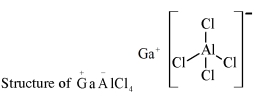
View full question & answer→MCQ 2011 Mark
Given below are two statements :
Statement $I$ : Boron is extremely hard indicating its high lattice energy
Statement $II$ : Boron has highest melting and boiling point compared to its other group members.
In the light of the above statements, choose the most appropriate answer from the options given below
- A
Statement $I$ is incorrect but Statement $II$ is correct
- ✓
Both Statement $I$ and Statement $II$ is correct
- C
Statement $I$ is correct but Statement $II$ is incorrect
- D
Both Statement $I$ and Statement $II$ is incorrect
AnswerCorrect option: B. Both Statement $I$ and Statement $II$ is correct
b
Boron is non- metallic in nature. It is extremely hard and black coloured solid. It exists in many allotropic forms. Due to very strong crystalline lattice, boron has unusually high melting point and boiling point.
| Element |
$B$ |
$Al$ |
$Ga$ |
$In$ |
$TI$ |
| Melting point |
$2453$ |
$933$ |
$303$ |
$430$ |
$576$ |
| Boiling point |
$3923$ |
$2740$ |
$2676$ |
$2353$ |
$1730$ |
View full question & answer→MCQ 2021 Mark
The incorrect statement from the following for borazine is:
- A
It has electronic delocalization
- B
It contains banana bonds.
- ✓
- D
Answerc
Borazine is $B _3 N _3 H _8$
$B _8 N _3 H _6+9 H _2 O \rightarrow 3 NH _3+3 H _8 BO _3+3 H _2$
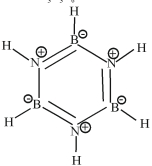
View full question & answer→MCQ 2031 Mark
$Be ( OH )_2$ react with $Sr ( OH )_2$ to yield an ionic salt. Choose the incorrect option related to this reaction from the following:
AnswerCorrect option: D. The elements $Be$ is present in the cationic part of the ionic salt.
d
$Be ( OH )_2$ is amphoteric in nature.
$Sr ( OH )_2$ is basic in nature.
These two undergo acid - base reaction to form a salt.
$Be ( OH )_2+ Sr ( OH )_2 \rightarrow Sr \left[ Be ( OH )_4\right]$
(salt)
View full question & answer→MCQ 2041 Mark
During water-gas shift reaction
- ✓
carbon monoxide is oxidized to carbon dioxide.
- B
carbon is oxidized to carbon monoxide.
- C
carbon dioxide is reduced to carbon monoxide.
- D
water is evaporated in presence of catalyst.
AnswerCorrect option: A. carbon monoxide is oxidized to carbon dioxide.
a

View full question & answer→MCQ 2051 Mark
Given below are two statements, one is labelled as Assertion $A$ and the other is labelled as Reason $R$
Assertion $A :$- Carbon forms two important oxides $- CO$ and $CO _2 . CO$ is neutral whereas $CO _2$ is acidic in nature.
Reason $R :$- $CO _2$ can combine with water in a limited way to form carbonic acid, while $CO$ is sparingly soluble in water.
In the light of the above statements, choose the most appropriate answer from the options given below :-
- A
Both $A$ and $R$ are correct but $R$ is NOT the correct explanation of $A$.
- ✓
Both $A$ and $R$ are correct and $R$ is the correct explanation of $A$.
- C
$A$ is not correct but $R$ is correct.
- D
$A$ is correct but $R$ is not correct.
AnswerCorrect option: B. Both $A$ and $R$ are correct and $R$ is the correct explanation of $A$.
b
The oxide which form acid on dissolving in water is acidic oxide.
View full question & answer→MCQ 2061 Mark
Given below are two statements:
Statement $I$ : Nickel is being used as the catalyst for producing syn gas and edible fats.
Statement $II$ : Silicon forms both electron rich and electron deficient hydrides.
In the light of the above statements, choose the most appropriate answer from the options given below:
- A
Both the statements $I$ and $II$ are correct
- B
Statement $I$ is incorrect but statement $II$ is correct
- C
Both the statements $I$ and $II$ are incorrect
- ✓
Statement $I$ is correct but statement $II$ is incorrect
AnswerCorrect option: D. Statement $I$ is correct but statement $II$ is incorrect
d
Statement- $I$ is correct.
$Ni$ is used in Hydrogenation of unsaturated fat to make edible fats.
Statements$-II$ is false as hydride of Silicon is electron precise and neither electron deficient nor electron rich.
View full question & answer→MCQ 2071 Mark
The correct order of bond enthalpy $\left( kJ\,mol ^{-1}\right)$ is :
- A
$Si - Si > C - C > Sn - Sn > Ge - Ge$
- B
$Si - Si > C - C > Ge - Ge > Sn - Sn$
- C
$C - C > Si - Si > Sn - Sn > Ge - Ge$
- ✓
$C - C > Si - Si > Ge - Ge > Sn - Sn$
AnswerCorrect option: D. $C - C > Si - Si > Ge - Ge > Sn - Sn$
d
(Bond enthalpy order $C - C > Si - Si > Ge - Ge > Sn - Sn )$
View full question & answer→MCQ 2081 Mark
During the borax bead test with $CuSO _4$, a blue green colour of the bead was observed in oxidising flame due to the formation of
AnswerCorrect option: C. $Cu \left( BO _2\right)_2$
c
Blue green colour is due to formation of $Cu \left( BO _2\right)_2$
$CuSO _4 \stackrel{\Delta}{\longrightarrow} CuO + SO _3$
$CuO + B _2 O _3 \rightarrow Cu \left( BO _2\right)_2$
View full question & answer→MCQ 2091 Mark
Given below are two statements:
Statement $I$ : The decrease in first ionization enthalpy from $B$ to $Al$ is much larger than that from $Al$ to $Ga$.
Statement $II$ : The d orbitals in Ga are completely filled.
In the light of the above statements, choose the most appropriate answer from the options given below
- A
Statement $I$ is incorrect but statement $II$ is correct.
- ✓
Both the statements $I$ and $II$ are correct
- C
Statement $I$ is correct but statement $II$ is incorrect
- D
Both the statements $I$ and $II$ are incorrect
AnswerCorrect option: B. Both the statements $I$ and $II$ are correct
b
The first ionization energies (as in NCERT) are as follows:
$B$ : $801\,kJ / mol$
$Al : 577\,kJ / mol$
Ga : $579\,kJ / mol$
$Ga :[ Ar ] 3 d ^{10} 4 s ^2 4 p ^1$
View full question & answer→MCQ 2101 Mark
Match List $I$ with List $II$
| List$I$ |
List$II$ |
| $A.$ Cobalt catalyst |
$I.$ $\left( H _2+ Cl _2\right)$ production |
| $B.$ Syngas |
$II.$ Water gas production |
| $C.$ Nickel catalyst |
$III.$ Coal gasification |
| $D.$ Brine solution |
$IV.$ Methanol production |
Choose the correct answer from the options given below :-
- A
$A-IV, B-I, C-II, D-III$
- B
$A-IV, B-III, C-I, D-II$
- C
$A-II, B-III, C-IV, D-I$
- ✓
$A-IV, B-III, C-II, D-I$
AnswerCorrect option: D. $A-IV, B-III, C-II, D-I$
d
Cobalt catalyst $\rightarrow$ Methanol production
Syn gas $\rightarrow$ Coal gasification
$\left( C _{\text {(Redhot coke) }}+ H _2 O ( g ) \rightarrow CO + H _2\right)$
Nickel catalyst $\rightarrow$ Water gas production
Brine solution $\rightarrow$ Production
(aq. $NaCl ) \quad\left(\begin{array}{l} H _2 \rightarrow \text { Cathode } \\ Cl _2 \rightarrow \text { anode }\end{array}\right)$
View full question & answer→MCQ 2111 Mark
For a good quality cement, the ratio of silica to alumina is found to be
Answera
For good quality cement, the ratio of silica $\left( SlO _2\right)$ to Alumina $\left( Al _2 O _3\right)$ should be between $2.5$ to $4$.
View full question & answer→MCQ 2121 Mark
Given below are two statements: one is labelled as Assertion $A$ and the other is labelled as Reason $R$.
Assertion $A$ : Boric acid is a weak acid
Reason $R$ : Boric acid is not able to release $H ^{+}$ion on its own. It receives $OH ^{-}$ion from water and releases $H ^{+}$ion.
In the light of the above statements, choose the most appropriate answer from the options given below.
- ✓
Both $A$ and $R$ are correct and $R$ is the correct explanation of $A$
- B
Both $A$ and $R$ are correct but $R$ is NOT the correct explanation of $A$
- C
$A$ is correct but $R$ is not correct
- D
$A$ is not correct but $R$ is correct
AnswerCorrect option: A. Both $A$ and $R$ are correct and $R$ is the correct explanation of $A$
a
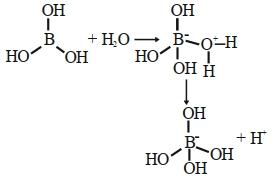
View full question & answer→MCQ 2131 Mark
When borax is heated with $CoO$ on a platinum loop, blue coloured bead formed is largely due to
AnswerCorrect option: B. $Co \left( BO _{2}\right)_{2}$
b
$Na _{2} B _{4} O _{7} \cdot 10 H _{2} O \stackrel{\Delta}{\longrightarrow} Na _{2} B _{4} O _{7}+10 H _{2} O$
$Na _{2} B _{4} O _{7} \stackrel{\Delta}{\longrightarrow} 2 NaBO _{2} \text { (sodium meta borate) }+ B _{2} O _{3}$
$B _{2} O _{3}+ CoO \rightarrow Co \left( BO _{2}\right)_{2} \text { (cobalt (II) meta borate) }$
$\quad\quad\quad\quad\quad\quad\quad$Blue Bead
View full question & answer→MCQ 2141 Mark
$BeCl _{2}$ reacts with $LiAlH _{4}$ to give ....
- A
$Be + Li \left[ AlCl _{4}\right]+ H _{2}$
- B
$Be + AlH _{3}+ LiCl + HCl$
- ✓
$BeH _{2}+ LiCl + AlCl _{3}$
- D
$BeH _{2}+ Li \left[ AlCl _{4}\right]$
AnswerCorrect option: C. $BeH _{2}+ LiCl + AlCl _{3}$
c
$2 BeCl _{2}+ LiAlH _{4} \rightarrow 2 BeH _{2}+ LiCl + AlCl _{3}$
This is the method to prepare $BeH _{2}$
View full question & answer→MCQ 2151 Mark
Match List$-I$ with List$-II$
|
List$-I$
(Si-Compounds)
|
List$-II$
(Si-Polymeric/other products)
|
| $(A)$ $\left( CH _{3}\right)_{4} Si$ |
$(I)$ Chain silicone |
| $(B)$ $\left( CH _{3}\right) Si ( OH )_{3}$ |
$(II)$ Dimeric silicone |
| $(C)$ $\left( CH _{3}\right)_{2} Si ( OH )_{2}$ |
$(III)$ Silane |
| $(D)$ $\left( CH _{3}\right)_{3} Si ( OH )$ |
$(IV)$ $2 D$ - Silicone |
Choose the correct answer from the options given below
- A
$(A) - (III), (B) - (II), (C) - (I), (D) - (IV)$
- B
$(A) - (IV), (B) - (I), (C) - (II), (D) - (III)$
- C
$(A) - (II), (B) - (I), (C) - (IV), (D) - (III)$
- ✓
$(A) - (III), (B) - (IV), (C) - (I), (D) - (II)$
AnswerCorrect option: D. $(A) - (III), (B) - (IV), (C) - (I), (D) - (II)$
d
$\left( CH _{3}\right)_{4} Si$ is a silane
$\left( CH _{3}\right) Si ( OH )_{3}$ polymerise to form 2D silicone
$\left( CH _{3}\right)_{2} Si ( OH )_{2}$ polymerise to form chain silicone
$\left( CH _{3}\right)_{3} Si ( OH )$ form dimer $\left( CH _{3}\right)_{3} Si - O - Si \left( CH _{3}\right)_{3}$
View full question & answer→MCQ 2161 Mark
Given are two statements one is labelled as Assertion $A$ and other is labelled as Reason $R$.
Assertion $A$ :Magnesium can reduce $Al _{2} O _{3}$ at a temperature below $1350^{\circ} C$, while above $1350^{\circ} C$ aluminium can reduce $MgO$.
Reason $R$ : The melting and boiling points of magnesium are lower than those of aluminium.
In light of the above statements. choose most appropriate answer from the options given below
- A
Both $A$ and $R$ are correct. and $R$ is correct explanation of $A$.
- ✓
Both $A$ and $R$ are correct. but $R$ is NOT the correct explanation of $A$.
- C
$A$ is correct $R$ is not correct.
- D
$A$ is not correct. $R$ is correct.
AnswerCorrect option: B. Both $A$ and $R$ are correct. but $R$ is NOT the correct explanation of $A$.
b
From Ellingham diagram given in NCERT, it can be seen that $Mg , MgO$ line crosses $Al , Al _{2} O _{3}$ line after $1350^{\circ} C$ hence assertion is true.
Yes, Mg have lower MP and BP than aluminium but it does not explain the above fact.
View full question & answer→MCQ 2171 Mark
The geometry around boron in the product ' $B$ ' formed from the following reaction is
$BF _{3}+ NaH \stackrel{450 K }{\longrightarrow} A + NaF$
$A + NMe _{3} \rightarrow B$
Answerb
$BH _{3}+ NaH \stackrel{450 K }{\longrightarrow} \underset{\text { (diborane) }}{ B _{2} H _{6}+ NaF }$
$B _{2} H _{6}+ NMe _{3} \longrightarrow 2\left[ BH _{3} \leftarrow NMe _{3}\right]$
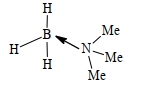
View full question & answer→MCQ 2181 Mark
Borazine, also known as inorganic benzene, can be prepared by the reaction of $3-equivalents$ of " $X$ " with $6-equivalents$ of "$Y$"."$X$" and "$Y$", respectively are.
- A
$B ( OH )_{3}$ and $NH _{3}$
- ✓
$B _{2} H _{6}$ and $NH _{3}$
- C
$B _{2} H _{6}$ and $HN _{3}$
- D
$NH _{3}$ and $B _{2} O _{3}$
AnswerCorrect option: B. $B _{2} H _{6}$ and $NH _{3}$
b
$3 B _{2} H _{6}+6 NH _{3} \stackrel{\Delta}{\longrightarrow} 2 B _{3} N _{3} H _{6}+12 H _{2}$
View full question & answer→MCQ 2191 Mark
Identify the correct statement for $B _{2} H _{6}$ from those given below.
$(A)$ In $B _{2} H _{6}$, all $B - H$ bonds are equivalent.
$(B)$ In $B _{2} H _{6}$ there are four $3-$centre$-2-$electron bonds.
$(C)$ $B _{2} H _{6}$ is a Lewis acid.
$(D)$ $B _{2} H _{6}$ can be synthesized form both $BF _{3}$ and $NaBH _{4}$.
$(E)$ $B _{2} H _{6}$ is a planar molecule.
Choose the most appropriate answer from the options given below..... .
AnswerCorrect option: C. $(C)$ and $(D)$ only
c
$(A)\, (B)$ Two $3$ centre $-2$-electron bonds
$(C)$ $B _{2} H _{6}$ is $e ^{-}$deficient species
$(E)$ $B _{2} H _{6}$ is non - Planar molecule
$(D)$ $BF _{3}+ LiAlH _{4} \rightarrow 2 B _{2} H _{6}+3 LiF +3 AlF _{3}$
$NaBH _{4}+ I _{2} \rightarrow B _{2} H _{6}+2 NaI + H _{2}$

View full question & answer→MCQ 2201 Mark
Given below are two statements: one is labelled as Assertion $(A)$ and the other is labelled as Reason $(R)$
Assertion $(A)$ : Boron is unable to form $BF _{6}^{3-}$
Reason $(R)$ : Size of $B$ is very small.
In the light of the above statements, choose the correct answer from the options given below.
- A
Both $(A)$ and $(R)$ are true and $(R)$ is the correct explanation of $(A)$
- ✓
Both $(A)$ and $(R)$ are true but $(R)$ is not the correct explanation of $(A)$
- C
$(A)$ is true but $(R)$ is false
- D
$(A)$ is false but $(R)$ is true
AnswerCorrect option: B. Both $(A)$ and $(R)$ are true but $(R)$ is not the correct explanation of $(A)$
b
Assertion $(A)$: True
Reason $(R)$: True but not correct explanation.
Correct explanation: Expansion of octet not possible for '$B$'.
View full question & answer→MCQ 2211 Mark
Which one of the following compounds of Group$-14$ elements is not known?
- A
$\left[\mathrm{GeCl}_{6}\right]^{2-}$
- ✓
$\left[\mathrm{SiCl}_{6}\right]^{2-}$
- C
$\left[\mathrm{Sn}(\mathrm{OH})_{6}\right]^{2-}$
- D
$\left[\mathrm{SiF}_{6}\right]^{2-}$
AnswerCorrect option: B. $\left[\mathrm{SiCl}_{6}\right]^{2-}$
b
$\left[\mathrm{SiCl}_{6}\right]^{2-}$ does not exist due to steric crowding of surrounding atoms.
View full question & answer→MCQ 2221 Mark
Outermost electronic configuration of a group $13$ element, $E$, is $4 \,\mathrm{~s}^{2}, 4 p^{1}$. The electronic configuration of an element of $p$-block period-five placed diagonally to element, $E$ is :
- A
$[\mathrm{Xe}]{5} \mathrm{~d}^{10} 6 \mathrm{~s}^{2} 6 \mathrm{p}^{2}$
- ✓
$[\mathrm{Kr}] 4 \mathrm{~d}^{10} 5 \mathrm{~s}^{2} 5 \mathrm{p}^{2}$
- C
$[\mathrm{Kr}] 3 \mathrm{~d}^{10} 4 \mathrm{~s}^{2} 4 \mathrm{p}^{2}$
- D
$ [Ar]$ $3 d^{10} 4 s^{2} 4 p^{2}$
AnswerCorrect option: B. $[\mathrm{Kr}] 4 \mathrm{~d}^{10} 5 \mathrm{~s}^{2} 5 \mathrm{p}^{2}$
b
The element $\mathrm{E}$ is $\mathrm{Ga}$ and the diagonal element of $5^{\mathrm{th}}$ period is ${ }_{50} \mathrm{Sn}$ having outer electronic configuration will be $[\mathrm{Kr}] \,5 \mathrm{~s}^{2} \,4 \mathrm{~d}^{10}\, 5 \mathrm{p}^{2}$.
View full question & answer→MCQ 2231 Mark
Given below are the statements about diborane.
$(a)$ Diborane is prepared by the oxidation of $\mathrm{NaBH}_{4}$ with $\mathrm{I}_{2}$.
$(b)$ Each boron atom is in sp $^{2}$ hybridized state.
$(c)$ Diborane has one bridged $3$ centre$-2-$electron bond.
$(d)$ Diborane is a planar molecule.
The option with correct statement(s) is :
- A
$(c)$ and $(d)$ only
- B
$(c)$ only
- ✓
$(a)$ only
- D
$(a)$ and $(b)$ only
AnswerCorrect option: C. $(a)$ only
c
Diborane is prepared by the reaction of $\mathrm{NaBH}_{4}$ with $\mathrm{I}_{2}$.
$2 \mathrm{NaBH}_{4}+\mathrm{I}_{2} \rightarrow \mathrm{B}_{2} \mathrm{H}_{6}+2 \mathrm{NaI}+\mathrm{H}_{2}$
In diborane, ' $B^{\prime}$ is $\mathrm{sp}^{3}$ hybrid, it is Non-planar and two $3 \mathrm{c}-2 \mathrm{e}^{-}$bonds are present.
View full question & answer→MCQ 2241 Mark
Match List$-I$ with List$-II :$
| List$-I$ |
List$-II$ |
| $(a)$ $\mathrm{NaOH}$ |
$(i)$ Acidic |
| $(b)$ $\mathrm{Be}(\mathrm{OH})_{2}$ |
$(ii)$ Basic |
| $(c)$ $\mathrm{Ca}(\mathrm{OH})_{2}$ |
$(iii)$ Amphoteric
|
| $(d)$ $\mathrm{B}(\mathrm{OH})_{3}$ |
|
| $(e)$ $\mathrm{Al}(\mathrm{OH})_{3}$ |
|
Choose the most appropriate answer from the option given below :
- A
$(a)-(ii), (b)-(ii), (c)-(iii), (d)-(ii), (e)-(iii)$
- ✓
$(a)-(ii), (b)-(iii), (c)-(ii), (d)-(i), (e)-(iii)$
- C
$(a)-(ii), (b)-(ii), (c)-(iii), (d)-(i), (e)-(iii)$
- D
$(a)-(ii), (b)-(i), (c)-(ii), (d)-(iii), (e)-(iii)$
AnswerCorrect option: B. $(a)-(ii), (b)-(iii), (c)-(ii), (d)-(i), (e)-(iii)$
b
$\mathrm{NaOH} \longrightarrow$ Basic
$\mathrm{Be}(\mathrm{OH})_{2} \longrightarrow$ Amphoteric
$\mathrm{Ca}(\mathrm{OH})_{2} \longrightarrow$ Basic
$\mathrm{B}(\mathrm{OH})_{3} \longrightarrow$ Acidic
$\mathrm{Al}(\mathrm{OH})_{3} \longrightarrow$ Amphoteric
View full question & answer→MCQ 2251 Mark
$'X'$ melts at low temperature and is a bad conductor of electricity in both liquid and solid state. $X$ is
Answera
$CCl_4$ is molecular solid so does not conduct electricity in liquid and solid state.
View full question & answer→MCQ 2261 Mark
The reaction of $\mathrm{H}_{3} \mathrm{N}_{3} \mathrm{B}_{3} \mathrm{Cl}_{3}$ $(A)$ with $\mathrm{LiBH}_{4}$ in tetrahydrofurane gives inorganic benzene $(B)$. Further, the reaction of $(A)$ with $(C)$ leads to $\mathrm{H}_{3} \mathrm{N}_{3} \mathrm{B}_{3}(\mathrm{Me})_{3}$. than Compounds $(\mathrm{B})$ and $(\mathrm{C})$ respectively, are
- A
Boron nitride and $MeBr$
- ✓
Borazine and $MeMgBr$
- C
Borazine and $MeBr$
- D
Diborane and $MeMgBr$
AnswerCorrect option: B. Borazine and $MeMgBr$
b
$\mathrm{H}_{3} \mathrm{N}_{3} \mathrm{B}_{3} \mathrm{Cl}_{3} (A)+3 \mathrm{LiBH}_{4} \xrightarrow [(T.H.F.)]{\text { In terahydrofurane }} $$\mathrm{H}_{3} \mathrm{N}_{3} \mathrm{B}_{3} \mathrm{H}_{3}(B)+3LiCl+3BH_3THF$
$\mathrm{H}_{3} \mathrm{N}_{3} \mathrm{B}_{3} \mathrm{Cl}_{3}(A)+3 MeMgBr(C)\rightarrow$$ \mathrm{H}_{3} \mathrm{N}_{3} \mathrm{B}_{3} \mathrm{(CH_3)}_{3}+3MgBrCl$
View full question & answer→MCQ 2271 Mark
The correct statements among $I$ to $III$ regarding group $13$ element oxides are,
$I$. Boron trioxide is acidic
$II$. Oxides of aluminium and gallium are amphoteric
$III$. Oxides of indium and thallium are basic
- ✓
$I, II$ and $III$
- B
$II$ and $III$ only
- C
$I$ and $III$ only
- D
$I$ and $II$ only
AnswerCorrect option: A. $I, II$ and $III$
a
$B_2O_3$ is acidic in nature
$Al_2O_3$ and $Ga_2O_3$ are amphoteric
Oxides of $In$ and $Tl$ are basic in nature. Because the metallic character of the elements increases on moving down the group.
View full question & answer→MCQ 2281 Mark
The electronegativity of aluminium is similar to
MCQ 2291 Mark
The number of $2-$ centre $-2-$ electron and $3-$ centre $-2-$ electron bonds in $B_2H_6$, respectively, are
- A
$2$ and $1$
- ✓
$4$ and $2$
- C
$2$ and $2$
- D
$2$ and $4$
AnswerCorrect option: B. $4$ and $2$
b
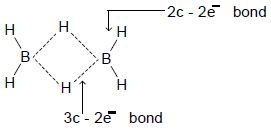
View full question & answer→MCQ 2301 Mark
Diborane $(B_2H_6)$ reacts independently with $O_2$ and $H_2O$ to produce, respectively
- A
$H_3BO_3$ and $B_2O_3$
- ✓
$B_2O_3$ and $H_3BO_3$
- C
$HBO_2$ and $H_3BO_3$
- D
$B_2O_3$ and $[BH_4]^-$
AnswerCorrect option: B. $B_2O_3$ and $H_3BO_3$
b
$B_2H_6 + 3H_2O \longrightarrow 2H_3BO_3 + 3H_2$
$B_2H_6 + 3O_2 \longrightarrow B_2O_3 + 3H_2O$
View full question & answer→MCQ 2311 Mark
Correct statements among $i$ to $iv$ regarding silicones are
$(i)$ they are polymers with hydrophobic character
$(ii)$ they are biocompatible
$(iii)$ in general, they have high thermal stability and low dielectric strength
$(iv)$ usually they are resistant to oxidation and used as greases.
AnswerCorrect option: D. $(i), (ii)$ and $(iv)$
d
Silicones are polymers and hydrophobic due to presence of alkyl groups. They are used as greases as some of them are cyclic
View full question & answer→MCQ 2321 Mark
The chloride that can not get hydrolysed is
- A
$PbCl_4$
- ✓
$CCl_4$
- C
$SnCl_4$
- D
$SiCl_4$
AnswerCorrect option: B. $CCl_4$
b
Central atom has no vacant orbital.
View full question & answer→MCQ 2331 Mark
The element that does $NOT$ show catenation is
Answerd
Due to the lowest bond energy of $Pb -Pb$ bond.
View full question & answer→MCQ 2341 Mark
$C_{60},$ an allotrope of carbon contains
- ✓
$20$ hexagons and $12$ pentagons.
- B
$12$ hexagons and $20$ pentagons
- C
$18$ hexagons and $14$ pentagons
- D
$16$ hexagons and $16$ pentagons
AnswerCorrect option: A. $20$ hexagons and $12$ pentagons.
a
In $\;{C_{60 < {\rm{ }}Vsub{\rm{ }} > }}$ molecule there are $20$ hexagons and $12$ pentagons $\therefore$ Ans.$(1)$
View full question & answer→MCQ 2351 Mark
The amorphous form of silica is
Answerb
Kieselguhr is amorphous form of silica
View full question & answer→MCQ 2361 Mark
The correct order of catenation is
- A
$C > Sn > Si \approx Ge$
- B
$Ge > Sn > Si > C$
- C
$Si > Sn > C > Ge$
- ✓
$C > Si > Ge \approx Sn$
AnswerCorrect option: D. $C > Si > Ge \approx Sn$
d
In this order of catenation is asked. Catenation is a self-linking property here and for group $14$ : Self-linking is through covalent bonding $C > Si > Ge \approx Sn$ In $C$ there is $2p -2p$ overlapping further $3p -3p, 4p-4p$ and so on and the extent of overlapping is more in $2p-2p > 3p-3p > 4p-4p \approx 5p-5p$
View full question & answer→MCQ 2371 Mark
The basic structural unit of feldspar, zeolites, mica and asbestos is
- A
$\begin{array}{*{20}{c}}
{R\,\,\,\,\,\,\,\,\,\,} \\
{|\,\,\,\,\,\,\,\,\,\,} \\
{{{[ - Si - O - ]}_n}} \\
{|\,\,\,\,\,\,\,\,\,\,} \\
{R\,\,\,\,\,\,\,\,\,\,}
\end{array}$ $(R = Me)$
- B
${\left( {Si{O_3}} \right)^{2 - }}$
- C
${Si{O_2}}$
- ✓
${\left( {Si{O_4}} \right)^{4 - }}$
AnswerCorrect option: D. ${\left( {Si{O_4}} \right)^{4 - }}$
d
Basic unit is silicat ${\left( {Si{O_4}} \right)^{4 - }}$
View full question & answer→MCQ 2381 Mark
The $C-C$ bond length is maximum in
Answerc
Since carbon in diamond is $sp^3$ hybridized and its $C -C$ bond order is $1$. In graphite and fullerene there is both $C -C$ and $C = C$ in conjugation, hence there is partial double bond character between carbon atoms
View full question & answer→MCQ 2391 Mark
Lithium aluminium hydride reacts with silicon tetrachloride to form
- A
$LiCl,AlH_3$ and $SiH_4$
- ✓
$LiCl, AlCl_3$ and $SiH_4$
- C
$LiH,AlCl_3$ and $SiCl_2$
- D
$LiH, AlH_3$ and $SiH_4$
AnswerCorrect option: B. $LiCl, AlCl_3$ and $SiH_4$
b
$SiCl_4 + LiAlH_4\to LiCl + AlCl_3 + SiH_4$
View full question & answer→MCQ 2401 Mark
A group $13$ element $'X'$ reacts with chlorine gas to produce a compound $XCl_3. XCl_3$ is electron deficient and easily reacts with $NH_3$ to form $Cl_3X \leftarrow NH_3$ adduct, however, $XCl_3$ does not dimerize. $X$ is
Answera
$BCl_3$
$B+C{{l}_{2}}\to \underset{\begin{smallmatrix}
[does\,not\,dimerise\,due\,to\, \\
(p\pi -p\pi )back\,bonding]
\end{smallmatrix}}{\mathop{BC{{l}_{3}}}}\,\xrightarrow{N{{H}_{3}}}$
$BCl_3$ is electron deficient but it does not form dimer like $Al,Ga$ or $In$ because its electron deficiency is complemented by the formation of co-ordinate bond between lone pair of electron of chlorine and empty unhybridized $p-$ orbital of boron forming $p\pi -p\pi$ bonding.
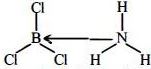
View full question & answer→MCQ 2411 Mark
In graphite and diamond, the percentage of $p-$ characters of the hybrid orbitals in hybridisation are respectively
- A
$33$ and $25$
- ✓
$67$ and $75$
- C
$50$ and $75$
- D
$33$ and $75$
AnswerCorrect option: B. $67$ and $75$
b
$\%$ of $p-$ in graphite ${(sp)^2} = \frac{2}{3} \times 100 = 67\% $
$\%$ of $p-$ in diamond ${(sp)^3} = \frac{3}{4} \times 100 = 75\% $
View full question & answer→MCQ 2421 Mark
Which one of the following is an oxide ?
- A
$KO_2$
- B
$BaO_2$
- ✓
$SiO_2$
- D
$CsO_2$
AnswerCorrect option: C. $SiO_2$
c
Compound nature
$KO_2$ Superoxide
$BaO_2$ Peroxide
$SiO_2$ Oxide
$CsO_2$ Superoxide
View full question & answer→MCQ 2431 Mark
Identify the reaction which does not liberate hydrogen
AnswerCorrect option: A. Reaction of lithium hydride with $B_2H_6$
a
Lithium hydride react with diborane to produce lithiumborohydride
$2LiH + B_2H_6 \longrightarrow 2Li[BH_4]$
View full question & answer→MCQ 2441 Mark
Match the items in Column $I$ with its main use listed in Column $II$
| Column $I$ |
Column $II$ |
| $(A)$ Silica gel |
$(i)$ Transistor |
| $(B)$ Silicon |
$(ii)$ Ion-exchanger |
| $(C)$ Silicone |
$(iii)$ Drying agent |
| $(D)$ Silicate |
$(iv)$ Sealant |
- ✓
$(A) - (iii), (B) - (i), (C) - (iv), (D) - (ii)$
- B
$(A) - (iv), (B) - (i), (C) - (ii), (D) - (iii)$
- C
$(A) - (ii), (B) - (i), (C) - (iv), (D) - (iii)$
- D
$(A) - (ii), (B) - (iv), (C) - (i), (D) - (iii)$
AnswerCorrect option: A. $(A) - (iii), (B) - (i), (C) - (iv), (D) - (ii)$
a
$A - $ Silica gel packets are used to absorb moisture and keep things dry $i.e.$ as drying agent.
$B -$ Silicon is a semiconductor and is used in transistors.
$C -$ Silicone is used as sealant.
$D -$ Silicates are widely used in ion-exchange beds in domestic and commercial water purification, softening, and other applications
View full question & answer→MCQ 2451 Mark
The bond angle $H-X-H$ is the greatest in the compound
- A
$PH_3$
- ✓
$CH_4$
- C
$NH_3$
- D
$H_2O$
AnswerCorrect option: B. $CH_4$
b
More the number of lone pairs on central atom, the greater is the contraction caused in the angle between bond pairs. In $PH_3$ the bond pairs of electrons are so much farther away from the central atom due to larger size. Thus the lone pair cause greater distortion in $PH_3$ . Hence the bond angle decreases to $98^o$ .
View full question & answer→MCQ 2461 Mark
Example of a three-dimensional silicate is
Answerc
The feldspars are most abundant aluminosilicate minerals in the Earth surface. The silicon atoms and aluminium atoms occupy the centres of interlinked tetrahedra of $SiO_4^{-4}$ and $AlO_4^{-5}$ . These tetrahedra connect at each corner to other tetrahedra forming an intricate, three dimesional, negatively charged framework. The sodium cations sit within the voids in this structure
View full question & answer→MCQ 2471 Mark
In the following sets of reactants which two sets best exhibit the amphoteric characters of $Al_2O_3. xH_2O$ ?
Set $1$: $Al_2O_3 .xH_2O\, (s)$ and $OH^-(aq)$
Set $2$: $Al_2O_3 .xH_2O\, (s)$ and $H_2O\,(l)$
Set $3$: $Al_2O_3 .xH_2O\, (s)$ and $H^+(aq)$
Set $4$: $Al_2O_3 .xH_2O\, (s)$ and $NH_3(aq)$
- A
$1$ and $2$
- ✓
$1$ and $3$
- C
$2$ and $4$
- D
$3$ and $4$
AnswerCorrect option: B. $1$ and $3$
b
Aluminium oxide is amphoteric oxide because it shows the properties of the both acidic and basic oxides . It reacts with both acids and bases to form salt and water.
$Al_2O_3 . xH_2O + 2NaOH \longrightarrow NaAlO_2 +H_2O$
$Al_2O_3 . xH_2O+HCl \longrightarrow AlCl_3 + H_2O$
View full question & answer→MCQ 2481 Mark
The gas evolved on heating $CaF_2$ and $SiO_2$ with concentrated $H_2SO_4$, on hydrolysis gives a white gelatinous precipitate. The precipitate is
Answerd
$2CaF_2 + SiO_2 + H_2SO_4\, \longrightarrow$
$Si{F_4} + {H_2}O + CaS{O_4}\xrightarrow{{hydrolysis}}CaSi{F_6}$
View full question & answer→MCQ 2491 Mark
Identify the incorrect statement
- A
In $(Si_3O_9)^{6-}$, tetrahedral $SiO_4$ units share two oxygen atoms
- ✓
Trialkylchlorosilane on hydrolysis gives $R_3SiOH$.
- C
$SiCl_4$ undergoes hydrolysis to give $H_4SiO_4$
- D
$(Si_3O_9)^{6-}$ has cyclic structure.
AnswerCorrect option: B. Trialkylchlorosilane on hydrolysis gives $R_3SiOH$.
b
The hydrolysis of Trialkylchlorosilane $R_3SiCl$ yields dimer :
$\begin{matrix}
\,\,\,R\,\,\,\,\,\,\,\,\,\,\,\,\,\,\,\,\,R\, \\
\,|\,\,\,\,\,\,\,\,\,\,\,\,\,\,\,\,\,\,\,\,|\, \\
R-Si-O-Si-R \\
|\,\,\,\,\,\,\,\,\,\,\,\,\,\,\,\,\,\,\,\,\,| \\
R\,\,\,\,\,\,\,\,\,\,\,\,\,\,\,\,\,R \\
\end{matrix}$
View full question & answer→MCQ 2501 Mark
The compound($s$) which react($s$) with $NH _3$ to give boron nitride ($BN$) is(are)
$(A)$ $B$ $(B)$ $B _2 H _6$ $(C)$ $B _2 O _3$ $(D)$ $HBF _4$
Answerb
$(A)$ $2 B +2 NH _3 \rightarrow 2 BN +3 H _2$
Boron produced BN with ammonia but Boron is element not compound. So that this option not involve in answer.
$(B) 3$
$3 B _2 H _6+6 NH _3 \rightarrow 3\left[ BH _2\left( NH _3\right)_2\right]^{+}\left[ BH _4^{-}\right] \xrightarrow{ T =200^{\circ} C } 2 B _3 N _3 H _6+12 H _2$
$B _3 N _3 H _6 \xrightarrow{ T >200^{\circ} C }( BN )_{ z }$
$(C)$ $B _2 O _3(\ell)+2 NH _3 \xrightarrow{1200^{\circ} C } 2 BN _{( s )}+3 H _2 O _{( g )}$
$(D)$ $HBF _4+ NH _3 \rightarrow NH _4\left[ BF _4\right]$
View full question & answer→MCQ 2511 Mark
The treatment of galena with $HNO _3$ produces a gas that is
$(A)$ paramagnetic $(B)$ bent in geometry $(C)$ an acidic oxide $(D)$ colorless
- A
$A,B$
- B
$A,C$
- ✓
$A,D$
- D
$A,B,C$
Answerc
$3 PbS +8 HNO _3 \rightarrow 3 Pb \left( NO _3\right)_2+2 NO +4 H _2 O + S$
NO $\Rightarrow$ Neutral oxide, Paramagnetic, Linear geometry, Colourless gas
View full question & answer→MCQ 2521 Mark
The reaction $Pb \left( NO _3\right)_2$ and $NaCl$ in water produces a precipitate that dissolves upon the addition of $HCl$ of appropriate concentration. The dissolution of the precipitate is due to the formation of
AnswerCorrect option: C. $\left[ PbCl _4\right]^{2-}$
c
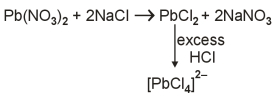
View full question & answer→MCQ 2531 Mark
The electrochemical extraction of aluminum from bauxite ore involves.
$(A)$ the reaction of $Al _2 O _3$ with coke ($C$) at a temperature $>2500^{\circ} C$.
$(B)$ the neutralization of aluminate solution by passing $CO _2$ gas to precipitate hydrated alumina $\left( Al _2 O _3 .3 H _2 O \right)$
$(C)$ the dissolution of $Al _2 O _3$ in hot aqueous $NaOH$.
$(D)$ the electrolysis of $Al _2 O _3$ mixed with $Na _3 AlF _6$ to give $Al$ and $CO _2$.
- A
$A,B,C$
- ✓
$B,C,D$
- C
$A,B$
- D
$A,C$
AnswerCorrect option: B. $B,C,D$
b
$(A)$ Electrochemical extraction of Aluminum from bauxite done below $2500^{\circ} C$
$(B)$ $2 Na \left[ Al ( OH )_4\right]_{\text {aq. }}+2 CO _{2( g )} \rightarrow Al _2 O _3 \cdot 3 H _2 O _{( s )} \downarrow+2 NaHCO _{3( aq .)}$
The sodium aluminate present in solution is neutralised by passing $CO _2$ gas and hydrated $Al _2 O _3$ is precipitated.
$(C)$ $Al _2 O _{3( s )}+2 NaOH _{( aq .)}+3 H _2 O _{(\ell} \rightarrow 2 Na \left[ Al ( OH )_4\right]_{ aq }$.
Concentration of bauxite is carried out by heating the powdered ore with hot concentrated solution of $NaOH$
$(D)$ In metallurgy of aluminum, $Al _2 O _3$ is mixed with $Na _3 AlF _6$
View full question & answer→MCQ 2541 Mark
The correct option($s$) related to the extraction of iron from its ore in the blast furnace operating in the temperature range $900-1500 K$ is(are)
$(A)$ Limestone is used to remove silicate impurity.
$(B)$ Pig iron obtained from blast furnace contains about $4 \%$ carbon.
$(C)$ Coke $(C)$ converts $CO _2$ to $CO$.
$(D)$ Exhaust gases consist of $NO _2$ and $CO$.
- A
$A,B,D$
- B
$A,B$
- ✓
$A,B,C$
- D
$A,B$
AnswerCorrect option: C. $A,B,C$
c
$(A)$ $CaO + SiO _2 \rightarrow CaSiO _3$ (in the temperature range $900-1500 K$ )
$(B)$ In fusion zone molten iron becomes heavy by absorbing elemental impurities and produces Pig iron. (in the temperature range $900-1500 K$ )
$(C)$ $C + CO _2 \rightarrow 2 CO$ (in the temperature range $900-1500 K$ )
$(D)$ Exhaust gases does not contain $NO _2$.
View full question & answer→MCQ 2551 Mark
Which among the following statement(s) is(are) true for the extraction of aluminium from bauxite?
$(A)$ Hydrated $Al _2 O _3$ precipitates, when $CO _2$ is bubbled through a solution of sodium aluminate.
$(B)$ Addition of $Na _3 AlF _6$ lowers the melting point of alumina.
$(C)$ $CO _2$ is evolved at the anode during electrolysis.
$(D)$ The cathode is a steel vessel with a lining of carbon.
- A
$A,B,C$
- ✓
$A,B,C,D$
- C
$A,B$
- D
$A,C$
AnswerCorrect option: B. $A,B,C,D$
b
$(A)$ $2 Na \left[ Al ( OH )_4\right]_{( aq .)}+ CO _2 \longrightarrow Na _2 CO _3+ H _2 O +2 Al ( OH )_3(\downarrow)$
or
$Al _2 O _3 .2 H _2 O \text { (ppt) }$
$(B)$ Function of $Na _3 AlF _6$ is to lower the melting point of electrolyte.
$(C)$ During electrolysis of $Al _2 O _3$, the reactions at anode are :
${\left[2 Al ^{3+}(\ell)+3 O ^{2-}(\ell) \xrightarrow{\text { At mode }} O _2( gas )+2 e ^{-}\right]}$
$C \text { (graphite })+ O _2 \longrightarrow CO (\uparrow)+ CO _2(\uparrow)$
$(D)$ The steel vessel with a lining of carbon acts as cathode.
View full question & answer→MCQ 2561 Mark
Choose the correct statement($s$) among the following.
$(A)$ $SnCl _2 \cdot 2 H _2 O$ is a reducing agent.
$(B)$ $SnO _2$ reacts with $KOH$ to form $K _2\left[ Sn ( OH )_6\right]$.
$(C)$ A solution of $PbCl _2$ in $HCl$ contains $Pb ^{2+}$ and $Cl ^{-}$ions.
$(D)$ The reaction of $Pb _3 O _4$ with hot dilute nitric acid to give $PbO _2$ is a redoxreaction.
- A
$A,C$
- B
$A,D$
- ✓
$A,B$
- D
$A,B,C$
Answerc
$(A)$ $SnCl _2 \cdot 2 H _2 O$ is a reducing agent since $Sn ^{2+}$ tends to convert into $Sn ^{4+}$.
$(B)$ $\underset{\text { (Anghoteric) }}{ SnO _2}+\underset{\text { (Base) }}{2 KOH _{(\text {aq. })}}+2 H _2 O \longrightarrow K _2\left[ Sn ( OH )_6\right]$
$(C)$ First group cations $\left( Pb ^{2+}\right)$ form insoluble chloride with $HCl$ that is $PbCl _2$ however it is slightly soluble in water and therefore lead +2 ion is never completely precipitated on adding hydrochloric acid in test sample of $Pb ^{2+}$, rest of the $Pb ^{2+}$ ions are quantitatively precipitated with $H _2 S$ in acidic medium.
So that we can say that filtrate of first group contain solution of $PbCl _2$ in $HCl$ which contains $Pb ^{2+}$ and $Cl ^{-}$
However in the presence of conc. $HCl$ or excess $HCl$ it can produce $H _2\left[ PbCl _4\right]$
So, we can conclude A, B or A,B,C should be answers.
$(D)$ $\underset{\substack{(2 PbO \\ \text { (nixure of of o.ddes) }}}{ Pb _3 O _4}+4 HNO _3 \longrightarrow PbO _2(\downarrow)+2 Pb \left( NO _3\right)_2+2 H _2 O$
It is not a redox reaction.
View full question & answer→MCQ 2571 Mark
The green colour produced in the borax bead test of a chromium$(III)$ salt is due to formation of______:
AnswerCorrect option: A. $Cr \left( BO _2\right)_3$
a
Chromium $(III) salt \xrightarrow{\Delta} Cr _2 O _3$
Borax $\xrightarrow{\Delta} B _2 O _3+ NaBO _2$
$2 Cr _2 O _3+6 B _2 O _3 \longrightarrow 4 Cr \left( BO _2\right)_3$
So correct answer is option$(1)$
View full question & answer→MCQ 2581 Mark
Among the following, the correct statement(s) is(are)
$[A]$ $\mathrm{A} 1\left(\mathrm{CH}_3\right)_3$ has the three-centre two-electron bonds in its dimeric structure
$[B]$ $\mathrm{BH}_3$ has the three-centre two-electron bonds in its dimeric structure
$[\mathrm{C}] \mathrm{AlCl}_3$ has the three-centre two-electron bonds in its dimeric structure
$[D]$ The Lewis acidity of $\mathrm{BCl}_5$ is greater than that of $\mathrm{AlCl}_5$
- A
$A,B,C$
- ✓
$A,B,D$
- C
$A,B$
- D
$A,C$
AnswerCorrect option: B. $A,B,D$
b
Both $\mathrm{Al}\left(\mathrm{CH}_3\right)_3$ and $\mathrm{BH}_3$ has $3 \mathrm{c}-2 \mathrm{e}$ bonds in the dimeric structure.
$\mathrm{BCl}_3$ is stronger Lewis acid than $\mathrm{AlCl}_3$.
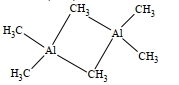
View full question & answer→MCQ 2591 Mark
The crystalline form of borax has
($A$) tetranuclear $\left[\mathrm{B}_4 \mathrm{O}_5(\mathrm{OH})_4\right]^{2-}$ unit
($B$) all boron atoms in the same plane
($C$) equal number of $s p^2$ and $s p^3$ hybridized boron atoms
($D$) one terminal hydroxide per boron atom
- A
$C,D$
- B
$A,C$
- C
$A,C,B$
- ✓
$A,C,D$
AnswerCorrect option: D. $A,C,D$
d
The correct options are
$A$ Tetranuclear $\left[ B _4 O _5( OH )_4\right]^{2-}$ unit
$C$ Equal number of $sp ^2$ and $sp ^3$ hybridized boron atoms
$D$ One terminal hydroxide per boron atom
Correct formula of borax is $Na _2\left[B_4 O _5( OH )_4\right] \cdot 8 H _2 O$.
Borax has tetranuclear. $\left[ B _4 O _5( OH )_4\right]^{2-}$ unit.
Only two $B$ atom lies in the same plane.
Two Boron are $sp ^2 \&$ two are $sp ^3$ hybridised.
One terminal hydroxide is present per boron atom.
Hence, options $A, C$ and $D$ are correct.
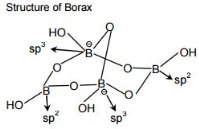
View full question & answer→MCQ 2601 Mark
Three moles of $B _2 H _6$ are completely reacted with methanol. The number of moles of boron containing product formed is
Answerb
$B _2 H _6+6 MeOH \longrightarrow 2 B ( OMe )_3+6 H _2$
$1$ mole of $B _2 H _6$ reacts with $6$ mole of $MeOH$ to give $2$ moles of $B ( OMe )$. $3$ mole of $B _2 H _6$ will react with $18$ mole of $MeOH$ to give $6$ moles of $B ( OMe ) 3$
View full question & answer→MCQ 2611 Mark
Under hydrolytic conditions, the compounds used for preparation of linear polymer and for chain termination, respectively, are
- A
$CH _3 SiCl _3$ and $Si \left( CH _3\right)_4$
- ✓
$\left( CH _3\right)_2 SiCl _2$ and $\left( CH _3\right)_3 SiCl$
- C
$\left( CH _3\right)_2 SiCl _2$ and $CH _3 SiCl _3$
- D
$SiCl _4$ and $\left( CH _3\right)_3 SiCl$
AnswerCorrect option: B. $\left( CH _3\right)_2 SiCl _2$ and $\left( CH _3\right)_3 SiCl$
b
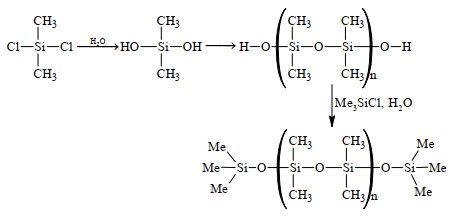
View full question & answer→MCQ 2621 Mark
The correct statement$(s)$ for orthoboric acid is/are
$(A)$ It behaves as a weak acid in water due to self ionization.
$(B)$ Acidity of its aqueous solution increases upon addition of ethylene glycol.
$(C)$ It has a three dimensional structure due to hydrogen bonding.
$(D)$ It is weak electrolyte in water.
- ✓
$(B,D)$
- B
$(B,C)$
- C
$(A,C)$
- D
$(A,D)$
AnswerCorrect option: A. $(B,D)$
a
$H _3 BO _3$ does not undergo self ionization.
On adding cis-diols, they form complexing species with orthoboric acid. Hence the acidity increases on adding ethylene glycol.
$Image$
It arranges into planar sheets due to $H$-bonding. Hence, it has $2$-dimensional structure due to $H$-bonding. It acts as a weak acid in water, so it is a weak electrolyte in water
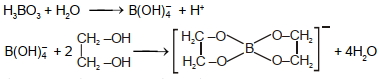
View full question & answer→MCQ 2631 Mark
With respect to graphite and diamond, which of the statement$(s)$ given below is (are) correct?
$(A)$ Graphite is harder than diamond.
$(B)$ Graphite has higher electrical conductivity than diamond
$(C)$ Graphite has higher thermal conductivity than diamond
$(D)$ Graphite has higher $C$ - $C$ bond order than diamond
- A
$(BA)$
- ✓
$(BD)$
- C
$(CA)$
- D
$(AB)$
AnswerCorrect option: B. $(BD)$
b
$(A)$ Diamond is harder than graphite.
$(B)$ Graphite is better conductor of electricity than diamond.
$(C)$ Diamond is better conductor of heat than graphite.
$(D)$ Bond order of graphite ( $\sim 1.5)>$ Bond order of diamond ( $=1$ )
View full question & answer→MCQ 2641 Mark
The bond energy (in ${k c a l ~ m o l}^{-1}$ ) of a $\mathrm{C}-\mathrm{C}$ single bond is approximately
Answerc
$E_{C-C} \cong 100 Kcal / mole$.
View full question & answer→MCQ 2651 Mark
$2 {X}+\mathrm{B}_2 \mathrm{H}_6 \rightarrow\left\lfloor\mathrm{BH}_2(\mathbf{X})_2\right\rfloor^{+}\left\lfloor\mathrm{BH}_4\right]^{-}$ the amine(s) ${X}$ is$(are)$
$(A)$ $\mathrm{NH}_3$ $(B)$ $\mathrm{CH}_3 \mathrm{NH}_2$ $(C)$ $\left(\mathrm{CH}_3\right)_2 \mathrm{NH}$ $(D)$ $\left(\mathrm{CH}_3\right)_3 \mathrm{~N}$
- A
$(A,D,B)$
- B
$(A,C,D)$
- ✓
$(A,B,C)$
- D
$(B, C,D)$
AnswerCorrect option: C. $(A,B,C)$
c
Small amines such as $NH _3, CH _3 NH _2$ and $\left( CH _3\right)_2 NH$ give unsymmetrical cleavage of diborane according to following reaction.
$B _2 H _6+2 NH _3 \rightarrow\left[\left[ H _2 B \left( NH _3\right)_2\right]^{+}\left[ BH _4\right]^{-}\right.$
Large amines, such as $\left( CH _3\right)_3 N$ gives Symmetrical cleavage of diborane according to following reaction.
$B _2 H _6+2 N \left( CH _3\right)_3 \rightarrow 2 H _3 B \leftarrow N \left( CH _3\right)_3$
View full question & answer→MCQ 2661 Mark
$STATEMENT-1$: $\quad \mathrm{Pb}^{4+}$ compounds are stronger oxidizing agents than $\mathrm{Sn}^{4+}$ compounds.and
$STATEMENT-2$: The higher oxidation states for the group $14$ elements are more stable for the heavier members of the group due to 'inert pair effect'.
- A
$STATEMENT-1$ is True, $STATEMENT-2$ is True; $STATEMENT-2$ is correct explanation for $STATEMENT-1$
- B
$STATEMENT-1$ is True, $STATEMENT-2$ is True; $STATEMENT-2$ is $NOT$ a correct explanation for $STATEMENT-1$
- ✓
$STATEMENT-1$ is True, $STATEMENT-2$ is False
- D
$STATEMENT-1$ is False, $STATEMENT-2$ is True
AnswerCorrect option: C. $STATEMENT-1$ is True, $STATEMENT-2$ is False
c
The lower oxidation states for the group $14$ elements are more stable for the heavier member of the group due to inert pair effect.
View full question & answer→MCQ 2671 Mark
$STATEMENT$-$1$: In water, orthoboric acid behaves as a weak monobasic acid. because
$STATEMENT$-$2$: In water, orthoboric acid acts as a proton donor.
- A
Statement-$1$ is True, Statement-$2$ is True; Statement-$2$ is a correct explanation for Statement-$1$.
- B
Statement-$1$ is True, Statement-$2$ is True; Statement-$2$ is $NOT$ a correct explanation for Statement-$1$.
- ✓
Statement-$1$ is True, Statement-$2$ is False.
- D
Statement-$1$ is False, Statement-$2$ is True.
AnswerCorrect option: C. Statement-$1$ is True, Statement-$2$ is False.
c
$\mathrm{H}_3 \mathrm{BO}_3$ (orthoboric acid) is a weak lewis acid.
$\mathrm{H}_3 \mathrm{BO}_3+\mathrm{H}_2 \mathrm{O} \rightleftharpoons \mathrm{B}(\mathrm{OH})_4^{-}+\mathrm{H}^{\oplus}$
It does not donate proton rather it acceptors $\mathrm{OH}^{-}$form water.
Hence $(C)$ is correct
View full question & answer→MCQ 2681 Mark
The species present in solution when $\mathrm{CO}_2$ is dissolved in water are
- ✓
$\mathrm{CO}_2, \mathrm{H}_2 \mathrm{CO}_3, \mathrm{HCO}_3^{-}, \mathrm{CO}_3^{2-}$
- B
$\mathrm{H}_2 \mathrm{CO}_3, \mathrm{CO}_3^{2-}$
- C
$\mathrm{CO}_3^{2-}, \mathrm{HCO}_3^{-}$
- D
$\mathrm{CO}_2, \mathrm{H}_2 \mathrm{CO}_3$
AnswerCorrect option: A. $\mathrm{CO}_2, \mathrm{H}_2 \mathrm{CO}_3, \mathrm{HCO}_3^{-}, \mathrm{CO}_3^{2-}$
a
$\mathrm{CO}_2+\mathrm{H}_2 \mathrm{O} \rightleftharpoons \mathrm{H}_2 \mathrm{CO}_3 \rightleftharpoons \mathrm{H}^{+}+\mathrm{HCO}_3^{-} \rightleftharpoons \mathrm{H}^{+}+\mathrm{CO}_3^{-2}$
View full question & answer→MCQ 2691 Mark
Match the following:
| Column $I$ |
Column $II$ |
| $(A)$ $\mathrm{Bi}^{3+} \longrightarrow(\mathrm{BiO})^{+}$ |
$(P)$ Heat |
| $(B)$ $\left[\mathrm{AlO}_2\right]^{-} \longrightarrow \mathrm{Al}(\mathrm{OH})_3$ |
$(Q)$ Hydrolysis |
| $(C)$ $\mathrm{SiO}_4^{4-} \longrightarrow \mathrm{Si}_2 \mathrm{O}_7^{6-}$ |
$(R)$ Acidification |
| $(D)$ $\left(\mathrm{B}_4 \mathrm{O}_7^{2-}\right) \longrightarrow\left[\mathrm{B}(\mathrm{OH})_3\right]$ |
$(S)$ Dilution by water |
- ✓
$A-Q; B-R; C-P; D-Q, R$
- B
$A-P; B-Q; C-R; D-Q, R$
- C
$A-Q; B-R; C-Q; D-R, P$
- D
$A-Q; B-P; C-S; D-R, Q$
AnswerCorrect option: A. $A-Q; B-R; C-P; D-Q, R$
View full question & answer→MCQ 2701 Mark
Name of the structure of silicates in which three oxygen atoms of $[SiO4]^{4-}$ are shared is
- A
- B
Three dimensional silicate
- C
- ✓
Answerd
In sheet silicates, three out of four oxygen of $S i O_{4}^{4-}$ unit are shared as shown below : In pyrosilicates, there is only one shared oxygen, in linear chain silicates, two oxygen per tetrahedra are shared while in three-dimensional silicates, all four oxygens are shared.
View full question & answer→MCQ 2711 Mark
Electrolytic reduction of alumina to aluminium by Hall-Heroult process is carried out in the presence of
- A
$NaCl$
- B
- ✓
Cryolite which forms a melt with lower melting temperature
- D
Cryolite which forms a melt with higher melting temperature
AnswerCorrect option: C. Cryolite which forms a melt with lower melting temperature
c
Hall and Heroult's process:
$2 Al _2 O _3+3 C \rightarrow 4 Al +3 O _2$
Cathode $: Al ^{3+}($ melt $)+3 e ^{-} \rightarrow Al (l)$
Anode $: C ( s )+ O ^{2-}( g )($ melt $) \rightarrow CO ( g )+2 e ^{-}$
$C ( s )+2 O ^{2-}( g )(\text { melt }) \rightarrow CO _2( g )+4 e ^{-}$
The electrolysis of alumina by Hall and Heroult's process is carried by using a fused mixture of alumina $\left( Al _2 O _3\right)$ and cryolite $\left( Na _3 AlF _6\right.$, sodium hexafluoroaluminate) along with minor quantities of aluminum fluoride $\left( AlF _3\right)$ and fluorspar $\left( CaF _2\right)$. The addition of cryolite and fluorspar increases the electrical conductivity of alumina and lowers the fusion temperature.
View full question & answer→MCQ 2721 Mark
In the commercial electrochemical process for aluminium extraction, the electrolyte used is
- A
$Al{(OH)_3}$ in $NaOH$ solution
- B
An aqueous solution of $A{l_2}{(S{O_4})_3}$
- ✓
A molten mixture of $A{l_2}{O_3}$ and $N{a_3}Al{F_6}$
- D
A molten mixture of $AlO(OH)$ and $Al{(OH)_3}$
AnswerCorrect option: C. A molten mixture of $A{l_2}{O_3}$ and $N{a_3}Al{F_6}$
c
In the commercial electrochemical process for aluminium extraction, the electrolyte used is .a molten mixture of $Al _2 O _3$ (alumina) and $Na _3 AIF _6$ (cryolite).
View full question & answer→MCQ 2731 Mark
The function of fluorspar in the electrolytic reduction of alumina dissolved in fused cryolite $(N{a_3}Al{F_6})$ is
- A
- ✓
To lower the temperature of the melt and to make the fused mixture very conducting
- C
To decrease the rate of oxidation of carbon at the anode
- D
AnswerCorrect option: B. To lower the temperature of the melt and to make the fused mixture very conducting
b
Fluorspar $( CaF_2 )$ is added in small quantity in the electrolytic reduction of alumina dissolved in fused cryolite $( Na_3A l F_6)$. Addition of cryolite and fluorspar increases the electrical conductivity of alumina and lowers the fusion temperature to around $1140 \,K$.
View full question & answer→MCQ 2741 Mark
- A
$PbS$
- ✓
$Graphite$
- C
$({H_3}B{O_3})$
- D
$Pb$
AnswerCorrect option: B. $Graphite$
View full question & answer→MCQ 2751 Mark
In the electrolysis of alumina, cryolite is added to
- A
Increase the melting point of alumina
- ✓
Increase the electrical conductivity
- C
Minimise the anodic effect
- D
Remove impurities from alumina
AnswerCorrect option: B. Increase the electrical conductivity
View full question & answer→MCQ 2761 Mark
Hydrogen gas will not reduce
Answerd
Aluminium oxide cannot be reduced by hydrogen even under very hot conditions because $Al$ is more reactive than $H$. While other oxides can be reduced by hydrogen as they are below hydrogen in the metal reactivity series.
View full question & answer→MCQ 2771 Mark
Which of the statements about anhydrous aluminium chloride is correct
AnswerCorrect option: C. It sublimes at ${100\,^o}C$ under vacuum
c
It exists as dimer in vapour.
It is a strong Lewis acid due to incomplete octet and because of that it can be easily hydrolyzed.
View full question & answer→MCQ 2781 Mark
In the reaction ${B_2}{O_3} + C + C{l_2} \to A + CO.$ The $A$ is
- ✓
$BC{l_3}$
- B
$BC{l_2}$
- C
${B_2}C{l_2}$
- D
$CC{l_2}$
AnswerCorrect option: A. $BC{l_3}$
a
(a) ${B_2}{O_3} + 3C + 3C{l_2} \to 2BC{l_3} + 3CO$
$BC{l_3}$ is obtained by passing chlorine over the heated mixture of ${B_2}{O_3}$ and powdered charcoal.
View full question & answer→MCQ 2791 Mark
The molecular formula of felspar is
- ✓
${K_2}O\,.\,A{l_2}{O_3}.\,6Si{O_2}$
- B
${K_2}O\,.\,3A{l_2}{O_3}.\,6Si{O_2}$
- C
$N{a_3}Al{F_6}$
- D
$CaS{O_4}.\,2{H_2}O$
AnswerCorrect option: A. ${K_2}O\,.\,A{l_2}{O_3}.\,6Si{O_2}$
a
Feldspar is $K _2 O _2 Al _2 O _3 \cdot 6 SiO _2$.
View full question & answer→MCQ 2801 Mark
The most acidic of the following compounds is
- A
${P_2}{O_3}$
- B
$S{b_2}{O_3}$
- ✓
${B_2}{O_3}$
- D
$A{s_2}{O_3}$
AnswerCorrect option: C. ${B_2}{O_3}$
View full question & answer→MCQ 2811 Mark
Which of the following is a non-metal
Answerc
Of the following options, only Boron is a non-metal.
View full question & answer→MCQ 2821 Mark
Which of the following is most acidic
- A
$N{a_2}O$
- B
$MgO$
- ✓
$A{l_2}{O_3}$
- D
$CaO$
AnswerCorrect option: C. $A{l_2}{O_3}$
c
$Na 2 O , MgO , CaO$ are metallic oxide of $s$ block. These maetallic oxides powerful bases, while $Al _2 O 3$ is metallic oxide of $p$ block which has comapratively more acidic character. Hence, it is the most acidic oxide among all.
View full question & answer→MCQ 2831 Mark
When orthoboric acid $({H_3}B{O_3})$ is heated, the residue left is
Answerc
(c) $2{H_3}B{O_3} \to {B_2}{O_3} + 3{H_2}O$.
View full question & answer→MCQ 2841 Mark
Which of the following form dimeric halides
Answerd
(d) $A{l_2}C{l_6},\,\,I{n_2}C{l_6},\,\,G{a_2}C{l_6}$
View full question & answer→MCQ 2851 Mark
The hardest substance amongst the following is
AnswerCorrect option: D. ${B_4}C$
d
(d)${B_4}C$ is the hardest substance along with diamond.
View full question & answer→MCQ 2861 Mark
- A
Amorphous boron of ultra purity
- B
Crystalline boron of ultra purity
- ✓
Amorphous boron of low purity
- D
Crystalline boron of low purity
AnswerCorrect option: C. Amorphous boron of low purity
c
(c) Moissan boron is amorphous boron, obtained by reduction of ${B_2}{O_3}$ with $Na$ or $Mg$. It has $95-98\%$ boron and is black in colour.
View full question & answer→MCQ 2871 Mark
Answerc
(c) Alumina is amphoteric oxide, which reacts acid as well as base.
View full question & answer→MCQ 2881 Mark
The most abundant metal in the earth crust is
Answera
(a) $Al$ is the most abundant metal in the earth crust.
View full question & answer→MCQ 2891 Mark
Crystalline metal can be transformed into metallic glass by
- A
- B
Pressing into thin plates
- C
Slow cooling of molten metal
- ✓
Very rapid cooling of a spray of the molten metal
AnswerCorrect option: D. Very rapid cooling of a spray of the molten metal
d
Crystalline metal can be transformed into a metallic glass by very rapid colling of molten metal. On rapid cooling of molten metal gives amorphous solid which is nothing but metallic glass.
View full question & answer→MCQ 2901 Mark
Which metal is protected by a layer of its own oxide
Answera
Aluminium in air is ordinarily protected by a molecule-thin layer of its own oxide. This aluminium oxide layer serves as a protective barrier to the underlying aluminium itself and preventing chemical reactions with the metal.
View full question & answer→MCQ 2911 Mark
Aluminium is a self-preserving metal, because
- A
It is not tarnished by air
- B
A thin film of basic carbonate on its surface
- ✓
A non-porous layer of oxide is formed on its surface
- D
It is not affected by salt water
AnswerCorrect option: C. A non-porous layer of oxide is formed on its surface
c
Aluminum is called self-protecting metal because when it comes in contact with the atmosphere it is covered entirely with a layer of aluminum oxide which stops further corrosion.
View full question & answer→MCQ 2921 Mark
An element $A$ dissolves both in acid and alkali. It is an example of
- A
Allotropic nature of $A$
- B
Dimorphic nature of $A$
- C
Amorphous nature of $A$
- ✓
Amphoteric nature of $A$
AnswerCorrect option: D. Amphoteric nature of $A$
d
(d) Amphoteric substance can react with both acid and base.
View full question & answer→MCQ 2931 Mark
Conc. $HN{O_3}$
- A
Reacts with aluminium vigrously
- B
Reacts with aluminium to form aluminium nitrate
- ✓
Does not react with aluminium
- D
AnswerCorrect option: C. Does not react with aluminium
c
Aluminum metal is not attacked by nitric acid of any concentration because of the thin and unreactive protective layer of aluminum oxide formed on the metallic surface due to the reaction of aluminium metal with oxygen of air.
View full question & answer→MCQ 2941 Mark
Which is true for an element $R$ present in III group of the periodic table
AnswerCorrect option: C. It forms ${R_2}{O_3}$
c
(c) $Al$ $\to$ $III$ group $\to$ Forms $A{l_2}{O_3}$
View full question & answer→MCQ 2951 Mark
When $Al$ is added to $KOH$ solution
Answerd
(d) $2KOH + 2Al + 2{H_2}O \to 2KAl{O_2} + 3{H_2}$
View full question & answer→MCQ 2961 Mark
- ✓
${K_2}S{O_4}.A{l_2}{(S{O_4})_3}.24{H_2}O$
- B
${K_2}S{O_4}.C{r_2}{(S{O_4})_3}.24{H_2}O$
- C
${K_2}S{O_4}.F{e_2}{(S{O_4})_3}.24{H_2}O$
- D
${(N{H_4})_2}S{O_4}.FeS{O_4}.6{H_2}O$
AnswerCorrect option: A. ${K_2}S{O_4}.A{l_2}{(S{O_4})_3}.24{H_2}O$
a
Potassium alum is the common alum of commerce whose chemical formula is
$K _2 SO _4 \cdot Al _2\left( SO _4\right)_3 \cdot 24 H _2 O$
Ammonium alum is $\left( NH _4\right) SO _4 \cdot Al _2\left( SO _4\right)_3 \cdot 24 H _2 O$.
Chrome alum is $K _2 SO _4 \cdot Cr _2\left( SO _4\right)_3 \cdot 24 H _2 O$
View full question & answer→MCQ 2971 Mark
Which of the following is not true about potash alum
AnswerCorrect option: A. Its empirical formula is $KAl{(S{O_4})_2}.12{H_2}O$
View full question & answer→MCQ 2981 Mark
Which one of the following is correct statement
- A
The hydroxide of aluminium is more acidic than that of boron
- B
The hydroxide of boron is basic, while that of aluminium is amphoteric
- ✓
The hydroxide of boron is acidic, while that of aluminium is amphoteric
- D
The hydroxide of boron and aluminium are amphoteric
AnswerCorrect option: C. The hydroxide of boron is acidic, while that of aluminium is amphoteric
c
(c) $B{(OH)_3} \Rightarrow {H_3}B{O_3}$ Boric acid
$Al{(OH)_3} \Rightarrow {\rm{Amphoteric}}$
View full question & answer→MCQ 2991 Mark
$AlC{l_3}$ is
Answera
$Al$ is electropositive so it is attract water ${ }^{-} OH$ and $Cl$ is electronegative so it is attract water $H ^{+}$ ions bond make by $(\sigma p -\sigma p ) Al$ and $Cl$.
View full question & answer→MCQ 3001 Mark
Aluminium has a great affinity for oxygen and its oxidation is an exothermic process. This fact is made use of in
- A
Preparing thin foils of aluminium
- B
- C
Preparing duralumin alloy
- ✓
Answerd
Thermite Welding is based on the fact that Aluminium has a great affinity for oxygen and its oxidation is an exothermic process.
View full question & answer→MCQ 3011 Mark
Which of the following is an amphoteric oxide
- A
$MgO$
- ✓
$A{l_2}{O_3}$
- C
$C{l_2}{O_7}$
- D
$T{i_2}{O_2}$
AnswerCorrect option: B. $A{l_2}{O_3}$
b
(b)$A{l_2}{O_3}$ is an amphoteric oxide.
View full question & answer→MCQ 3021 Mark
Aluminium oxide is not reduced by chemical reactions since
- A
Aluminium oxide is reactive
- B
Reducing agents contaminate
- ✓
Aluminium oxide is highly stable
- D
The process pollutes the environment
AnswerCorrect option: C. Aluminium oxide is highly stable
c
(c)Aluminium oxide is highly stable therefore, it is not Reduced by chemical reactions.
View full question & answer→MCQ 3031 Mark
- A
- B
- C
- ✓
As oxidizer in metallurgy
AnswerCorrect option: D. As oxidizer in metallurgy
d
(d) Aluminium is used as reducing agent in metallurgy.
View full question & answer→MCQ 3041 Mark
In the thermite process the reducing agent is
Answera
(a) $Al$ is used as reducing agent in thermite process.
View full question & answer→MCQ 3051 Mark
Which one is used as a bye-product in Serpeck's process
- ✓
$N{H_3}$
- B
$C{O_2}$
- C
${N_2}$
- D
$P{H_3}$
AnswerCorrect option: A. $N{H_3}$
a
A reaction of Serpeck's Process: $AlN +3 H _2 O \rightarrow Al ( OH )_3+ NH _3$
So, the byproduct of Serpeck's process is $NH _3$
View full question & answer→MCQ 3061 Mark
In the metallurgy of aluminium, cryolite is mixed in the molten state because it
- A
Increases the melting point of alumina
- B
- C
- ✓
Decreases the melting point of alumina
AnswerCorrect option: D. Decreases the melting point of alumina
d
(d) Cryolite $N{a_3}Al{F_6}$
(1) Decreases the melting point of alumina
(2) Increases conductivity of the solution
View full question & answer→MCQ 3071 Mark
In the electrolytic extraction of aluminium, cryolite is used
- A
- ✓
To decrease temperature to dissolve bauxite
- C
- D
AnswerCorrect option: B. To decrease temperature to dissolve bauxite
b
(b) Cryolite $N{a_3}Al{F_6}$ is added
(1) To decrease the melting temp from $2323\,K$ to $1140\,K$
(2) To increase the electrical conductivity of solution
View full question & answer→MCQ 3081 Mark
In the extraction of aluminium, bauxite is dissolved in cryolite because
- A
- ✓
It reduces melting point of aluminium oxide
- C
It increases the resistance of aluminium oxide
- D
AnswerCorrect option: B. It reduces melting point of aluminium oxide
View full question & answer→MCQ 3091 Mark
For purification of alumina, the modern processes most useful when $(i)$ the impurity present is a lot of iron oxides and $(ii)$ the impurity present is a lot of silica, are
- A
For $(i)$ Hall's process; for $(ii)$ Baeyer's process
- B
For $(i)$ Hall's process; for $(ii)$ Serpeck's process
- C
For $(i)$ Serpeck's process; for $(ii)$ Baeyer's process
- ✓
For $(i)$ Baeyer's process; for $(ii)$ Serpeck's process
AnswerCorrect option: D. For $(i)$ Baeyer's process; for $(ii)$ Serpeck's process
d
(d) Iron oxide impurity -Baeyer’s process
Silica impurity -Serpeck’s process
View full question & answer→MCQ 3101 Mark
In electrolysis of aluminium oxide which of the following is added to accelerate the process
Answerb
(b)Cryolite is added to lower the melting point of alumina and to increase the electrical conductivity.
View full question & answer→MCQ 3111 Mark
In the electrolytic method of obtaining aluminium from purified bauxite, cryolite is added to the charge in order to
- A
Minimize the heat loss due to radiation
- B
Protect aluminium produced from oxygen
- ✓
Dissolve bauxite and render it conductor of electricity
- D
Lower the melting point of bauxite
AnswerCorrect option: C. Dissolve bauxite and render it conductor of electricity
c
(c) In electrolytic method of obtaining aluminium from purified bauxite, cryolite is added to charge because it reduces the melting point of Bauxite (from ${1200\,^o}C$ to ${800^o} - {900\,^o}C$) and also it increases electrical conductivity of mixture.
View full question & answer→MCQ 3121 Mark
Hoop's process is used for the purification of the metal
Answera
(a) Hoop’s process $⇒$ Purification of $Al$
Hall and Heroult process $⇒$ Reduction of $A{l_2}{O_3}$
Baeyer’s and Serpeck’s process $⇒$ Concentration of Bauxite ore
View full question & answer→MCQ 3131 Mark
In the Hoope's process for refining of aluminium, the fused materials form three different layers and they remain separated during electrolysis also. This is because
AnswerCorrect option: C. The $3$ layers have different densities
View full question & answer→MCQ 3141 Mark
In Hall’s process, the main reagent is mixed with
- A
$NaF$
- ✓
$N{a_3}Al{F_6}$
- C
$Al{F_3}$
- D
AnswerCorrect option: B. $N{a_3}Al{F_6}$
b
(b) Pure alumina is a bad conductor of electricity and the fusion temperature of pure alumina is about $2000\,^°C$ and at this temperature when the electrolysis is carried of fused mass the metal formed vapoureses as the boiling point of $Al$ is $1800\,^°C$.
To overcome this difficulty, $N{a_3}Al{F_6}$ and $Ca{F_2}$ are mixed with alumina.
View full question & answer→MCQ 3151 Mark
- A
$ZnC$
- B
$TiC$
- C
$SiC$
- ✓
$Ca{C_2}$
AnswerCorrect option: D. $Ca{C_2}$
d
Calcium carbide $\left( CaC _2\right)$ is ionic as it is ionic compound remaining all are covalent carbides.
View full question & answer→MCQ 3161 Mark
In $IIIA$ group, $Tl$ (thalium) shows $+1$ oxidation state while other members show $+3$ oxidation state. Why
Answerb
(b) Inert pair effect become significant for the $6^{th}$ and $7^{th}$ period of $p$ -block element.
View full question & answer→MCQ 3171 Mark
The chemical name of borax is
- A
- B
- C
- ✓
Sodium tetraborate decahydrate
AnswerCorrect option: D. Sodium tetraborate decahydrate
d
(d)Sodium tetraborate decahydrate $(N{a_2}{B_4}{O_7}.10{H_2}O)$
View full question & answer→MCQ 3181 Mark
- A
${B_3}{H_3}{N_3}$
- B
$B{H_3}N{H_3}$
- ✓
${B_3}{H_6}{N_3}$
- D
${H_3}{B_3}{N_6}$
AnswerCorrect option: C. ${B_3}{H_6}{N_3}$
c
(c) Inorganic benzene is ${B_3}{H_6}{N_3}$
View full question & answer→MCQ 3191 Mark
Hydrated $AlC{l_3}$ is used as
- A
Catalyst in cracking of petroleum
- B
Catalyst in Friedel Craft reaction
- ✓
- D
Answerc
(c) Hydeated $AlC{l_3}$ in used as mordant.
View full question & answer→MCQ 3201 Mark
$A{l_2}{O_3}$ formation involves evolution of a large quantity of heat, which makes its use in
Answera
(a) In thermite welding large quantity of heat is used which is evolved during $A{l_2}{O_3}$ formation.
View full question & answer→MCQ 3211 Mark
Colour of the bead in borax bead test is mainly due to the formation of
Answerc
Borax on strong heating loses its water of crystallization and then shrinks forming a
transparent glassy bead of sodium metaborate $\left(\mathrm{N} \mathrm{aB} \mathrm{O}_{2}\right)$ and boric anhydride $\left(\mathrm{B}_{2} \mathrm{O}_{3}\right)$ as shown
in reaction given below:
$\mathrm{Na}_{2} \mathrm{B}_{4} \mathrm{O}_{7} \cdot 10 \mathrm{H}_{2} \mathrm{O} \rightarrow \mathrm{Na}_{2} \mathrm{B}_{4} \mathrm{O}_{7}+10 \mathrm{H}_{2} \mathrm{O}$
$\mathrm{Na}_{2} \mathrm{B}_{4} \mathrm{O}_{7} \rightarrow 2 \mathrm{NaBO}_{2}+\mathrm{B}_{2} \mathrm{O}_{3}$
Boric anhydride, being non-volatile displaces more volatile acidic oxides and combine with basic oxides present to form metaborates which are identified through their characteristic colours.
View full question & answer→MCQ 3221 Mark
In $LiAlH_4,$ metal $Al$ is present in
- ✓
- B
- C
in both anionic and cationic part
- D
neither in cationic nor in anionic part
Answera
$\mathrm{LiAlH}_{4}$ is a reducing agent, composed of $\mathrm{Li}^{+}$ cation and $\mathrm{AlH}_{4}^{-}$ anion.
Therefore metal Al is present in anionic part.
Hence correct option is ( $\mathrm{A}$ ).
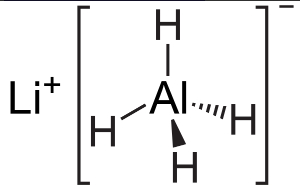
View full question & answer→MCQ 3231 Mark
The weakest Lewis acid is
- ✓
$BF_3$
- B
$BCl_3$
- C
$BBr_3$
- D
$BI_3$
AnswerCorrect option: A. $BF_3$
View full question & answer→MCQ 3241 Mark
$BCl_3$ does not exist as dimer but $BH_3$ exist as dimer $(B_2H_6)$ becuase
AnswerCorrect option: C. Large sized chlorine atoms do not fit in between the small boron atoms whereas small sized hydrogenatoms get fitted between boron atoms
c
Large sized chlorine atoms do not fit in between the small baron atoms whereas small sized hydrogen atoms get fitted in between boron atoms so $BCl _3$ does not exist as dimer but $BH _3$ exist as dimer $\left( B _2 H _6\right)$.
$B _2 H _6+ H _2 O \stackrel{\text { Cold is enough }}{\longrightarrow} H _3 BO _3+6 H _2$

View full question & answer→MCQ 3251 Mark
$Be$ and $Al$ exhibit many properties which are similar, but the two elements differ in :
- A
Exhibiting amphoteric nature in their oxides
- ✓
Forming polymeric hydrides
- C
Exhibiting maximum covalency in compounds
- D
AnswerCorrect option: B. Forming polymeric hydrides
View full question & answer→MCQ 3261 Mark
$H_3BO_3$ is
- ✓
Monobasic and weak Lewis acid
- B
Monobasic and weak Bronsted acid
- C
Monobasic and strong Lewis acid
- D
Tribasic and weak Bronsted acid
AnswerCorrect option: A. Monobasic and weak Lewis acid
a
Central boron atom in $\mathrm{H}_{3} \mathrm{BO}_{3}$ is electron deficient, therefore it accepts a pair of electrons, hence it is weak Lewis acid. There is no d-orbital of suitable energy in boron atom.
So, it can accommodate only one additional electron pair in its outermost shell. Thus, $\mathrm{H}_{3} \mathrm{BO}_{3}$ is monobasic weak Lewis acid.
$\underset{\text { Base }}{\mathrm{H}_{2} \mathrm{O}}$+$\underset{\text { Acid }}{\mathrm{B}(\mathrm{OH})_{3}} \longrightarrow\left[\mathrm{B}(\mathrm{OH})_{4}\right]^{-}+\mathrm{H}^{+}$
View full question & answer→MCQ 3271 Mark
Which of the following is correct ?
AnswerCorrect option: A. The members of $B_nH_{n+6}$ are less stable than $B_nH_{n+4}$ series
a
The members of $B _{ n } H _{ n +6}$ are less stable than $B _{ n } H _{ n +4}$ series.
View full question & answer→MCQ 3281 Mark
In which of the following, a salt of the type $KMO_2$ is obtained?
- A
$B_2H_6 + KOH \,(aq)\, \rightarrow$
- B
$Al + KOH\, (aq)\, \rightarrow$
- ✓
- D
Answerc
Reactions will be as follows:
$B_{2} H_{6}+2 K O H+2 H_{2} O \rightarrow \underset {Potassium metaborate} {2 K B O_{2}}+6 H_{2}$
$2 A l+2 K O H+2 H_{2} \longrightarrow \underset {Potassium metaaluminate} {2 k A O_{2}}+3 H_{2}$
Hence, in both reactions, salt of type $K M O_{2}$ is obtacued $\therefore$
Option $(C)$ is correct.
View full question & answer→MCQ 3291 Mark
Which of the following mineral does not contain aluminium?
Answerd
Cryolite; $\mathrm{Na}_{3} \mathrm{AlF}_{6}$, sodium hexafluoroaluminate.
Mica: $\mathrm{KAl}_{3} \mathrm{Si}_{3} \mathrm{O} 10(\mathrm{OH})_{2}$ Basic potassium aluminum silicate
Feldspars $\mathrm{KAlSi}_{3} \mathrm{O}_{8} \mathrm{NaAlSi}_{3} \mathrm{O}_{8} \mathrm{CaAl}_{2} \mathrm{Si}_{2} \mathrm{O}_{8}$
fluorspar: $\mathrm{CaF}_{2}, \mathrm{calcium}$ fluoride. So only in fluorspar there is no Al present.
Hence option D is correct.
View full question & answer→MCQ 3301 Mark
The function of fluorspar in the electrolytic reduction of alumina dissolved in fused cryolite $(Na_3AlF_6)$ is :
- A
- ✓
to lower the temperature of melt and to make the fused mixture very conducting
- C
to decrease the rate of oxidation of carbon anode
- D
AnswerCorrect option: B. to lower the temperature of melt and to make the fused mixture very conducting
b
The electrolysis of alumina is carried out in a steel tank lined inside with graphite.
The graphite lining serves as a cathode.
The anode is also made of graphite rods hanging in the molten mass.
The electrolyte consists of alumina dissolved in fused cryolite(N a $_{3} \mathrm{AlF}_{6}$ ) and fluorspar ($\left.\mathrm{CaF}_{2}\right)$
Cryolite lowers the melting point of alumina to $950^{\circ} \mathrm{C}$ and fluorspar increases the fluidity of the mass, so that the liberated aluminium metal may sink at the bottom of the cell.
Therefore, it makes the fused mixture very conducting and lowers the fusion temperature of the melt.
When an electric current is passed through this mixture, the aluminium is collected at the cathode in the molten state and sinks at the bottom and is tapped off.
View full question & answer→MCQ 3311 Mark
Which of the following compound is formed in borax bead test?
Answera
Answer:- (A) Metaborate
On heating, borax loses water of crystallisation and swells up to form fluffy mass. On further heating, it melts to give a clear liquid which solidifies to a transparent glossy bead consisting of sodium metaborate and boric unhydride.
$\mathrm{Na}_{2} \mathrm{B}_{4} \mathrm{O}_{7} \cdot 10 \mathrm{H}_{2} \mathrm{O} \stackrel{\Delta}{\longrightarrow} \mathrm{Na}_{2} \mathrm{B}_{4} \mathrm{O}_{7} \stackrel{\Delta}{\longrightarrow}{\underset { Sodium Metaborate }{2 \mathrm{NaBO}_{2}}}+\mathrm{B}_{2} \mathrm{O}_{3}$
Thus, Metaborate is formed.
View full question & answer→MCQ 3321 Mark
- A
$B_3N_3H_6$
- ✓
$B_3N_3$
- C
$SiC$
- D
$P_4S_3$
AnswerCorrect option: B. $B_3N_3$
b
Boron Nitride $(BN)$ is also called Inorganic graphite.Boron nitride is a chemical compound with chemical formula $BN$, consisting of equal numbers of boron and nitrogen atoms. $BN$ is isoelectronic to a similarly structured carbon lattice and thus exists in various crystalline forms.
View full question & answer→MCQ 3331 Mark
Hydrated $AlCl_3$ is used as :
- A
catalysed in cracking of petroleum
- B
catalysed in Friedel-Craft's reaction
- C
- ✓
View full question & answer→MCQ 3341 Mark
Carbongene has $X\%$ of $CO_2$ and is used as an antidote for poisoning of $Y.$ Then, $X$ and $Y$ are
- A
$X = 95\%$ and $Y =$ lead poisoning
- ✓
$X = 5\%$ and $Y = CO$ poisoning
- C
$X = 30\%$ and $Y = CO_2$ poisoning
- D
$X = 45\%$ and $Y = CO$ poisoning
AnswerCorrect option: B. $X = 5\%$ and $Y = CO$ poisoning
b
A carbongene mixture of $95\, \%$ oxygen and $5 \,\%$ carbon dioxide can be used as an antidote in $CO$ poisoning and artificial respiration in case of pneumonia patients.
View full question & answer→MCQ 3351 Mark
${H_3}B{O_3} + {H_2}O_2 \to {H_2}O + 'X' {\xrightarrow{{NAOH}} }{'Y'}$
Which of the following statements is $/$ are Correct for $'Y'$
- A
Boron atom $(s)$ in $(Y)$ are $sp^3$ hybridised
- B
There are two peroxy linkages in $Y$
- C
$'Y'$ is used as brightener in washing powder
- ✓
View full question & answer→MCQ 3361 Mark
Covalent electron deficient hydride is formed by
Answerb
$(AlH_3)_n : e^-$ deficient, $SiH_4, HCl$ covalent
View full question & answer→MCQ 3371 Mark
Maximum number of atoms which are present in one plane of $H_3BO_3$?
View full question & answer→MCQ 3381 Mark
The element which exists in liquid state for a wide range of temperature and can be used for measuring high temperature is :-
Answerb
The melting point of gallium is $30^{\circ} \mathrm{C}$ and boiling point is $2240^{\circ} \mathrm{C}$. Thus, the element exists in liquid state for a wide range of temperature.
View full question & answer→MCQ 3391 Mark
Which of the following oxides is acidic in nature?
- ✓
$B_2O_3$
- B
$Ga_2O_3$
- C
$Al_2O_3$
- D
$In_2O_3$
AnswerCorrect option: A. $B_2O_3$
a
$\mathrm{B}_{2} \mathrm{O}_{3}$ is acidic oxide, $\mathrm{Al}_{2} \mathrm{O}_{3}$ and $\mathrm{Ga}_{2} \mathrm{O}_{3}$ are amphoteric and $\mathrm{In}_{2} \mathrm{O}_{3}$ is basic oxide.
View full question & answer→MCQ 3401 Mark
Boron does not form $B^{3+}$ cation easily. it is due to
AnswerCorrect option: A. energy required to form $B^{3+}$ ion is far more than that which would be compensated by lattice energies or hydration energies of such ion
a
As the Boron atom is small in size a large amount of energy is needed to remove $3$ electrons from the boron atom. So Boron does not form $B_3+$ ion. The atomic number of Boron is $5$ . Its electronic configuration is $1s [2] 2 s[2] 2 p[1]$
When one electron is removed from the $p$ orbital a $He$-like fulfilled s orbital is left. This is highly stable. So the second ionization enthalpy is quite high. Again when one electron is removed a half filled orbital is left. So the third ionization enthalpy is also quite high.
Since the total energy needed to make $B _3+$ is the total of all the ionization enthalpies an enormous amount of energy is required to form it.
View full question & answer→MCQ 3411 Mark
Boric acid is an acid because its molecule
AnswerCorrect option: A. accepts $OH^-$ from water
a
$B(OH)_3 + OH^-\to [B(OH)_4]^-$
View full question & answer→MCQ 3421 Mark
Which of following salt does not give borax bead test
- ✓
$Al^{+3}$
- B
$Co^{+2}$
- C
$Cu^{+2}$
- D
$Ni^{+2}$
AnswerCorrect option: A. $Al^{+3}$
View full question & answer→MCQ 3431 Mark
Which of the following compounds is formed by addition of mineral acid to an aqueous solution of borax ?
Answerb
Addition of mineral acid to an aqueous solution of Borax, orthoboric acid is formed.
$\mathrm{Na}_{2} \mathrm{B}_{4} \mathrm{O}_{7}+2 \mathrm{HCl}+5 \mathrm{H}_{2} \mathrm{O} \rightarrow 4 \mathrm{H}_{3} \mathrm{BO}_{3}+2 \mathrm{NaCl}$
Hence, the correct answer is option B.
View full question & answer→MCQ 3441 Mark
Which is true about $H_3BO_3$
- A
Soluble in water at low temperature
- B
- C
Forms when borax react with a base
- ✓
Answerd
Soluble in hot water, monobasic forms when borax reacts with acid.
View full question & answer→MCQ 3451 Mark
The incorrect order of $1^{st}$ $IP$ of the elements is
- ✓
$Al > Ga$
- B
$P > S$
- C
$Cu < Zn$
- D
$Zr < Hf$
AnswerCorrect option: A. $Al > Ga$
View full question & answer→MCQ 3461 Mark
Which match is not incorrect ?
- A
$CsI_3 \Rightarrow C{s^ + },3{I^ - }$
- B
$TiC{l_3} \Rightarrow T{l ^{ + 1}},Cl _3^ - $
- C
${\text{GaC}}{{\text{l}}_3} \Rightarrow G{a^{ + 1}},Cl_3^ - $
- ✓
${\text{InC}}{{\text{l}}_3} \Rightarrow \operatorname{I} {n^{ + 3}},3C{l^ - }$
AnswerCorrect option: D. ${\text{InC}}{{\text{l}}_3} \Rightarrow \operatorname{I} {n^{ + 3}},3C{l^ - }$
View full question & answer→MCQ 3471 Mark
The possible oxidation state of $Tl$ are
- A
$+1$ and $+2$
- B
$+2$ and $+3$
- C
$+1$ and $-1$
- ✓
$+1$ and $+3$
AnswerCorrect option: D. $+1$ and $+3$
d
Tl shows both +1 and +3 oxidation states. The stability of +1 oxidation state increases down the group $\mathrm{T} 1>\mathrm{In}>\mathrm{Ga}>\mathrm{Al}$ and +3 oxidation state is highly oxidising in character.
View full question & answer→MCQ 3481 Mark
Which of the following cation can not give borax bead test ?
- A
$Cr^{3+}$
- B
$Co^{2+}$
- ✓
$Ag^+$
- D
$Mn^{2+}$
AnswerCorrect option: C. $Ag^+$
c
$Ag^+$ ion can not give borax bead test because formed silver metaborate $AgBO_2$ is white/ colourless.
View full question & answer→MCQ 3491 Mark
Which acid is not an arrhenius acid
- A
$HNO_3$
- B
$HClO_4$
- ✓
$H_3BO_3$
- D
$H_3PO_4$
AnswerCorrect option: C. $H_3BO_3$
c
$H_3BO_3 \Rightarrow B(OH)_3$
View full question & answer→MCQ 3501 Mark
Which of the following cation can not give borax bead test ?
- A
$Cr^{3+}$
- B
$Co^{2+}$
- ✓
$Ag^+$
- D
$Mn^{2+}$
AnswerCorrect option: C. $Ag^+$
c
$Ag ^{+}$ ion can not give borax bead test because formed silver metaborate $AgBO _2$ is white/colorless.
View full question & answer→MCQ 3511 Mark
Borax has the molecular formula
- A
$Na_2[B_4O_3(OH)_4].6H_2O$
- B
$Na_2[B_4O_5(OH)_4].6H_2O$
- ✓
$Na_2[B_4O_5(OH)_4].8H_2O$
- D
$Na_2[B_4O_6(OH)_2].8H_2O$
AnswerCorrect option: C. $Na_2[B_4O_5(OH)_4].8H_2O$
c
Borax, also called sodium tetraborate, is a powdery white mineral that has been used as a cleaning product for several decades.
Formula of borax is $Na _2\left[ B _4 O _5( OH )_4\right] \cdot 8 H _2 O$.
View full question & answer→MCQ 3521 Mark
Which one is a pseudo alum
- A
$(NH_4)_2SO_4.Fe_2(SO_4)_3.24H_2O$
- B
$K_2SO_4.Cr_2(SO_4)_3.24H_2O$
- ✓
$MnSO_4.Al_2(SO_4)_3.24H_2O$
- D
AnswerCorrect option: C. $MnSO_4.Al_2(SO_4)_3.24H_2O$
c
Alum $\mathrm{M}_{2} \mathrm{SO}_{4}\,\, \,\mathrm{M}_{2}^{\prime}\left(\mathrm{SO}_{4}\right)_{3} \cdot 24 \mathrm{H}_{2} \mathrm{O}$
here $M=M^{+}$ monovalent
$M^{\prime}=M^{+2} \text { divalent }$
View full question & answer→MCQ 3531 Mark
$Pb{O_2}$ is
Answerd
(d)It react with alkali as well as acid.
View full question & answer→MCQ 3541 Mark
Lead pipes are not suitable for drinking water because
AnswerCorrect option: C. Lead reacts with water containing air to form $Pb{(OH)_2}$
c
Lead pipes are not suitable for drinking water because Lead reacts will water containing air to form $Pb ( OH )_2$ which is poisonous for our health.
View full question & answer→MCQ 3551 Mark
Which alkali metal carbonate decomposes on heating to liberate $C{O_2}$ gas
- ✓
$L{i_2}C{O_3}$
- B
$CaC{O_3}$
- C
$N{a_2}C{O_3}$
- D
$A{l_2}C{O_3}$
AnswerCorrect option: A. $L{i_2}C{O_3}$
a
(a)Among alkali metal carbonates only $L{i_2}C{O_3}$ decomposes.
$L{i_2}C{O_3}\xrightarrow{\Delta }L{i_2}O + C{O_2} \uparrow $
View full question & answer→MCQ 3561 Mark
In laboratory silicon can be prepared by the reaction
- A
By heating carbon in electric furnace
- B
By heating potassium with potassium dichromate
- ✓
- D
Answerc
In laboratory, Silicon is prepared by the reaction of Silica with Magnesium.
Reaction: $SiO _2+2 Mg \rightarrow Si +2 MgO$
View full question & answer→MCQ 3571 Mark
Suppose you have to determine the percentage of carbon dioxide in a sample of a gas available in a container. Which is the best absorbing material for the carbon dioxide
- A
- B
Cold, solid calcium chloride
- ✓
Cold, solid calcium hydroxide
- D
AnswerCorrect option: C. Cold, solid calcium hydroxide
c
(c) $C{O_2}$ is acidic oxide and thus more effectively absorbed by an alkali.
View full question & answer→MCQ 3581 Mark
The number and type of bonds between $2$ carbon atoms in $Ca{C_2}$
- A
One sigma $(\sigma )$ and one pi $(\pi )$ bond
- ✓
One sigma $(\sigma )$ and two pi $(\pi )$ bond
- C
One sigma $(\sigma )$ and half pi $(\pi )$ bond
- D
One sigma $C{O_2}$ bond
AnswerCorrect option: B. One sigma $(\sigma )$ and two pi $(\pi )$ bond
b
(b) $Ca{C_2}$ have one sigma and two pi $(\pi )$ bond.
View full question & answer→MCQ 3591 Mark
Metalloid among the following is
Answerd
(d) $C$ and $Si$ are non-metal and $Pb$ is a metal.
View full question & answer→MCQ 3601 Mark
Nitrogen gas is absorbed by
MCQ 3611 Mark
Formation of in-numberable compounds of carbon is due to its
- A
- ✓
- C
Covalent and ionic tendency
- D
Answerb
(b) Generally $IV$ group element shows catenation tendency and carbon has more catenation power.
View full question & answer→MCQ 3621 Mark
Colour is imported to glass by mixing
Answerb
(b)Metal oxides or some salts are fused with glass to imported colour of glass.
View full question & answer→MCQ 3631 Mark
In which of the following the inert pair effect is most prominent
Answerd
(d) The inert pair effect is most prominent in $Pb$ because from top to bottom due to increase in number of shells.
View full question & answer→MCQ 3641 Mark
Plumbosolvancy implies dissolution of lead in
Answerc
Plumbosolvency is the ability of a solvent, notably water, to dissolve lead. In the public supply of water, this is an undesirable property.
So the plumbosolvency implies the dissolution of lead in ordinary water.
View full question & answer→MCQ 3651 Mark
The type of glass used in making lenses and prisms is
Answera
Flint glass is used in opticals and prisms. Flint glass is optical glass that has a relatively high refractive index and low Abbe number. A concave lens of flint glass is commonly combined with a convex lens of crown glass to produce an achromatic doublet lens because of their compensating optical properties, which reduces chromatic aberration.
View full question & answer→MCQ 3661 Mark
When carbon monoxide is passed over solid caustic soda heated to ${200^o}\,C$, it forms
- A
$N{a_2}C{O_3}$
- B
$NaHC{O_3}$
- ✓
$H - COONa$
- D
$C{H_3}COONa$
AnswerCorrect option: C. $H - COONa$
c
(c) $Co + NaOH\xrightarrow{{200^\circ C}}\mathop {HCOONa}\limits_{{\text{Sod}}{\text{.}}\,{\text{formate}}} $
View full question & answer→MCQ 3671 Mark
Extraction of lead by reduction methods is done by
- ✓
Adding more galena into reverberatory furnace
- B
Adding more lead sulphate into reverberatory furnace
- C
Adding more galena and coke into the reverberatory furnace
- D
Self reduction of oxide from sulphide present in the furnace
AnswerCorrect option: A. Adding more galena into reverberatory furnace
a
Lead is a chemical element with atomic number $82$ and symbol $Pb$. Lead is easily extracted from its ores. A principal ore of lead, galena(lead sulfide $PbS$ ).
View full question & answer→MCQ 3681 Mark
Which gas is used in excess water
AnswerCorrect option: A. $C{O_2}$
a
Aerated water: any water artificially impregnated with a large amount of gas ( carbon dioxide) is aerated water. This gas is either artificially injected under pressure or occurring due to natural geological processes.
View full question & answer→MCQ 3691 Mark
The compound which does not possess a peroxide linkage is
- A
$N{a_2}{O_2}$
- B
$Cr{O_5}$
- C
${H_2}S{O_5}$
- ✓
$Pb{O_2}$
AnswerCorrect option: D. $Pb{O_2}$
d
A peroxide is a compound containing an oxygen-oxygen single bond or the peroxide anion The $O - O$ group is called the peroxide group or peroxo group.
$PbO _2$ do not have peroxide linkage. Remaining all compounds have the $O - O$ (peroxide linkage).
View full question & answer→MCQ 3701 Mark
Silicon is an important constituent of
Answera
Silicon is an important constituent of rock in form of silica $SiO _2$.
Amalgams contains $Hg$.
Haemoglobin contains iron.
Chlorophyll contains $Mg$.
View full question & answer→MCQ 3711 Mark
Answera
Silicon carbide $( SiC )$, also known as carborundum, is a semiconductor containing silicon and carbon. It occurs in nature as the extremely rare mineral moissanite.
View full question & answer→MCQ 3721 Mark
${H_2}{O_2}$ on reaction with $PbS$ gives
- A
$PbO$
- ✓
$PbS{O_4}$
- C
$Pb{O_2}$
- D
$PbHS{O_4}$
AnswerCorrect option: B. $PbS{O_4}$
b
(b) When hydrogen peroxide react with $PbS$ then they form $PbS{O_4}$.
View full question & answer→MCQ 3731 Mark
Solid $C{O_2}$ is known as dry ice, because
- A
It melts at $0\,^°C$
- B
It evaporates at $40\,^°C$
- ✓
It evaporates at $ - 78\,^\circ C$ without melting
- D
Its boiling point is more than $199\,^°C$
AnswerCorrect option: C. It evaporates at $ - 78\,^\circ C$ without melting
c
(c) Solid $C{O_2}$ is knows as dry ice because it evaporates at $-78\,^°C$ without changing in the liquid state.
View full question & answer→MCQ 3741 Mark
Which of the following cuts ultraviolet rays
Answerb
(b) Crook's glass is a special type of glass containing cerium oxide. It does not allow the passage of ultra violet ray and is used for making lenses.
View full question & answer→MCQ 3751 Mark
Carbon suboxide ${C_3}{O_2}$ has
- ✓
- B
- C
Trigonal planar structure
- D
Distorted tetrahedral structure
Answera
(a) Carbon suboxide has linear structure with $C - C$ bond length equal to $130\;\mathop A\limits^o $ and $C - O$ bond length equal to $120\;\mathop A\limits^o $.
$O = C = C = C = O \leftrightarrow {O^ - } - C \equiv C - C \equiv {O^ + }$
View full question & answer→MCQ 3761 Mark
Which of the following is a mixed oxide
- A
$F{e_2}{O_3}$
- B
$Pb{O_2}$
- ✓
$P{b_3}{O_4}$
- D
$Ba{O_2}$
AnswerCorrect option: C. $P{b_3}{O_4}$
c
(c) $P{b_3}{O_4}$ is a mixed oxide. It can be represented as $2PbO - Pb{O_2}$.
View full question & answer→MCQ 3771 Mark
Noble gases are absorbed on
- A
Anhydrous $CaC{l_2}$
- ✓
- C
Conc. ${H_2}S{O_4}$
- D
Answerb
(b) Noble gases are found in very minute amount in atmosphere. These are separated from each other by using coconut charcoal. Which adsorb different gas at different temperature.
View full question & answer→MCQ 3781 Mark
Answerc
(c) Lapis Lazuli is a rock composed mainly of the following mineral, lazurite, hauynite sodalite, nosean, calcite, pyrite, lapis lazuli is actually sulphur containing, sodium aluminium silicate having chemical composition $3N{a_2}O.3A{l_2}.6Si{O_2}.2N{a_2}S$.
View full question & answer→MCQ 3791 Mark
Which of the following statement is correct with respect to the property of elements in the carbon family with an increase in atomic number, their
AnswerCorrect option: D. Stability of $+2$ oxidation state increases
d
(d) In carbon family stability $+2$ oxidation state increases on moving down the group in the periodic table with an increase in atomic number due to screening effect.
View full question & answer→MCQ 3801 Mark
When tin is treated with concentrated nitric acid
- A
It is converted into stannous nitrate
- B
It is converted into stannic nitrate
- ✓
It is converted into metastannic acid
- D
AnswerCorrect option: C. It is converted into metastannic acid
c
(c) Tin is oxidised to meta stannic acid when it is treated with nitric acid.
$Sn + 4HN{O_3} \to {H_2}Sn{O_3} + 4N{O_2} + {H_2}O$
View full question & answer→MCQ 3811 Mark
- A
$Pb + Zn + Sn$
- B
$Pb + Zn$
- ✓
$Pb + Sn$
- D
$Sn + Zn$
AnswerCorrect option: C. $Pb + Sn$
c
(c)$Pb + Sn$
View full question & answer→MCQ 3821 Mark
A metal used in storage batteries is
Answerb
$Pb$ metal used in secondary cell which is a lead storage battery. Overall reaction in the battery
$Pb ( s )+ PbO _2( s )+2 H _2 SO _4( aq ) \rightarrow 2 P bSO _4( s )+2 H _2 O ( g )$
View full question & answer→MCQ 3831 Mark
- ✓
$P{b_3}{O_4}$
- B
$PbO$
- C
$Pb{O_2}$
- D
$P{b_4}{O_3}$
AnswerCorrect option: A. $P{b_3}{O_4}$
a
(a) $P{b_3}{O_4} \Rightarrow $ Red lead (Sindhur)
View full question & answer→MCQ 3841 Mark
- A
$PbC{O_3}$
- B
$PbC{O_3}.PbO$
- ✓
$2PbC{O_3}.\,Pb{(OH)_2}$
- D
$2PbS{O_4}.PbO$
AnswerCorrect option: C. $2PbC{O_3}.\,Pb{(OH)_2}$
c
(c)White lead $ \Rightarrow 2PbC{O_3}.Pb{(OH)_2}$
View full question & answer→MCQ 3851 Mark
Lead pipes are corroded quickly by
- A
Dil. ${H_2}S{O_4}$
- B
Conc. ${H_2}S{O_4}$
- ✓
- D
Answerc
(c) Organic acids dissolve lead in presence of oxygen
$Pb + 2C{H_3}COOH + \frac{1}{2}{O_2} \to Pb{(C{H_3}COO)_2} + {H_2}O$
View full question & answer→MCQ 3861 Mark
- ✓
$PbO$
- B
$Pb{O_2}$
- C
$P{b_3}{O_4}$
- D
$Pb{(C{H_3}COO)_2}$
Answera
Litharge is one of the natural mineral forms of lead($II$) oxide, $PbO$. Litharge is a secondary mineral which forms from the oxidation of galena ores
View full question & answer→MCQ 3871 Mark
The element of ${s^2}{p^2}$ configuration is of ..... group
Answera
(a) ${S^2}{P^2}$ Total $4$ valence electrons $⇒$ $IV$ group
View full question & answer→MCQ 3881 Mark
Which of the following compounds of elements in group $IV$ would you expect to be most ionic in character
- A
$CC{l_4}$
- B
$SiC{l_4}$
- ✓
$PbC{l_2}$
- D
$PbC{l_4}$
AnswerCorrect option: C. $PbC{l_2}$
c
(c) $PbC{l_2}$ is most ionic because on going down the group the metallic character increases and also the inert pair effect predominates.
View full question & answer→MCQ 3891 Mark
Which of the following compounds of lead is used in match industry
- A
$PbO$
- ✓
$Pb{O_2}$
- C
$PbC{l_2}$
- D
AnswerCorrect option: B. $Pb{O_2}$
b
Lead dioxide $PbO _2$ is an oxidizing agent used in the manufacture of dyes, matches, and rubber substitutes.
View full question & answer→MCQ 3901 Mark
Type metal is an alloy of $Pb,\,Sb$ and $Sn$. It consists of
- A
Equal amounts of the three metals
- ✓
- C
- D
Answerb
(b) Type metal $Pb = 82\%, Sb = 15\%, Sn = 3\%$
View full question & answer→MCQ 3911 Mark
Which is correct oxidation state of lead
- ✓
$+ 2$, $+ 4$
- B
$+ 1$, $+ 2$
- C
$+ 3$, $+ 4$
- D
$4$
AnswerCorrect option: A. $+ 2$, $+ 4$
a
Lead shows two types oxidation states
$+2$ oxidation state which is lower oxidation state due to inert pair effect(stable oxidation state for lead).
$+4$ oxidation state which is Higher oxidation state
View full question & answer→MCQ 3921 Mark
- A
$2PbS{O_4}.PbO$
- ✓
${(C{H_3}COO)_2}Pb$
- C
$PbC{O_3}$
- D
$PbC{O_3}.Pb{(OH)_2}$
AnswerCorrect option: B. ${(C{H_3}COO)_2}Pb$
b
(b) Sugar of lead ${(C{H_3}COO)_2}Pb$ $⇒$ lead acetate
View full question & answer→MCQ 3931 Mark
Which of the following compounds has peroxide linkage
- A
$P{b_2}{O_3}$
- B
$Si{O_2}$
- C
$C{O_2}$
- ✓
$Pb{O_2}$
AnswerCorrect option: D. $Pb{O_2}$
d
In $H _2 O , SiO _2, CO _2$ and $PbO _2$, oxidation states of oxygen are $-2,-2,-2$ and $-1$ respectively.
Oxidation state of oxygen in peroxide linkage is $-1$.
View full question & answer→MCQ 3941 Mark
Red lead in an example of a/an .... oxide
Answerc
(c) $P{b_3}{O_4}$ is a mixed oxide of $2PbO + Pb{O_2}$
View full question & answer→MCQ 3951 Mark
Which of the following lead oxides is ‘Sindhur’
- A
$PbO$
- B
$Pb{O_2}$
- C
$P{b_2}{O_3}$
- ✓
$P{b_3}{O_4}$
AnswerCorrect option: D. $P{b_3}{O_4}$
d
Lead $(II,IV)$ oxide, red lead or triplumbic tetroxide, is a bright red or orange crystalline or amorphous solid pigment. Chemically, red lead is $Pb _3 O _4$, or $2 P bO . PbO$ 2. It is used in the manufacture lead glass, rust-proof paints and in sindur.
View full question & answer→MCQ 3961 Mark
Element showing the phenomenon of allotropy is
Answerb
Among the given elements tin ( $Sn$ ) shows the allotropy.
$\beta$-tin (the metallic form, or white tin), which is stable at and above room temperature, is malleable. In contrast, $\alpha$-tin (nonmetallic form, or gray tin), which is stable below $13.2^{\circ} C \left(55.8^{\circ} F \right)$, is brittle.
View full question & answer→MCQ 3971 Mark
Which of the following element is a metalloid
Answerc
(c) Boron $(B)$, $Si$, $Ge$, $As$, $Sb$, and $At$ are the metalloid elements.
Bismuth $(Bi)$ and tin $(Sn)$ are metals while carbon $(C)$ is non-metal.
View full question & answer→MCQ 3981 Mark
Which gas is liberated when $A{l_4}{C_3}$ is hydrolysed
- ✓
$C{H_4}$
- B
${C_2}{H_2}$
- C
${C_2}{H_6}$
- D
$C{O_2}$
AnswerCorrect option: A. $C{H_4}$
a
(a) $A{l_4}{C_3} + 12{H_2}O \to 3C{H_4} + 4Al{(OH)_3}$
View full question & answer→MCQ 3991 Mark
Which of the following attacks glass
Answerb
(b) Glass being a mixture of sodium and calcium silicates reacts with hydrofluoric acid forming sodium and calcium fluorosilicates respectively.
$N{a_2}Si{O_3} + 3{H_2}{F_2} \to N{a_2}Si{F_4} + 3{H_2}O$
$CaSi{O_3} + 3{H_2}{F_2} \to CaSi{F_4} + 3{H_2}O$
The etching of glass is based on these reactions.
View full question & answer→MCQ 4001 Mark
Answerd
(d)Lead is maximum in flint glass.
View full question & answer→MCQ 4011 Mark
The metal which does not form ammonium nitrate by reaction with dilute nitric acid is
Answerc
(c) Lead form nitric oxide with dil. $HN{O_3}$
$3Pb + 8HN{O_3} \to 3Pb{(N{O_3})_2} + 2NO + 4{H_2}O$
View full question & answer→MCQ 4021 Mark
Carbon differs from other elements of the group. Which is the false statement
AnswerCorrect option: C. Due to $d$ - orbital in penultimate shell
c
(c) Carbon has $2$ electrons in their penultimate shell configuration so due to $d$ - orbital in penultimate shell is false statement.
View full question & answer→MCQ 4031 Mark
Silicon chloroform is prepared by
AnswerCorrect option: A. $Si$ + $HCl$
a
(a) $Si + 3HCl \to \mathop {SiHC{l_3} + {H_2}}\limits_{{\rm{silicon}}\,\,{\rm{chloroform}}} $
View full question & answer→MCQ 4041 Mark
Which of the following is the most stable
- ✓
$P{b^{2 + }}$
- B
$G{e^{2 + }}$
- C
$S{i^{_{2 + }}}$
- D
$S{n^{2 + }}$
AnswerCorrect option: A. $P{b^{2 + }}$
a
(a) $P{b^{ + 2}}$ on going down the group due to inert pair effect $+ 2$ state is more stable than $+ 4.$
View full question & answer→MCQ 4051 Mark
- A
$C{H_3}COOH$
- B
${H_2}S{O_4}$
- C
$HCl$
- ✓
$HN{O_3}$
AnswerCorrect option: D. $HN{O_3}$
d
(d) Lead is soluble in dil. $HN{O_3}$. However, it becomes passive towards conc. $HN{O_3}$.
View full question & answer→MCQ 4061 Mark
Which species does not exist
- A
${(SiC{l_6})^{2 - }}$
- ✓
${(CC{l_6})^{2 - }}$
- C
${(GeC{l_6})^{2 - }}$
- D
${(SnC{l_6})^{2 - }}$
AnswerCorrect option: B. ${(CC{l_6})^{2 - }}$
b
(b) $CC{l_6}$ does not exist because carbon has a valancy of $4$.
View full question & answer→MCQ 4071 Mark
Hydrolysis of which of the following carbides does not take place :-
- A
$Al_4C_3$
- B
$Mg_2C_3$
- ✓
$SiC$
- D
$CaC_2$
View full question & answer→MCQ 4081 Mark
$RCl\mathop {\xrightarrow{{cu - powder}}}\limits_{Si} {R_2}SiC{l_2} $ $\xrightarrow{{{H_2}O}}{R_2}Si{(OH)_2} $ $\xrightarrow{{condensation}}A$
Compound $(A)$ is
Answera
The hydrolysis of $\mathrm{R}_{2} \mathrm{SiCl}_{2}$ will give dialkyl silanediol which on polymerization will give a linear polymer.
$\mathrm{RCl} \frac{\mathrm{Cu}-\mathrm{powder}}{\mathrm{Si}} \mathrm{R}_{2} \mathrm{SiCl}_{2} \stackrel{\mathrm{H}_{2} \mathrm{O}}{\longrightarrow} \mathrm{R}_{2} \mathrm{Si}(\mathrm{OH})_{2}\frac{\text { condensation }}{\longrightarrow}-\mathrm{O}-\mathrm{R}_{2} \mathrm{Si}-\mathrm{O}-\mathrm{R}_{2} \mathrm{Si}-\mathrm{O}-\mathrm{R}_{2} \mathrm{Si}-\mathrm{O}-$
Compound (A) is a linear silicone.
View full question & answer→MCQ 4091 Mark
Inert pair effect is predominant in
Answerb
Inert pair effect is the name given to tendency of electrons present in the outer most s sub shell of post-transition metals, like $\mathrm{Pb}$, Bi etc. to not undergo ionisation, and to remain unshared.
This is most stated in Groups 13,14 and 15
A possible given explanation is that due to presence of f-subshell electrons are to diffused, due to the shape of the forbitals, to effectively shield the s electrons from the pull of the nucleus.
A good example would be the elements of Group $13 .$ Aluminium in +1 state is unknown, and the stability of +1 oxidation state increases as we go down the group.
Thallium is most stable in +1 oxidation state, and compounds of Thallium in +3 oxidation state are known to be very strong oxidising agents, and have a tendency to reduce quickly to +1 state.
Hence option B is correct.
View full question & answer→MCQ 4101 Mark
Silicate having one monovalent corner oxygen atom in each tetrahedron unit is
Answera
$3$ oxygen atoms are comman and one oxygen atom is monovalent in sheet silicate.
View full question & answer→MCQ 4111 Mark
Which substance is an example of a network solid?
- ✓
$SiO_2$
- B
$NO_2$
- C
$SO_2$
- D
$CO_2$
AnswerCorrect option: A. $SiO_2$
View full question & answer→MCQ 4121 Mark
Which one of the following is present in the chain structure of silicates ?
AnswerCorrect option: B. ${(SiO_3^{2 - })_n}$
b
Chain silicates are formed by sharing two oxygen atoms by each tetrahedron.
Anions of chain silicate have two general formula:
(i) $\left(\mathrm{SiO}_{3}^{2-}\right)_{\mathrm{n}}$
(ii) $\left(\mathrm{Si}_{4} \mathrm{O}_{11}^{6-}\right)_{\mathrm{n}}$
For example, spodumene $\operatorname{li} A l\left(\mathrm{SiO}_{3}\right)_{2} ;$ enstatite $\mathrm{MgSiO}_{3}$ are pyroxene type chain silicates.
Hence, option $\mathrm{B}$ is correct.
View full question & answer→MCQ 4131 Mark
View full question & answer→MCQ 4141 Mark
The most basic oxide of elements in group $14$ of the periodic table is
- A
$SiO_2$
- B
$GrO$
- C
$SnO_2$
- ✓
$PbO$
Answerd
in a group oxide strength is depemd upon the atomic size so most size is $Pb$ hence $Pb$ oxide is most oxide.
Lead also form an oxide $Pb _3 O _4$ which is a mixed oxide of $PbO$ and $PbO 2$. Among the monoxides, $CO$ is neutral, $GeO$ is basic while $SnO$ and $PbO$ are amphoteric.
In $CO_2$, $C$ is sp hybridised
View full question & answer→MCQ 4151 Mark
Chrome yellow is chemically known as
Answera
Chrome yellow is $lead(II)$ chromate ( $PbCrO_4$ ). It occurs naturally as the mineral crocoite but the mineral ore was never used as a pigment for paint. lead cromate is correct answer
View full question & answer→MCQ 4161 Mark
Which is amphoteric oxides ?
MCQ 4171 Mark
Percentage of lead in lead pencil is
Answera
Pencils are no longer made of lead they are now made from a mixture of clay and graphite.
Hence, $0 \,\%$ of lead are present in pencil.
View full question & answer→MCQ 4181 Mark
Borax is actually made of two tetrahedra and two triangular units joined together and should be written as : $Na_2[B_4O_5(OH)_4]·8H_2O$
Consider the following statements about borax :
$a.$ Each boron atom has four $B-O$ bonds
$b.$ Each boron atom has three $B-O$ bonds
$c.$ Two boron atoms have four $B-O$ bonds while other two have three $B-O$ bonds
$d.$ Each boron atom has one $-OH$ groups
Select correct statement(s) :
- A
$a, b$
- B
$b, c$
- ✓
$c, d$
- D
$a, c$
AnswerCorrect option: C. $c, d$
View full question & answer→MCQ 4191 Mark
Two students were given the task to prepare an adduct $NH_3 \to BH_3$ at low temperature :-
Student $I$ :- She mixed $B_2H_6$ and $NH_3$
Student $II$ :- He mixed $B_2H_6$ with $THF$ followed by addition of $NH_3$
Which student is expected to get the $CORRECT$ final product ?
- A
$I$ only
- ✓
$II$ only
- C
Both $I$ and $II$
- D
Neither $I$ nor $II$
AnswerCorrect option: B. $II$ only
View full question & answer→MCQ 4201 Mark
How many different types of $OBO$ angles are there in sodium peroxoborate ?
Answerb
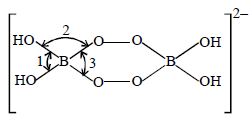
View full question & answer→MCQ 4211 Mark
$N{a_2}{B_4}{O_7}.10{H_2}O \xrightarrow{\Delta } X + NaB{O_2} + {H_2}O$
$X + C{r_2}{O_3}\xrightarrow{\Delta }Y$ (Green coloured)
$X$ and $Y$ are
- A
$Na_3BO_3, Cr(BO_2)_3$
- B
$Na_2B_4O_7, Cr(BO_2)_3$
- ✓
$B_2O_3, Cr(BO_2)_3$
- D
$B_2O_3, CrBO_3$
AnswerCorrect option: C. $B_2O_3, Cr(BO_2)_3$
c
Reaction of process: $Na _2 B _4 O _7 \cdot 10 H _2 O \stackrel{\text { Heat }}{\rightarrow} B _2 O _3+ NaBO _2+ H _2 O$
$3 B _2 O _3+ Cr _2 O _3 \stackrel{\text { Heat }}{\rightarrow} 2 Cr \left( BO _2\right)_3$
View full question & answer→MCQ 4221 Mark
The incorrect statement regarding above reactions is
$\mathop {Al}\limits_{metal} \xrightarrow[{(aq.)}]{{HCl}}'X' + Gas\,'P'$
$\mathop {Al}\limits_{metal} \xrightarrow[{ + {H_2}O}]{{NaOH\,(aq.)}}'Y' + Gas\,'Q'$
- A
$Al$ Show amphoteric nature
- ✓
Gas $'P'$ and Gas $'Q'$ are different
- C
Both $X$ and $Y$ are water soluble
- D
Gas $'Q'$ is inflammable
AnswerCorrect option: B. Gas $'P'$ and Gas $'Q'$ are different
b
$2 Al +6 HCl \longrightarrow 2 AlCl_ 3+3 H _2$
$Al + NaOH \longrightarrow NaAlO _2+ H _2$
View full question & answer→MCQ 4231 Mark
Consider the following flow diagram :-
Compound $X$ and $Y$ are respectively.
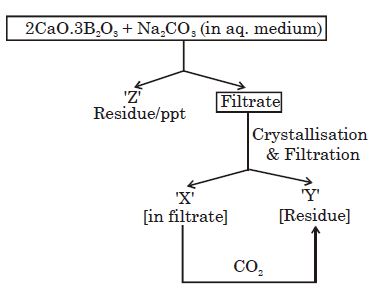
- A
$Na_2B_4O_7.10H_2O, B_2O_3$
- ✓
$NaBO_2, Na_2B_4O_7.10H_2O$
- C
$NaBO_2, CaCO_3$
- D
$Na_2B_4O_7.10H_2O, CaCO_3$
AnswerCorrect option: B. $NaBO_2, Na_2B_4O_7.10H_2O$
b
$\mathop {2CaO.3{B_2}{O_3}}\limits_{Colemanite} + 2N{a_2}C{O_3} \to $ $2CaCO_3^ - + N{a_2}{B_4}{O_7} + 2NaB{O_2}$ $\xrightarrow{\begin{subarray}{l}
Filtered \\
- CaC{O_3}\,(as\,residue)
\end{subarray} }\underbrace {N{a_2}{B_4}{O_7} + NaB{O_2}}_{in\,solution}$ $\xleftarrow[\begin{subarray}{l}
and\,allowed\,to\, \\
crystallise\,out \\
and\,filtered
\end{subarray} ]{{Concentrated}}\mathop {N{a_2}{B_4}{O_7}.10{H_2}O}\limits_{as\,residue} $ $\mathop { + NaB{O_2}}\limits_{in\,filtrate} \xrightarrow{\begin{subarray}{l}
C{O_2}\,passed\,and \\
crystallise\,out\,again
\end{subarray} }N{a_2}{B_4}{O_7}.10{H_2}O \downarrow $
$[4NaB{O_2} + C{O_2} \to N{a_2}{B_4}{O_7} + N{a_2}C{O_3}]$
View full question & answer→MCQ 4241 Mark
Which reaction involves a change in the electron pair geometry for the underlined element ?
- ✓
$\underline B{F_3} + {F^ - } \to B{F_4}^ - $
- B
$\underline N {H_3} + {H^ + } \to \underline N H_4^ + $
- C
$2\underline S {O_2} + {O_2} \to 2\underline S {O_3}$
- D
${H_2}\underline O + {H^ + } \to {H_3}{\underline O ^ + }$
AnswerCorrect option: A. $\underline B{F_3} + {F^ - } \to B{F_4}^ - $
a
Electronic geometry $ \Rightarrow $ Hybridisation
View full question & answer→MCQ 4251 Mark
Select the incorrect statement
$(a)$ $PCl_5$ form weak monobasic acid during hydrolysis
$(b)$ In $B_3N_3H_6$ nucleophile attack on $B-$ atom
$(c)$ $Al_2Cl_6$ is a polar and planar molecule
$(d)$ In $AlF_3$, hybridisation of $Al$ is $sp^2$
- A
$b, c$ and $d$
- B
$a, b, c$
- ✓
$a, c, d$
- D
$a, b, c, d$
AnswerCorrect option: C. $a, c, d$
c
$(a)$ $PC{l_5} + HOH \to {H_3}P{O_4} + HCl$
$(d)$ $\mathrm{AlF}_{3}-$ Ionic compound No hybridisation
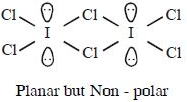
View full question & answer→MCQ 4261 Mark
$Al_4C_3$ is an ionic carbide, named as
Answerb
$Al _4 C _3$ is an ionic carbide, named is like methanide
View full question & answer→MCQ 4271 Mark
$AlCl_3$ on hydrolysis gives:
- A
$Al_2O_3 .H_2O$
- ✓
$Al(OH)_3$
- C
$Al_2O_3$
- D
$AlCl_3.6H_2O$
AnswerCorrect option: B. $Al(OH)_3$
b
$\mathrm{AlCl}_{3}$ on hydrolysis gives $\mathrm{Al}(\mathrm{OH})_{3}$
Hydrolysis is breaking with the help of water.
$\mathrm{AlCl}_{3}+3 \mathrm{H}_{2} \mathrm{O} \rightarrow \mathrm{Al}(\mathrm{OH})_{3}+3 \mathrm{HCl}$
Hence option B is correct.
View full question & answer→MCQ 4281 Mark
Which of the following sublimes on heating?
- A
$Al_2O_3$
- B
$Al(OH)_3$
- C
$(AlH_3)_n$
- ✓
$(AlCl_3)_n$
AnswerCorrect option: D. $(AlCl_3)_n$
d
Sublimation is the process where a solid directly converts into gas without reaching liquid state.
Ammonium chloride is the solid which directly converts into gas on heating.
View full question & answer→MCQ 4291 Mark
The gaseous product $(s)$ expected at room temperature by reaction of sodium borohydride and boron trifluoride under anhydrous conditions is/are:
- A
$H_2$
- B
$B_2H_6$ and $H_2$
- ✓
$B_2H_6$
- D
$BH_2F$ and $H_2$
AnswerCorrect option: C. $B_2H_6$
c
$3 \mathrm{Na}\left[\mathrm{BH}_{4}\right]+4 \mathrm{BF}_{3} \longrightarrow 2 \mathrm{B}_{2} \mathrm{H}_{6}(\mathrm{g})+3 \mathrm{Na}\left[\mathrm{BF}_{4}\right]$
$\mathrm{B}_{2} \mathrm{H}_{6}$ is the gaseous product
View full question & answer→MCQ 4301 Mark
Anhydrous $ALCl_3$ is covalent however,when it is dissolved in water hydrared ionic species are formed. This transformation is owing to
- A
the trivalent state of $Al$
- ✓
the large hydration energy of $Al^{3+}$
- C
the low hydration energy of $Al^{3+}$
- D
the polar nature of water
AnswerCorrect option: B. the large hydration energy of $Al^{3+}$
b
When $AlCl _3$ dissolves in water, it dissociates into cation and anion. And due to hydration of these ions compound; it dissolves in water so this happens due to large hydration energy of ions.
View full question & answer→MCQ 4311 Mark
The incorrect statement regarding above reactions is
$\mathop {Al}\limits_{Metal} \xrightarrow{{HCl(aq.)}}'X' + Gas\,'P'$
$\mathop {Al}\limits_{metal} \xrightarrow[{ + {H_2}O}]{{NaOH\,(aq.)}}'Y' + Gas\,'Q'$
- A
$Al$ shows amphoteric character
- ✓
Gas $'P'$ and $'Q'$ are different
- C
Both $X$ and $Y$ are water soluble
- D
Gas $Q$ is inflammable
AnswerCorrect option: B. Gas $'P'$ and $'Q'$ are different
b
$\mathop {Al}\limits_{Metal} \xrightarrow{{HCl(aq.)}}AlC{l_3} + \mathop {{H_2}}\limits_{(P)} \uparrow $
$\mathop {Al}\limits_{Metal} \xrightarrow[{ + {H_2}O}]{{NaOH(aq.)}}Na[Al{(OH)_4}] + \mathop {{H_2}}\limits_{(Q)} \uparrow $
View full question & answer→MCQ 4321 Mark
Compare $\pi - $ bond strength between $B$ and $N$ given in two compounds
$(I)$ $\begin{array}{*{20}{c}}
{{{\left( {C{H_3}} \right)}_3}Si - NB{H_2}}\\
{\,\,\,\,\,\,\,\,\,\,\,\,\,\,\,\,|}\\
{\,\,\,\,\,\,\,\,\,\,\,\,\,\,\,\,\,\,\,\,\,\,\,\,\,\,\,\,\,\,\,Si{{(C{H_3})}_3}}
\end{array}$ $(II)$ $\begin{array}{*{20}{c}}
{{{\left( {C{H_3}} \right)}_3}C - NB{H_2}}\\
{\,\,\,\,\,\,\,\,\,\,\,\,\,\,\,\,|}\\
{\,\,\,\,\,\,\,\,\,\,\,\,\,\,\,\,\,\,\,\,\,\,\,\,\,\,\,\,\,\,\,C{{(C{H_3})}_3}}
\end{array}$
AnswerCorrect option: D. $II > I$
View full question & answer→MCQ 4331 Mark
$(i)\,Al\,\xrightarrow{{{N_2}}}\,A$ $(ii)\,Al\,\xrightarrow{c}\,B$
Here $A$ and $B$ on hydrolysis respectively gives
- A
$NH_3, \,C_2H_2$
- B
$NO,\, CH_4$
- ✓
$NH_3,\,CH_4$
- D
$NO,\,C_2H_2$
AnswerCorrect option: C. $NH_3,\,CH_4$
c
$A = AlN \xrightarrow{{{H_2}O}} NH_3$
$B = Al_ 4C_3 \xrightarrow{{{H_2}O}} CH_4$
View full question & answer→MCQ 4341 Mark
$N{a_2}{B_4}{O_7}.10{H_2}O\,\xrightarrow{\Delta }$ $NaB{O_2} + \,(A)\, + \,{H_{2\,}}O(A)\, + $ $MnO\,\xrightarrow{\Delta }\,(B),\,(A)$ and $(B)$ are
AnswerCorrect option: C. $B_2O_3, Mn(BO_2)_2$
View full question & answer→MCQ 4351 Mark
$BCl_3 + H_2O \longrightarrow$ Product, here product
- ✓
$H_3BO_3 + HCl$
- B
$B_2O_3 + HOCl$
- C
$B_2H_6 + HCl$
- D
$B_2O_3 + HCl$
AnswerCorrect option: A. $H_3BO_3 + HCl$
a
$BCl _3+3 H _2 O \rightarrow H _3 BO _3+3 HCl$
The products formed in the reaction are $H _3 BO _3+3 HCl$.
View full question & answer→MCQ 4361 Mark
Which of the following organo-silicon compound on hydrolysis will give a three dimensional silicone
- A
${R_3}SiCl$
- ✓
$RSiC{l_3}$
- C
$SiC{l_4}$
- D
${R_2}SiC{l_2}$
AnswerCorrect option: B. $RSiC{l_3}$
View full question & answer→MCQ 4371 Mark
Which of the following upon hydrolysis can produce a hydrocarbon that has the same degree of unsaturation as are the number of carbon atoms present in the produced hydrocarbon
- ✓
$CaC_2$
- B
$Be_2C$
- C
$Al_4C_3$
- D
$Mg_2C_3$
AnswerCorrect option: A. $CaC_2$
a
$(i)$ $\mathrm{CaC}_{2} \stackrel{\mathrm{H}_{2} \mathrm{O}}{\longrightarrow} \mathrm{Ca}(\mathrm{OH})_{2}+\mathrm{C}_{2} \mathrm{H}_{2}(\mathrm{g})$
$\begin{array}{r}
{\mathrm{CH} \equiv \mathrm{CH} \longrightarrow \mathrm{no} \text { of carbon }=2} \\
{\mathrm{DU}=2}
\end{array}$
$\begin{gathered}
(ii)\,{\text{B}}{{\text{e}}_2}{\text{C}}\frac{{{{\text{H}}_2}{\text{O}}}}{{}}{\text{Be}}{({\text{OH}})_2} + {\text{C}}{{\text{H}}_4} \hfill \\
{\text{C}}{{\text{H}}_4}({\text{g}}) \to {\text{no}}\,of\,carbon = 1\,{\text{DU}} = 0 \hfill \\
\end{gathered} $
$(iii)$ $\mathrm{Al}_{4} \mathrm{C}_{3} \stackrel{\mathrm{H}_{2} \mathrm{O}}{\longrightarrow} \mathrm{Al}(\mathrm{OH})_{3}+\mathrm{CH}_{4}(\mathrm{g})$
$(iv)\,{\text{M}}{{\text{g}}_2}{{\text{C}}_3}\xrightarrow{{{{\text{H}}_2}{\text{O}}}}{\text{Mg}}{({\text{OH}})_3} + {{\text{C}}_3}{{\text{H}}_4}({\text{g}})$
$\begin{aligned}
\mathrm{C}_{3} \mathrm{H}_{4} \longrightarrow \mathrm{CH}_{3}-\mathrm{C} \equiv \mathrm{CH} \text { no. of carbon } &=3 \\
\mathrm{DU} &=2
\end{aligned}$
View full question & answer→MCQ 4381 Mark
Consider the following reactions
$M{e_3}SiCl\xrightarrow{{{H_2}O}}A$
$M{e_3}SiCl_2\xrightarrow{{{H_2}O}}B$
$MeSiCl_3\xrightarrow{{{H_2}O}}C$
$(A), (B)$ and $(C)$ are known as ____,____, and ____ respectively in silicones formation
- ✓
Terminal group , chain forming group, branching and bridging group
- B
Chain forming group, branching, bridging ground and terminal group
- C
Terminal group, branching and bridging group and chain forming group
- D
Branching and bridging group, Terminal group and chain forming group
AnswerCorrect option: A. Terminal group , chain forming group, branching and bridging group
View full question & answer→MCQ 4391 Mark
Which of the following are correct order of stability of oxidation states of cations
$(a)\ Pb^{+2} > Pb^{+4} , Tl^{+1} < Tl^{+3}$
$(b)\ Bi^{+3} < Sb^{+3 }, Sn^{+2} < Sn^{+4}$
$(c)\ Pb^{+2} > Pb^{+4} , Bi^{+3} > Bi^{+5}$
$(d)\ Tl^{+3} < In^{+3} , Sn^{+2} > Sn^{+4}$
$(e)\ Sn^{+24} < Pb^{+2} , Sn^{+4} > Pb^{+4}$
$(f)\ Sn^{+2} < Pb^{+2} , Sn^{+4} < Pb^{+4}$
- A
$e$ and $f$
- B
$a,$ $c$ and $d$
- C
$a,$ $b$ and $f$
- ✓
$c$ and $e$
AnswerCorrect option: D. $c$ and $e$
View full question & answer→MCQ 4401 Mark
If in a mineral $1000$ tetrahedral basic unit of silicates are arranged in chain then what will be the formula of anion of that mineral ?
- A
$S{i_{1000}}{O_{3000}} ^{- 2000}$
- B
$S{i_{1000}}{O_{3001}} ^{- 2004}$
- C
$S{i_{1000}}{O_{3000}} ^{-2001}$
- ✓
$S{i_{1000}}{O_{3001}} ^{-2002}$
AnswerCorrect option: D. $S{i_{1000}}{O_{3001}} ^{-2002}$
View full question & answer→MCQ 4411 Mark
Which of the following is electron precise type of hydride
- ✓
$GeH_4$
- B
$CaH_4$
- C
$NH_3$
- D
$CuH$
AnswerCorrect option: A. $GeH_4$
a
After sharing all valence electrons, when central atom completes its octet (without any lone pairs), then it is called electron precised hydrides.
View full question & answer→MCQ 4421 Mark
Formula of the following silicate anion structure is, where $ \bullet $ $ -'Si'$ atom, $o-'O'$ atom
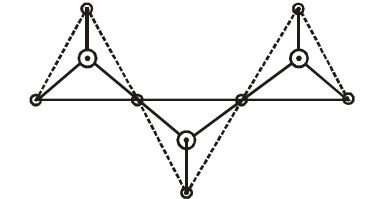
- A
$SiO_4^{4 - }$
- B
$S{i_2}O_7^{6 - }$
- ✓
$S{i_3}O_{10}^{ - 8}$
- D
$S{i_3}O_{9}^{ 6-}$
AnswerCorrect option: C. $S{i_3}O_{10}^{ - 8}$
c
$\left.\left(\mathrm{SiO}_{3}\right)_{\mathrm{n}}^{-2 \mathrm{n}}+\mathrm{O}^{-2} \text { (if } \mathrm{n}=\text { definite }\right)$
View full question & answer→MCQ 4431 Mark
$(Me)_2\, SiCl_2$ on condensation after hydrolysis will produce
- A
$Si(OH)_4$
- B
$(Me)_2 \,Si = O$
- ✓
$[—O—(Me)_2\, Si—O—]_n$
- D
$Me_2 \,SiCl(OH)$
AnswerCorrect option: C. $[—O—(Me)_2\, Si—O—]_n$
c
$R_2SiCl_2$ linear chain polymer
View full question & answer→MCQ 4441 Mark
${H_2}{C_2}{O_4}$ $\xrightarrow{\Delta }$ gas $(A)$ + gas $(B)$ + liquid $(C)$.
Gas $(A)$ burns with a blue flame and is oxidised to gas $(B)$
Gas $(A) + Cl_2 \to (D)$
$A, B$ and $D$ are
- A
$CO_2, CO, H_2O$
- B
$CO, CO_2, CO_2Cl_2$
- C
$CO, H_2O, NH_2CONH_2$
- ✓
$CO, CO_2, COCl_2$
AnswerCorrect option: D. $CO, CO_2, COCl_2$
d
${H_2}{C_2}{O_4}\xrightarrow{\Delta }\mathop {CO}\limits^{(A)} + \mathop {C{O_2}}\limits^{(B)} + \mathop {{H_2}O}\limits^{(C)} $
$\mathop {CO}\limits^{(A)} \xrightarrow{{{O_2}}}C{O_2}$
$CO + C{l_2} \to \mathop {COC{l_2}}\limits^{(D)} $
View full question & answer→MCQ 4451 Mark
$Si_3O_9^{-6}$ (having three tetrahedral) is represented as
Answerb
$(Si_3O_9^{-6})$ means cyclic silicate.
View full question & answer→MCQ 4461 Mark
$PbI_4$ does not exist because
- A
- ✓
$Pb(IV)$ is oxidizing and $I^-$ is strong reducing agent
- C
$Pb(IV)$ is less stable than $Pb(II)$
- D
$Pb^{4+}$ is not easily formed
AnswerCorrect option: B. $Pb(IV)$ is oxidizing and $I^-$ is strong reducing agent
b
$PbI_4$ does not exist because the iodine reduces the lead to $Pb\,(II)$ and the $Pb$ oxidizes the iodine to iodine$(I_2)$. Since the iodine is not a strong reducuing agent to reduce $Pb ( II )$ to $Pb$, the compound $PbI_2$ is formed.
View full question & answer→MCQ 4471 Mark
The gaseous product of the reaction between $Sn$ and conc. $H_2SO_4$ is
- A
$H_2$
- ✓
$SO_2$
- C
$SnH_4$
- D
$SO_3$
AnswerCorrect option: B. $SO_2$
b
Tin react with sulfuric acid to produce tin($II$) sulfate, sulfur dioxide and water.
View full question & answer→MCQ 4481 Mark
The dehydration of malonic acid $CH_2(COOH)_2$ with $P_4O_{10}$ gives:
View full question & answer→MCQ 4491 Mark
The structural of silicon $(IV)$ oxide belongs to the type
- A
- B
macromolecular, with a layer structure
- C
molecular lattice, with vander Waals' forces among the molecules
- ✓
macromolecular, with a non-layer structure
AnswerCorrect option: D. macromolecular, with a non-layer structure
d
$\mathrm{Si}(\mathrm{IV})$ oxide is macromolecular with a non layer structure similar to diamond.
View full question & answer→MCQ 4501 Mark
Consider the following route of reactions ${R_2}SiC{l_2} + Warer \to \left( A \right)\xrightarrow{{Polymarisation}}\left( B \right)$
Compound $(B)$ in above reaction is
View full question & answer→MCQ 4511 Mark
The substance that has the lowest boiling point is
- A
$HCl$
- B
$H_2S$
- C
$PH_3$
- ✓
$SiH_4$
AnswerCorrect option: D. $SiH_4$
d
$SiH _4$ has a lowest boiling point of $161\, K$
$H _2 S$ boiling point $216\, K$.
$HCl$ boiling point $188\, K$.
$PH _3$ boiling point $185\, K$
View full question & answer→MCQ 4521 Mark
Shape of $(SiH_3)_3N$ and $(SiH_3)_3P$ respectively are
- A
Trigonal planar, Trigonal planar
- ✓
Trigonal planar, Tetrahedral
- C
- D
Tetrahedral, Trigonal planar
AnswerCorrect option: B. Trigonal planar, Tetrahedral
View full question & answer→MCQ 4531 Mark
Name the two type of the structure of silicate in which one oxygen atom of $[SiO_4]^{4-}$ is shared ?
Answerc
In pyrosilicate, only one oxygen atom is shared.
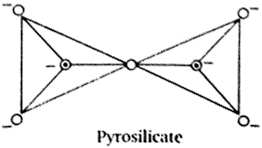
View full question & answer→MCQ 4541 Mark
Which of the following oxide is amphoteric ?
- ✓
$SnO_2$
- B
$CaO$
- C
$SiO_2$
- D
$CO_2$
AnswerCorrect option: A. $SnO_2$
a
$\mathrm{SnO}_{2}$ react with acid as well base
So amphoteric
$\mathrm{SnO}_{2}+4 \mathrm{HCl} \longrightarrow \mathrm{SnCl}_{4}+2 \mathrm{H}_{2} \mathrm{O}$
$\mathrm{SnO}_{2}+2 \mathrm{NaOH} \longrightarrow \mathrm{Na}_{2} \mathrm{SnO}_{3}+\mathrm{H}_{2} \mathrm{O}$
View full question & answer→MCQ 4551 Mark
The tendency of $BF_3, BCl_3$ and $BBr_3$ to behave as Lewis acid decreases in the sequence
- A
$BCl_3 > BF_3 > BBr_3$
- ✓
$BBr_3 > BCl_3 > BF_3$
- C
$BBr_3 > BF_3 > BCl_3$
- D
$BF_3 > BCl_3 > BBr_3$
AnswerCorrect option: B. $BBr_3 > BCl_3 > BF_3$
b
As the extent of $p \pi-p \pi$ back bonding decreases, electron-deficiency increases and hence the Lewis acid strength increases.
View full question & answer→MCQ 4561 Mark
The stability of $+ 1$ oxidation state among $Al,Ga, In$ and $Tl$ increases in the sequence
- ✓
$Al < Ga < In < Tl$
- B
$Tl < In < Ga < Al$
- C
$In < Tl < Ga < Al$
- D
$Ga < In < Al < Tl$
AnswerCorrect option: A. $Al < Ga < In < Tl$
a
$\mathrm{Al}<\mathrm{Ga}<\mathrm{In}<\mathrm{TI}$
This is due to inert pair effect or tendency of $ns^2$ electrons do not participate in bond formation. This tendency decreases on moving down the group.
View full question & answer→MCQ 4571 Mark
Which of the following oxidation states are the most characteristic for lead and tin respectively ?
- ✓
$+2, +4$
- B
$+4, +4$
- C
$+2, +2$
- D
$+4, +2$
AnswerCorrect option: A. $+2, +4$
a
When $ns^2$ electrons of outermost shell do not participate in bonding then these $ns^2$ electrons are called inert pair and the effect is called inert pair effect. Due to this inert pair effect Ge, $5 n$ and $P b$ of group $IV$ have a tendency to form both $+4$ and $+2$ ions. Now the inert pair effect increases down the group, hence the stability of $M^{2+}$ ions increases and $M^{4+}$ ions decreases down the group. For this reason, $P b^{2+}$ is more stable than $\mathrm{pb}^{4+}$ and $\mathrm{Sn}^{4-}$ is more stable than $\mathrm{Sn}^{2+}$
View full question & answer→MCQ 4581 Mark
Which of the following anions is present in the chain structure of silicates ?
- A
$(Si_2O_5^{2-})_n$
- ✓
$(SiO_3^{2-})_n$
- C
$SiO_4^-$
- D
$Si_2O_7^{6-}$
AnswerCorrect option: B. $(SiO_3^{2-})_n$
b
Chain silicates are formed by sharing two oxygen atoms by each tetrahedra. Anions of chain silicate have two general formula:
(i) $\left(5 i 0_{3}^{2}\right)_{n}^{2 n}$
(ii) $\left(5 i_{4} \mathrm{O}_{11}\right)_{n}^{6 n-}$
View full question & answer→MCQ 4591 Mark
The correct order regarding the electronegativity of hybrid orbitals of carbon is
- A
$sp < sp^2 < sp^3$
- B
$sp > sp^2 < sp^3$
- ✓
$sp > sp^2 > sp^3$
- D
$sp < sp^2 > sp^3$
AnswerCorrect option: C. $sp > sp^2 > sp^3$
c
The correct order regarding the electronegativity of hybrid orbitals of carbon is $sp >s p^{2}>s p^{3}$ because in $sp, sp^{2}$ and $s p^{3}$ hybrid orbitals s-orbital character is $50 \%, 33.3 \%$ and $25 \%$ respectively and due to higher s-character electron attracting tendency, i.e. electronegativity increases.
View full question & answer→MCQ 4601 Mark
Which one of the following statements about the zeolites is false
AnswerCorrect option: B. Some of the $SiO_4^{ - 4}$ units are replaced by $AlO_4^{ - 5}$ and $AlO_6^{9 - }$ ions in zeolites
b
(b) Zeolite have $Si{O_4}$ and $Al{O_4}$ tetrahedrons linked together in a three dimensional open structure in which four or six membered ring predominate. Due to open chain structure they have cavities and can take up water and other small molecules.
View full question & answer→MCQ 4611 Mark
Glass reacts with $HF$ to produce
- ✓
$Si{F_4}$
- B
${H_2}Si{F_6}$
- C
${H_2}Si{O_3}$
- D
$N{a_3}Al{F_6}$
AnswerCorrect option: A. $Si{F_4}$
View full question & answer→MCQ 4621 Mark
Purification of aluminium done by electrolytic refining is known as
Answerd
Purification of aluminium by electrolytic refining is called Hoope's process. By this method $99.9\, \%$ pure aluminium metal is obtained. The cell used in this method consists of three layers. In the cell pure $Al$ acts as cathode while anode is of impure $Al.$
View full question & answer→MCQ 4631 Mark
Percentage of lead in lead pencil is
Answera
Pencils are no longer made of lead they are now made from a mixture of clay and graphite.
Hence, $0 \,\%$ of lead are present in pencil.
View full question & answer→MCQ 4641 Mark
Aluminium $(III)$ chloride forms a dimer because
AnswerCorrect option: A. Higher coordination number can be achieved by aluminium
a
$AlCl _3$ can form dimer and exists as $Al _2 Cl _6$, aluminium has vacant $d$-orbitals which can accommodate electron from chlorine atom. $AlCl _3$ is an electron deficient compound in $Al$ (octet incomplete) thus behaves as Lewis acid and $Al$ completes it by taking electron pair from $Cl$-atom as shown in figure.
View full question & answer→MCQ 4651 Mark
Which of the following statements about ${H_3}B{O_3}$ is not correct
AnswerCorrect option: A. It is a strong tribasic acid
a
It is weak monoprotic acid and it does not act as proton donor but removes proton from water.
View full question & answer→MCQ 4661 Mark
Carbon and silicon belong to $(IV)$ group. The maximum coordination number of carbon in commonly occurring compounds is $4$, whereas that of silicon is $6$. This is due to
AnswerCorrect option: C. Availability of low lying $d$ - orbitals in silicon
c
$C -2 s ^2 2 p ^2$
$Si -3 s ^2 3 p ^2$
Carbon has no $d$-orbital to expand but $Si$ has vacant $d$-orbitals and it can expand its valency using these vacand $d$-orbitals and forms $6$ coordinated compounds.
View full question & answer→MCQ 4671 Mark
Which one of the following statements is not correct
- A
Zinc dissolves in sodium hydroxide solution
- B
Carbon monoxide reduces iron $(III)$ oxide to iron
- C
Mercury $(II)$ iodide dissolves in excess of potassium iodide solution
- ✓
Tin $(IV)$ chloride is made by dissolving tin solution in concentrated hydrochloric acid
AnswerCorrect option: D. Tin $(IV)$ chloride is made by dissolving tin solution in concentrated hydrochloric acid
d
Zinc dissolves in sodium hydroxide solution due to formation of
$Zn + NaOH \rightarrow Na _2 ZnO _2 \text {. }$
Mercury $(II)$iodide dissolves in excess of potassium iodide solution due to formation of
$HgI _2+2 KI \rightarrow K _2 HgI _4$
Tin $(IV)$ chloride is made by
$Sn +2 Cl _2 \rightarrow SnCl _4$
View full question & answer→MCQ 4681 Mark
Which of the following is a formula of methanides:
$(a)$ $Be _{2} C$
$(b)$ $CaC _{2}$
$(c)$ $Mg _{2} C _{3}$
$(d)$ $Al _{4} C _{3}$
- ✓
Only $a, d$
- B
Only $a, b$
- C
Only $c, d$
- D
Only $b, d$
AnswerCorrect option: A. Only $a, d$
a
The reactions that give methanides are as follows.
$Be _{2} C +4 H _{2} O \rightarrow 2 Be ( OH )_{2}+ CH _{4}$
$CaC _{2}+2 H _{2} O \rightarrow Ca ( OH )_{2}+ C _{2} H _{2}$
$Mg _{2} C _{3}+4 H _{2} O \rightarrow 2 Mg ( OH )_{2}+ C _{3} H _{4}$
$SiC + H _{2} O \stackrel{\text { above } 1300^{\circ} C }{\longrightarrow} SiO _{2}+ CH _{4}$
View full question & answer→MCQ 4691 Mark
Assertion : Atomic radius of gallium is higher than that of aluminium
Reason : The presence of additional $d-$ electron offer poor screening effect for the outer electrons from increased nuclear charge.
- A
If the Assertion is correct but Reason is incorrect.
- B
If both Assertion and Reason are correct but Reason is not a correct explanation of the Assertion.
- ✓
If both Assertion and Reason are correct and the Reason is a correct explanation of the Assertion.
- D
If both the Assertion and Reason are incorrect.
AnswerCorrect option: C. If both Assertion and Reason are correct and the Reason is a correct explanation of the Assertion.
c
Atomic radius of gallium is less than that of aluminium.
View full question & answer→MCQ 4701 Mark
The liquefied metal which expands on solidification is
Answera
Gallium $(Ga)$ is soft , silvery metal. Its melting point is $30\,^oC$. This metal expands by $3.1\%$ when it solidifies and hence, it should not be stored in glass or metal containers.
View full question & answer→MCQ 4711 Mark
A neutral molecule $XF_3$ has a zero dipole moment. The element $X$ is most likely
Answerb
$BF_3$ has planar and symmetrical structure thus as a result the resultant of two bond moments, being equal and opposite to the third, cancels out and hence molecule possess zero dipole moment.
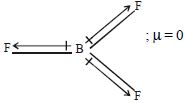
View full question & answer→MCQ 4721 Mark
The correct formula of borax is
- A
$Na_2[B_4O_4(OH)_3].9 H_2O$
- ✓
$Na_2[B_4O_5(OH)_4].8 H_2O$
- C
$Na_2[B_4O_6(OH)_5].7 H_2O$
- D
$Na_2[B_4O_7(OH)_6].6 H_2O$
AnswerCorrect option: B. $Na_2[B_4O_5(OH)_4].8 H_2O$
b
Borax is sodium tetraborate decahydrate i.e. $Na_2[B_4O_5(OH)_4].8H_2O$
View full question & answer→MCQ 4731 Mark
Assertion : Both $Be$ and $Al$ can form complexes such as $BeF_4^{2-}$ and $AlF_6^{3-}$ respectively, $BeF_6^{3-}$ is not formed.
Reason : In case of $Be$, no vacant $d-$ orbitals are present in its outermost shell.
- ✓
If both Assertion and Reason are correct and the Reason is a correct explanation of the Assertion.
- B
If both Assertion and Reason are correct but Reason is not a correct explanation of the Assertion.
- C
If the Assertion is correct but Reason is incorrect.
- D
If both the Assertion and Reason are incorrect.
AnswerCorrect option: A. If both Assertion and Reason are correct and the Reason is a correct explanation of the Assertion.
a
Both assertion and reason are correct and reason is correct explanation of assertion.
View full question & answer→MCQ 4741 Mark
Assertion : Silicones are hydrophobic in nature.
Reason : $Si -O -Si$ linkages are moisture sensitive.
- A
If both Assertion and Reason are correct and the Reason is a correct explanation of the Assertion.
- ✓
If both Assertion and Reason are correct but Reason is not a correct explanation of the Assertion.
- C
If the Assertion is correct but Reason is incorrect.
- D
If both the Assertion and Reason are incorrect.
AnswerCorrect option: B. If both Assertion and Reason are correct but Reason is not a correct explanation of the Assertion.
View full question & answer→MCQ 4751 Mark
Carbon cannot be used to produce magnesium by chemical reduction of $MgO$ because
- A
Carbon is not a powerful reducing agent
- ✓
Magnesium reacts with carbon to form carbides
- C
Carbon does not react with magnesium
- D
AnswerCorrect option: B. Magnesium reacts with carbon to form carbides
b
Carbon cannot be used to produce magnesium by chemical reduction of $MgO$ because magnesium reacts with carbon to form carbides.
$2 Mg +3 C \stackrel{2000^{\circ} C }{\longrightarrow} Mg _2 C _3$
View full question & answer→MCQ 4761 Mark
Carborundum is obtained when silica is heated at high temperature with
Answera
Silica on heating with carbon at elevated temperature, gives carborundum (silicon carbide)
$Si{O_2}\, + \,3C\,\xrightarrow{\Delta }\,\mathop {SiC}\limits_{carborundum} \, + \,2CO$
Carborundum is a very hard substance
View full question & answer→MCQ 4771 Mark
Assertion : $Pb^{4+}$ compounds are stronger oxidizing agents than $Sn^{4+}$ compounds.
Reason : The higher oxidation states for the group $14$ elements are more stable for the heavier members of the group due to ‘inert pair effect’.
- A
If both Assertion and Reason are correct and the Reason is a correct explanation of the Assertion.
- B
If both Assertion and Reason are correct but Reason is not a correct explanation of the Assertion.
- ✓
If the Assertion is correct but Reason is incorrect.
- D
If both the Assertion and Reason are incorrect.
AnswerCorrect option: C. If the Assertion is correct but Reason is incorrect.
c
Assertion is true because lower oxidation state becomes more and more stable for heavier elements in $p-$ block due to inert pair effect. Hence Reason is false.
View full question & answer→MCQ 4781 Mark
An inorganic salt $(A)$ is decomposed on heating to give two products $(B)$ and $(C)$. Compound $(C)$ is a liquid at room temperature and is neutral to litmus while the compound $(B)$ is a colourless neutral gas. Compounds $(A)$, $(B)$ and $(C)$ are
- ✓
$NH_4NO_3,\,N_2O,\,H_2O$
- B
$NH_4NO_2,\,NO,\,H_2O$
- C
$CaO,\,H_2O,\,CaCl_2$
- D
$Ba(NO_3)_2,\,H_2O,\,NO_2$
AnswerCorrect option: A. $NH_4NO_3,\,N_2O,\,H_2O$
a
Reaction involved is :
$\mathop {N{H_4}N{O_3}\,}\limits_A \xrightarrow{\Delta }\,\mathop {{N_2}O}\limits_B \, + \,\mathop {2{H_2}O}\limits_C $
Hence option $(a)$ is correct.
View full question & answer→MCQ 4791 Mark
$Ge\,(II)$ compounds are powerful reducing agents whereas $Pb\,(IV)$ compounds are strong oxidants. It can be due to
- A
$Pb$ is more electropositive than $Ge$
- B
Ionization potential of lead is less than that of $Ge$
- C
Ionic radii of $Pb^{2+}$ and $Pb^{4+}$ are larger than those of $Ge^{2+}$ and $Ge^{4+}$
- ✓
More pronounced inert pair effect in lead than in $Ge$
AnswerCorrect option: D. More pronounced inert pair effect in lead than in $Ge$
d
$Ge\,(II)$ tends to acquire $Ge\,(IV)$ state by loss of electrons. Hence it is reducing in nature. $Pb\,(IV)$ tends to acquire $Pb\,(II)$ $O.S$. by gain of electrons. Hence it is oxidising in nature. This is due to inert pair effect.
View full question & answer→MCQ 4801 Mark
Which of the following product is formed when $SiF_4$ reacts with water ?
- A
$SiF_3$
- ✓
$H_4SiO_4$
- C
$H_2SO_4$
- D
$H_2SiF_4$
AnswerCorrect option: B. $H_4SiO_4$
b
In reaction with water, $SiF_4$ (like $SiCl_4$ ) gets hydrolysed to form $H_4SiO_4$ (silicic acid).
$Si{F_4} + 4{H_2}O \to \mathop {Si{{(OH)}_4}\,or\,{H_4}Si{O_4}}\limits_{{\text{(Silicic acid)}}} + 4HF$
View full question & answer→MCQ 4811 Mark
Assertion : Coloured cations can be identified by borax bead test.
Reason : Transparent bead $(NaBO_2 + B_2O_3)$ forms coloured bead with coloured cation.
- ✓
If both Assertion and Reason are correct and the Reason is a correct explanation of the Assertion.
- B
If both Assertion and Reason are correct but Reason is not a correct explanation of the Assertion.
- C
If the Assertion is correct but Reason is incorrect.
- D
If both the Assertion and Reason are incorrect.
AnswerCorrect option: A. If both Assertion and Reason are correct and the Reason is a correct explanation of the Assertion.
a
Borax $(Na_2B_4O_7)$ when heated at about $740\,^oC$, forms a glassy bead which gives
different colour beads with different cations. Hence, it is used to identify cations in qualitative analysis. This test is called borax bead test.
$N{{a}_{2}}{{B}_{4}}{{O}_{7}}\,\xrightarrow{740\,{{\,}^{o}}C}\underbrace{\underset{\begin{smallmatrix}
\,\,\,\text{sodium } \\
\text{metaborate}
\end{smallmatrix}}{\mathop{2NaB{{O}_{2}}}}\,\,+\,\,\underset{\begin{smallmatrix}
\text{ boric} \\
anhydride
\end{smallmatrix}}{\mathop{{{B}_{2}}{{O}_{3}}}}\,}_{\text{glassy bead}}$
View full question & answer→MCQ 4821 Mark
Thermodynamically, the most stable form of carbon is
Answerb
Graphite is thermodynamically, the most stable allotrope of carbon. That is why $\Delta _fH^o$ (graphite) is taken as zero.
$\Delta _fH^o$ (diamond) $= +1.90\,kJ\,mol^{-1}$
$\Delta _fH^o$ (fullerene) $= +38.1\,kJ\,mol^{-1}$
View full question & answer→MCQ 4831 Mark
Assertion : $PbCl_2$ is more stable than $PbCl_4$.
Reason : $PbCl_4$ is powerful oxidising agent.
- A
If both Assertion and Reason are correct and the Reason is a correct explanation of the Assertion.
- ✓
If both Assertion and Reason are correct but Reason is not a correct explanation of the Assertion.
- C
If the Assertion is correct but Reason is incorrect.
- D
If both the Assertion and Reason are incorrect.
AnswerCorrect option: B. If both Assertion and Reason are correct but Reason is not a correct explanation of the Assertion.
b
$Pb^{2+}$ is more stable than $Pb^{4+}$ due to inert pair effect. Due to this reason, $PbCl_4$ decomposer readily into $PbCl_2$ and $Cl_2$
$PbCl_4 \to PbCl_2 + Cl_2$
Thus $Pb^{4+}$ salts are better oxidising agents
View full question & answer→MCQ 4841 Mark
Select correct statement $(s)$.
- A
Cyanamide ion $(CN_2\,^{2-})$ is isoelectronic with $CO_2$ and has the same linear structure
- B
$Mg_2C_3$ reacts with water to form propyne
- C
$CaC_2$ has $NaCl$ type lattice
- ✓
Answerd
In $CO_2$ we have $22(6+8+8=22)$ electrons.
In $(CN_2^{2-})$, we have $22(6+7+7+2=22)$ electrons. Both $CO_2$ and $(CN_2^{2-})$ have linear structures. Thus, statement $(a)$ is correct.
$M{{g}_{2}}{{C}_{3}}+4{{H}_{2}}O\to 2Mg{{(OH)}_{2}}+\underset{\Pr opyne}{\mathop{C{{H}_{3}}C\equiv CH}}\,$
i.e., statement $(b)$ is also correct.
The structure of $CaC_2$ is of $NaCl$ type
i.e., statement $(c)$ is also correct.
View full question & answer→MCQ 4851 Mark
Non-oxide ceramics can be
Answerd
Ceramics are inorganic , non-metallic, solid minerals. They come in a variety of forms, including silicates (silica, $SiO_2$ with metal oxides), oxides (oxygen and metals), carbides (carbon and metals), aluminates (alumina, $Al_2O_3$ with metal oxides) and nitrides.
The given ceramics are $B_4C$ (carbides), $SiC$ (carbides), $Si_3N_4$ (nitrides) and thus, none of these is an oxide . All of these are nonoxide ceramics.
View full question & answer→MCQ 4861 Mark
The repeating unit in silicone is
- A
$SiO_2$
- ✓
$\begin{array}{*{20}{c}}
{\begin{array}{*{20}{c}}
{R\,\,\,\,\,\,\,} \\
{|\,\,\,\,\,\,\,\,\,}
\end{array}} \\
{ - Si - {O^ - }} \\
{|\,\,\,\,\,\,\,\,\,\,} \\
{R\,\,\,\,\,\,\,\,\,}
\end{array}$
- C
$\begin{array}{*{20}{c}}
{R\,\,\,\,\,\,\,\,\,\,\,\,\,\,\,\,\,\,\,\,\,} \\
{|\,\,\,\,\,\,\,\,\,\,\,|\,\,\,\,\,\,\,\,\,\,\,\,} \\
{O - Si - {O^ - }} \\
| \\
R
\end{array}$
- D
$\begin{array}{*{20}{c}}
{\,\,|\,\,\,\,\,\,\,\,\,\,\,\,\,\,\,\,\,\,\,\,\,\,\,\,\,\,\,\,\,\,\,} \\
{ - Si - O - O - R} \\
{|\,\,\,\,\,\,\,\,\,\,\,\,\,\,\,\,\,\,\,\,\,\,\,\,\,\,\,\,\,\,\,} \\
{R\,\,\,\,\,\,\,\,\,\,\,\,\,\,\,\,\,\,\,\,\,\,\,\,\,\,\,\,\,\,}
\end{array}$
AnswerCorrect option: B. $\begin{array}{*{20}{c}}
{\begin{array}{*{20}{c}}
{R\,\,\,\,\,\,\,} \\
{|\,\,\,\,\,\,\,\,\,}
\end{array}} \\
{ - Si - {O^ - }} \\
{|\,\,\,\,\,\,\,\,\,\,} \\
{R\,\,\,\,\,\,\,\,\,}
\end{array}$
b
Polymeric organosilicon compounds containing $Si-O-Si$ bonds are called silicones. Silicones have general formula $(R_2SiO)_n$. Hence repeating unit of silicone is $R_2SiO^ -$.
View full question & answer→MCQ 4871 Mark
Borax is used as cleansing agent because on dissolving in water it gives
Answera
Borax is $Na_2B_4O_7.10H_2O$. It gives alkaline solution on dissolution in water as it is a salt of strong base and weak acid.
$Na_2B_4O_7 + 7H_2O \to 4H_3BO_3 + 2NaOH$
View full question & answer→MCQ 4881 Mark
Assertion : Silicones are hydrophobic in nature.
Reason : $Si-O-Si$ linkages are moisture sensitive.
- A
If both Assertion and Reason are correct and the Reason is a correct explanation of the Assertion.
- B
If both Assertion and Reason are correct but Reason is not a correct explanation of the Assertion.
- ✓
If the Assertion is correct but Reason is incorrect.
- D
If both the Assertion and Reason are incorrect.
AnswerCorrect option: C. If the Assertion is correct but Reason is incorrect.
c
Silicons are hydrophobic in nature i.e. it is water repellant because most of the groups which form bulky silicon molecule are organic in nature so they are water repellant. Thus assertion is true. The $Si-O-Si$ linkages are stable, so these are moisture resistant. Hence reason is false.
View full question & answer→MCQ 4891 Mark
In diborane, the two $H - B - H$ angles are nearly
- A
$60^°$, $120^°$
- ✓
$95^°$, $120^°$
- C
$95^°$, $150^°$
- D
$120^°$, $180^°$
AnswerCorrect option: B. $95^°$, $120^°$
b
(b) Dilthey in $1921$ proposed a bridge structure for diborane. Four hydrogen atoms, two on the left and two on the right, known as terminal hydrogens and two boron atoms lie in the same plane. Two hydrogen atoms forming bridges, one above and other below, lie in a plane perpendicular to the rest of molecule.
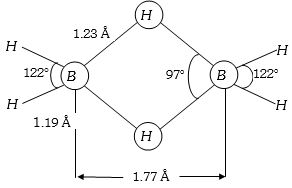
View full question & answer→MCQ 4901 Mark
Assertion : $SiF_6^{2-}$ is known but $SiCl_6^{2-}$ is not
Reason : Size of fluorine is small and its lone pair of electrons interacts with $d-$ orbitals of $Si$ strongly.
- ✓
If both Assertion and Reason are correct and the Reason is a correct explanation of the Assertion.
- B
If both Assertion and Reason are correct but Reason is not a correct explanation of the Assertion.
- C
If the Assertion is correct but Reason is incorrect.
- D
If both the Assertion and Reason are incorrect.
AnswerCorrect option: A. If both Assertion and Reason are correct and the Reason is a correct explanation of the Assertion.
a
$SiF_6^{2-}$ is known because $F$ has small size and thus the ion is quite stable unlike $SiCl_6^{2-}$ in which size of $Cl$ atom is large which destabilise it.
View full question & answer→MCQ 4911 Mark
The liquid field metal expanding on solidification is
Answera
(a) Liquified Ga expand on solidification $Ga$ is less electropositive in nature, It has the weak metallic bond so it expand on solidification.
View full question & answer→MCQ 4921 Mark
Which of the following is only acidic in nature
- A
$Be{(OH)_2}$
- B
$Mg{(OH)_2}$
- ✓
$B{(OH)_3}$
- D
$Al{(OH)_3}$
AnswerCorrect option: C. $B{(OH)_3}$
c
(c) Except $B{(OH)_3}$ all other hydroxide are of metallic hydroxide having the basic nature $B{(OH)_3}$ are the hydroxide of nonmetal showing the acidic nature.
View full question & answer→MCQ 4931 Mark
Assertion : $PbI_4$ is a stable compound.
Reason : Iodide stabilizes higher oxidation state
- A
If both Assertion and Reason are correct and the Reason is a correct explanation of the Assertion.
- B
If both Assertion and Reason are correct but Reason is not a correct explanation of the Assertion.
- C
If the Assertion is correct but Reason is incorrect.
- ✓
If both the Assertion and Reason are incorrect.
AnswerCorrect option: D. If both the Assertion and Reason are incorrect.
d
As we move down the group $IVA$, $+2$ oxidation state becomes more stable. Thus $Pb^{4+}$ is not possible, i.e., $PbI_4$ is highly unstable. $I_2$ is a weak oxidising agent so it cannot oxidise $Pb$ to $Pb^{4+}$ oxidation state. So assertion and reason both are wrong.
View full question & answer→MCQ 4941 Mark
Assertion : Diamond is a bad conductor.
Reason : Graphite is a good conductor.
- A
If both Assertion and Reason are correct and the Reason is a correct explanation of the Assertion.
- ✓
If both Assertion and Reason are correct but Reason is not a correct explanation of the Assertion.
- C
If the Assertion is correct but Reason is incorrect.
- D
If both the Assertion and Reason are incorrect.
AnswerCorrect option: B. If both Assertion and Reason are correct but Reason is not a correct explanation of the Assertion.
b
Diamond is a bad conductor because of lack of free electrons in its lattice. Graphite is a good conductor of electricity because of free electron in its lattice. So both assertion and reason are correct but reason is not correct explanation of assertion.
View full question & answer→MCQ 4951 Mark
Assertion : Stannous chloride gives grey precipitate with mercuric chloride, but stannic chloride does not do so.
Reason : Stannous chloride is a powerful oxidising agent which oxidises mercuric chloride to metallic mercury.
- A
If both Assertion and Reason are correct and the Reason is a correct explanation of the Assertion.
- B
If both Assertion and Reason are correct but Reason is not a correct explanation of the Assertion.
- ✓
If the Assertion is correct but Reason is incorrect.
- D
If both the Assertion and Reason are incorrect.
AnswerCorrect option: C. If the Assertion is correct but Reason is incorrect.
c
$Sn^{4+}$ is more stable than $Sn^{2+}$
So, $Sn^{2+}$ is oxidised to $Sn^{4+}$ by losing $2$ electrons when it reacts with mercuric chloride, i.e., $SnCl_2$ is a reducing agent.
$2HgC{{l}_{2}}+SnC{{l}_{2}}\to H{{g}_{2}}C{{l}_{2}}+SnC{{l}_{4}}$
$H{{g}_{2}}C{{l}_{2}}+SnC{{l}_{2}}\to \underset{(grey\,ppt)}{\mathop{2Hg}}\,+SnC{{l}_{4}}$
View full question & answer→MCQ 4961 Mark
Which of the following is the correct statement for red lead
- A
It is an active form of lead
- B
Its molecular formula is $P{b_2}{O_3}$
- C
It decomposes into $Pb$ and $C{O_2}$
- ✓
It decomposes into $PbO$ and ${O_2}$
AnswerCorrect option: D. It decomposes into $PbO$ and ${O_2}$
d
(d) Generally red lead decompose into $PbO$ and ${O_2}$.
View full question & answer→MCQ 4971 Mark
The purification of alumina is called
Answerc
(c) The purification of alumina can be done by Baeyer’s process.
View full question & answer→MCQ 4981 Mark
Which of the following glass is used in making wind screen of automobiles
Answerc
The windscreen of automobiles is made up of safety glass.
Safety glass is glass with additional safety features that make it less likely to break, or less likely to pose a threat when broken.
View full question & answer→MCQ 4991 Mark
Bauxite containing impurities of iron oxide is purified by
Answerc
(c) For the purification of red bauxite which contains iron oxide as impurity $\to$ Baeyer’s process. For the purification of white bauxite which contains silica as the main impurity Serpeck’s process.
View full question & answer→MCQ 5001 Mark
Assertion : $Al(OH)_3$ is insoluble in $NH_4OH$ but soluble in $NaOH$ .
Reason : $NaOH$ is strong alkali.
- ✓
If both Assertion and Reason are correct and the Reason is a correct explanation of the Assertion.
- B
If both Assertion and Reason are correct but Reason is not a correct explanation of the Assertion.
- C
If the Assertion is correct but Reason is incorrect.
- D
If both the Assertion and Reason are incorrect.
AnswerCorrect option: A. If both Assertion and Reason are correct and the Reason is a correct explanation of the Assertion.
a
$Al(OH)_3$ is soluble in strong alkali like $NaOH$ because of formation of meta-aluminate ion
$NaOH + Al(OH)_3 \to NaAlO_2 + 2H_2O$
View full question & answer→