Question
Alveoli are very flexible.

Answer

  1. Alveoli are made up of collagen and elastin fibres.
  2. They are very thin (0.0001 mm) and lined by non-ciliated squamous epithelium.
  3. All the above structural components make the alveoli very flexible.

Need a full question paper?

Generate a complete, print-ready paper with questions like this in minutes — across 16+ boards, with answer keys.

Start Generating Free

Similar questions

Where are parathyroid glands located? What are their functions?### Write a short note on the functions of Parathyroid hormone (PTH).
During a medical investigation, an infant was found to possess an extra chromosome 21. Describe the symptoms the child is likely to develop later in the life.
Name the infective stage of Plasmodium. Give Symptoms of malaria
Study the figure (a) and (b) given below and answer the questions given after the graphs.
  1. Under the influence of which type of Natural Selection would graph (a) become like graph.
  2. What could be the likely reasons of new variations arising in the population?
  3. Who suggested Natural Selection as a mechanism of evolution?
Given below is a list of six micro-organisms. State their usefulness to humans.
  1. Nucleopolyhedrovirus.
  2. Saccharomyces cerevisiae.
  3. Monascus purpureus.
  4. Trichoderma polysporum.
  5. Penicillium notatum.
  6. Propionibacterium sharmanii.
Why are plants obtained through micropropagation termed somaclones? Name three food plants produced on commercial scale using this method.
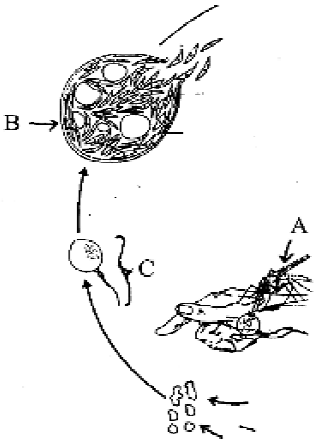
Study a part of the life cycle of malarial parasite given below. Answer the questions that follow:
  1. Mention the roles of ‘A’ in the life cycle of the malarial parasite.
  2. Name the event ‘C and the organ where this event occurs.
  3. Identify the organ ‘B’ and name the cells being released from it.
Explain the structure of cyton.
Enlist the steps involved in inbreeding of cattle. Suggest two disadvantages of this practice.
A heavily bleeding and bruised road accident victim was brought to a nursing home. The doctor immediately gave him an injection to protect him against a deadly disease.
  1. Write what did the doctor inject into the patient's body.
  2. How do you think this injection would protect the patient against the disease?
  3. Name the disease against which this injection was given and the kind of immunity it provides.