The fluid seen in the intercellular spaces in Human is …………………..
- Ablood
- ✓lymph
- Cinterstitial fluid
- Dwater
Answer: B.
View full solution →708 questions across 10 question groups — pick any mix to generate a BIOLOGY paper with step-by-step answer keys.
MCQ
164 Q→02Answer the following questions
226 Q→03Answer the following questions.
44 Q→04Answer the following questions in detail.
82 Q→05Answer the following questions in detail.
90 Q→06Complete the following table.
11 Q→07Diagram based question.
10 Q→08Write the short note.
18 Q→09Answer the following in detail :
34 Q→10Case study (4 Marks)
29 Q→One sample from each question group in this chapter. Select any group above to see the full set with answer keys.
Answer: B.
View full solution →Answer: A.
View full solution →Answer: C.
View full solution →Answer: B.
View full solution →Answer: A.
View full solution →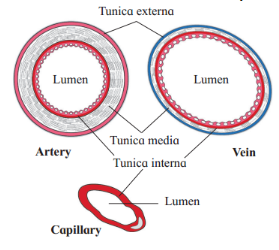
| Instrument / Technique | Purpose of use |
| Sphygmomanometer | ——————— |
| —————- | X-ray imaging of the cardiac blood vessels to locate the position of blockages. |
| ————— | To measure ECG. |
| Cardiovascular disorders | Symptom |
| Coronary Artery Diseases (CAD) | Deposition of calcium, fat, cholesterol and ——————— |
| —————- | Pain in chest resulting from reduction in the blood supply to the cardiac muscles. |
| Silent Heart Attack | Myocardial infarction without ———————- |
| Waves on ECG | Heart Activity | Caused due to |
| P wave | Atrial contraction | —————- |
| QRS wave | —————– | Ventricular depolarization |
| T wave | —————– | Ventricular repolarization |
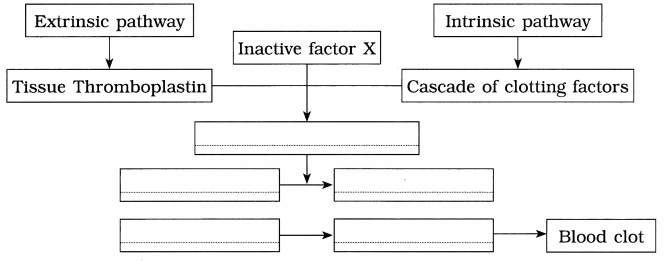
| WBCS | % | Nucleus | Function |
| Neutrophils | 70% | ___________ | ______________________________ |
| __________ | ________ | Twisted | Secretes heparin, histamine and serotonin |
| Fosinophils | _______ | __________ | Antihistamin/Antiallergic in function |
| Manocytes | 3-5% | __________ | ________________________________ |
| ________ | _________ | __________ | Responsible for cell mediated as well as humoral immunity |
Observe the cardiac cycle given below and answer the following questions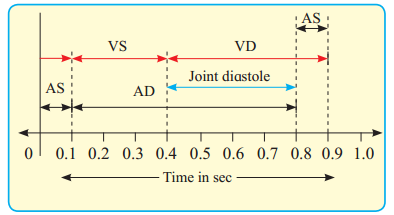
1.Which phases of cardiac cycle are shown in the above diagrammatic representation ?
2.How much time is taken for entire heart to be in diastole?
3.How much longer is ventricular systole as compared to atrial systole?
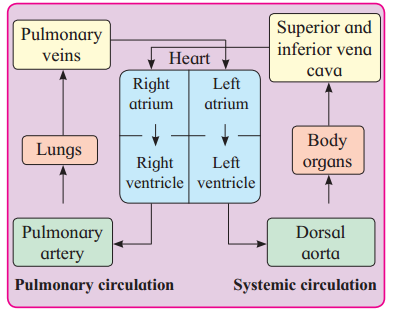
Observe the diagrams of blood cells and answer the following questions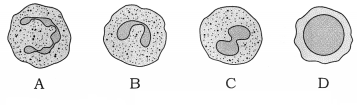
(a) Which of the above is agranulocyte ?
(b) Describe its origin and structure.
(c) Mention its types.
(d) Explain its function.
Pick question groups from the list above, set marks and difficulty, and export a branded PDF with step-by-step answer keys. First 3 chapters free — no signup.