Question
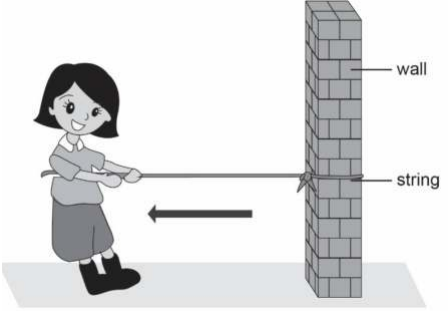
Ameeta ties four strings made of different materials to a wall.
She then pulls each string until it breaks.
The arrow shows the direction of the force.
Image

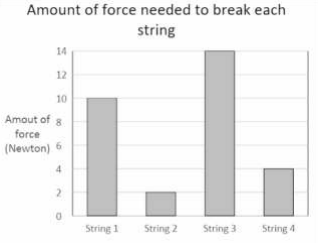
The table shows the amount of force needed to break each string.
String Amount of force needed to break the string (Newton)
String $1$ $10$
String $2$ $2$
String $3$ $14$
String $4$ $4$
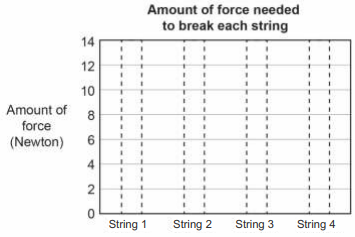
$1.$ Draw the bars in the graph below to show the observations of Ameeta’s activity.
Fill in the dotted columns to show the correct values along the $Y- $axis.
Image
$2.$ Which string is made of the strongest ibre$?$
$A.$ String $1$
$B.$ String $2$
$C.$ String $3$
$D.$ String $4$
$3.$ What must Ameeta keep the same in her activity$?$
$A.$ Colour of the strings
$B.$ Length of the strings
$C.$ Thickness of the strings
$D.$ Height of the strings from ground
$4.$ Which of the following statements is/are true about polymers$?$
Circle ‘Yes’ or ‘No’ to mark your response.
Is the statement correct? Yes or No
All synthetic ibres are polymers. Yes/No
Some natural ibres are polymers. Yes/No
Polymers are made of multiple small chemical units. Yes/No

Answer

$1.$ Draws the bars in the graph correctly
Image
$2. C.$ String $3$
$3. C.$ Thickness of the strings
$4.$ Yes
Yes
Yes

Need a full question paper?

Generate a complete, print-ready paper with questions like this in minutes — across 16+ boards, with answer keys.

Start Generating Free

Similar questions

The equations below show four chemical reactions.
$(i)$ Copper sulphate $+$ Zinc $\rightarrow$ Zinc sulphate $+$ Copper
$(ii)$ Copper sulphate $+$ Iron $\rightarrow$ Iron sulphate $+$ Copper
$(iii)$ Iron sulphate $+$ Copper $\rightarrow$ no reaction
$(iv)$ Zincsulphate $+$ Copper $\rightarrow$ no reaction
$5.$ What can be concluded from the above reactions$?$
$A.$ Copper is less reactive than both zinc and iron
$B.$ Zinc is less reactive than iron but more reactive than copper
$C.$ Copper is less reactive than zinc but more reactive than iron
$D.$ Iron is less reactive than both zinc and copper
$6.$ Why is example $(i)$ regarded as a displacement reaction? Explain your answer. 
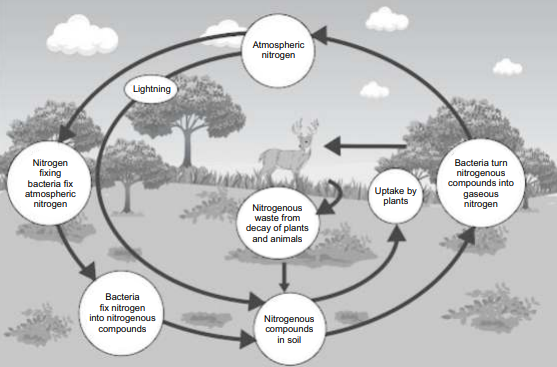
The picture shows the nitrogen cycle.
Image
$9.$ How do plants take up nitrogen$?$
$A.$ She should repeat the same experiment.
$B.$ She should leave the test tube undisturbed for six hours.
$C.$ She should repeat the experiment with test tubes containing more sugar solution.
$D.$ She should keep an extra set of test tubes with sugar solution but without the yeast.
$10.$ Plants and animals are continuously using nitrogen. Will there be a depletion of nitrogen in the environment due to this continuous use$?$ Explain your answer.
Amit was travelling in a car when he saw lightning at some distance.
He heard a loud thunder after a few seconds.
$3.$ What should Amit do immediately to remain safe$?$
$A.$ Increase the speed of the car
$B.$ Stop the car and remain seated inside
$C.$ Stop the car and take shelter inside a building
$D.$ Turn the car and travel in the opposite direction
$4.$ Which of these conditions results in lightning?
$A.$ Negative and positive charges meeting
$B.$ The number of negative charges increasing
$C.$ The number of positive charges increasing
$D.$ Negative and positive charges moving away from each other
$5. $ A lightning conductor protects a building from lightning.
What is a lightning conductor made of$?$
$A.$ Glass
$B.$ Metal
$C.$ Wood
$D.$ Plastic
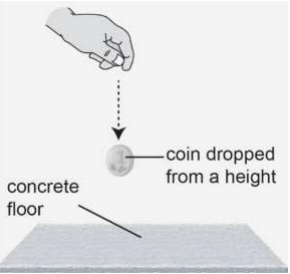
Mayank dropped four coins from the same height onto a concrete floor.
Image

The table below shows the type of sound that each coin produced after hitting the floor.
Coin Temperature of the ball when heated for a minute
Coin $1$ Ringing sound
Coin $2$ Damp sound
Coin $3$ Damp sound
Coin $4$ Ringing sound
$9.$ Which coins in Mayank’s activity are made of metal$?$
$A.$ Coin $1$ and Coin $2$
$B.$ Coin $2$ and Coin $3$
$C.$ Coin $3$ and Coin $4$
$D$. Coin $4$ and Coin $1$
$10.$ On which type of loor will Mayank’s activity produce the same results$?$
$A.$ Glass
$B.$ Sand
$C.$ Grass
$D.$ Carpet
The picture shows the relative size of different types of cells between $100\ nm$ and $100\ mm.$
Image
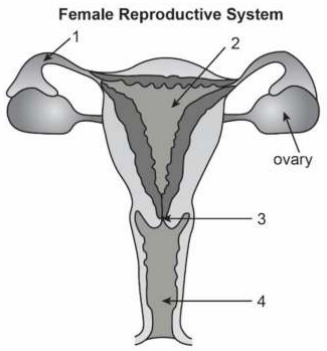
$1$. A mature egg and a sperm unite to form a zygote.
In which part of the female reproductive system does a zygote form$?$
$A. 1$
$B. 2$
$C. 3$
$D. 4$
$2.$ How many eggs are usually released each month by the ovary of a woman$?$
$A.$ One
$B.$ Two
$C.$ Fourteen
$D.$ Twenty-four
$3.$ In which part of the female reproductive system does an embryo implant$?$
$A. 1$
$B. 2$
$C. 3$
$D. 4$
$4.$ Which of these statements is true about a foetus$?$
Circle ‘Yes’ or ‘No’ for the correct response.
Is this statement true about a foetus? Yes or No
All body parts can be identiied properly Yes/No
It is covered by a hard shell of protective layers. Yes/No
It resembles a large ball made of millions of cells. Yes/No
$5.$ Where does the fertilisation of egg occur in the process of In Vitro Fertilisation $(IVF)?$
$A.$ Ovary
$B.$ Water
$C.$ Uterus
$D.$ Petri dish
A farmer wants to grow crops in his ield between the months of June and July.
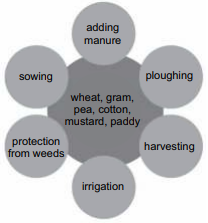
The chart below shows a list of crops and different agricultural practices.
Image
$5.$ Select two crops from the list that grow best during June and July
$6.$ The farmer prepared the soil in his ield by turning and loosening the soil.
How does turning and loosening the soil help in growing plants?
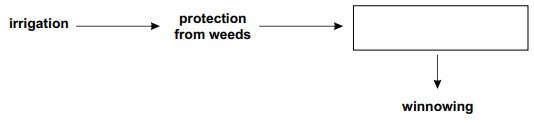
$7.$ Farmers follow a sequence of agricultural practices to grow crops. A part of the sequence is shown below.
Choose an appropriate agricultural practice from the chart above to ill in the box.
Image
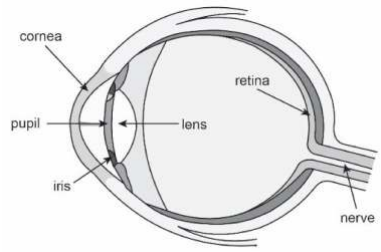
The diagram shows the basic parts of the human eye.
Image
$9.$ Which part protects the human eye from injury$?$
$A.$ Iris
$B.$ Lens
$C.$ Retina
$D.$ Cornea
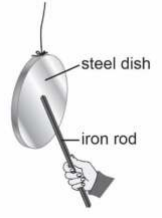
Aditi hangs four steel dishes of the same size but different thickness.
She hits each of them with an iron rod.
Image
  Dish $1$ Dish $2$ Dish $3$ Dish $4$
Thickness of dish $1\ mm$ $1.5\ mm$ $0.5\ mm$ $2\ mm$
$8.$ The thicker the dish, the lower will be the vibration.
Which dish will produce the loudest sound when hit$?$
$A.$ Dish $1$
$B.$ Dish $2$
$C.$ Dish $3$
$D. $ Dish $4$
$9.$ Which of these statements proves that sound can travel through solids$?$
$A.$ We can hear the sound of wind.
$B.$ We can hear the sound of lightning.
$C.$ We can hear a bell ringing from a distance.
$D.$ We can hear heartbeats by using a stethoscope.
$10.$ Which part of the human ear vibrates on receiving sound waves$?$
$A.$ Ear lobe
$B.$ Eardrum
$C.$ Inner ear
$D.$ Ear canal
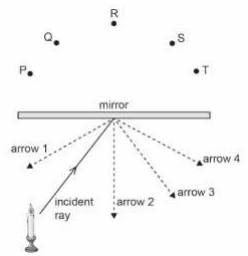
The picture shows a light ray from a candle falling on a mirror.
$P, Q, R, S$ and $T$ are ive points behind the mirror
Image
$1.$ Which arrow represents the light ray relected by the mirror$?$
$A.$ Arrow $1$
$B.$ Arrow $2$
$C.$ Arrow $3$
$D.$ Arrow $4$
$2.$ At which point will the image of the candle form$?$
Will the image be erect or inverted$?$
$3.$ Which of these statements is true for relection of light rays$?$
Circle ‘Yes’ or ‘No’ for the correct response.
Is the statement true? Yes or No
Light rays are relected by plane surfaces only. Yes/No
Angle of incidence is equal to the angle of relection. Yes/No
Incident ray and relected ray meet at the same point. Yes/No
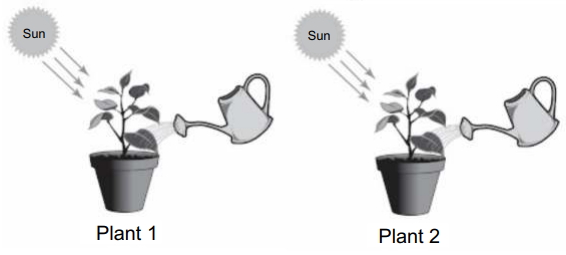
Nisha performs an experiment with two potted plants. She keeps the pots in sunlight and waters
them equally. She adds manure to the soil in Pot $1.$
Image
She creates a table to record her observations.
  Manure added Height of the plant at the start of the experiment Height of the plant after $4$ weeks
Plant $1$ Yes $..........$ $..........$
Plant $2$ no $..........$ $..........$
$10.$ What is Nisha investigating?