MCQ
Among different types of sparingly soluble salts have nearly same solubility product constants, the least soluble salt is that which
  • A
    Produces low charge on ions
  • B
    Produces high charge on ions
  • Produces minimum number of ions
  • D
    Produces maximum number of ions

Answer

Correct option: C.
Produces minimum number of ions
c

Need a full question paper?

Generate a complete, print-ready paper with questions like this in minutes — across 16+ boards, with answer keys.

Start Generating Free

Similar questions

A gas decolourised by $KMn{O_4}$ solution but gives no precipitate with ammoniacal cuprous chloride is
During an isothermal expansion of an ideal gas its
A mixture of two completely miscible non-ideal liquids which distil as such without change in its composition at a constant temperature as though it were a pure liquid. This mixture is known as
The bond dissociation enthalpy of $H_2(g)$ and $N(g)$ are $436\  kJ\ mol^{-1}$ and $940\  kJ\ mol^{-1}$ and enthaply of formation of $NH_3$ is $- 45\  kJ\  moI^{-1}$ . The enthaply of atomisation of $NH_3$ is.....$kJ\  mol^{-1}$
In Dumas' method for estimation of nitrogen, 0.5 gram of an organic compound gave 60 mL of nitrogen collected at 300 K temperature and 715 mm Hg pressure. The percentage composition of nitrogen in the compound (Aqueous tension at $300 \mathrm{~K}=15 \mathrm{~mm} \mathrm{Hg}$ ) is
van't-Hoff factor $(i)$ for this reaction is
The complex showing a spin-only magnetic moment of $2.82$ $B.M.$ is
Of the following pairs, the one containing example of metalloid elements in the periodic table is
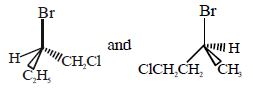
The given pair are
Which of the following combination of statements is true regarding the interpretation of the atomic orbitals?

$(1)$ An electron in an orbital of high angular momentum stays away from the nucleus than an electron in the orbital of lower angular momentum.

$(2)$ For a given value of the principal quantum number, the size of the orbit is inversely proportional to the azimuthal quantum number

$(3)$ According to wave mechanics, the ground state angular momentum is equal to $\frac {h}{2\pi }$

$(4)$ The plot of $\Psi \,\,Vs\,\,r$ for various azimuthal quantum numbers, shows peak shifting towards higher $r$ value