MCQ
Among the following, the compound that is both paramagnetic and coloured is
  • A
    $K_2Cr_2O_7$
  • B
    $(NH_4)_2[TiCl_6]$
  • $VOSO_4$
  • D
    $K_3[Cu(CN)_4]$

Answer

Correct option: C.
$VOSO_4$
c
In $K _2 Cr _2 O _7$, the oxidation state of $Cr$ is $+6$.

$Cr ^{-6}=[ Ar ] 3 d ^0$

In $\left( NH _4\right)_2\left[ TiCl _6\right]$, the oxidation state of $Ti$ is $+4$.

$Ti ^{+4}=[ Ar ] 3 d ^0$

In $VOSO _4$, the oxidation state of $V$ is $+4$.

$V ^{+4}=[ Ar ] 3 d ^1$

In $K _3\left[ Cu ( CN )_4\right]$, the oxidation state of $Cu$ is $+1$.

$Cu ^{+1}=[ Ar ] 3 d ^{10}$

In $VOSO _4, V ^{+4}$ configuration is $d ^1$, so it has one unpaired d-electron so it is paramagnetic and colored. All other compounds don't have any unpaired $d$ electrons, so they are diamagnetic in nature.

Need a full question paper?

Generate a complete, print-ready paper with questions like this in minutes — across 16+ boards, with answer keys.
Start Generating Free

Similar questions

When a nucelophile encounters a ketone the site of attack is:
Conductivity of $0.001\  M$ aq.solution of $Na_2SO_4$ is found to be $2.6 × 10^{-3}\  S\, cm^{-1}$ at $25\,^oC$. If limiting molar conductance of $Na^+$ is $50\  S\, cm^2 \,mol^{-1}$, then limiting molar conductance of $SO_4^{2-}$ will be .............. ${\rm{S}}\,{\rm{c}}{{\rm{m}}^2}{\rm{mo}}{{\rm{l}}^{ - 1}}$ (neglect conductivity of water).
Raoult’s law is obeyed by each constituent of a binary liquid solution when
Compare rate of reaction with $AgNO_3$
$0.6\,g$ of a solute is dissolved in $0.1\,litre$ of a solvent which develops an osmotic pressure of $ 1.23\,atm$ at ${27\,^o}C$. The molecular mass of the substance is ........ $g\,mol{e^{ - 1}}$
An organic compound of molecular formula ${C_4}{H_{10}}O$ does not react with sodium. With excess of $HI,$ it gives only one type of alkyl halide. The compound is
Draw an energy profile diagram for a three step reaction in which first step is  slowest and last step is fastest. (Assume that reaction is exothermic)
(image) $+ PhMgBr_{(excess)} \to  P \xrightarrow{{{H_2}O}} Q$ ;

$Q$ is

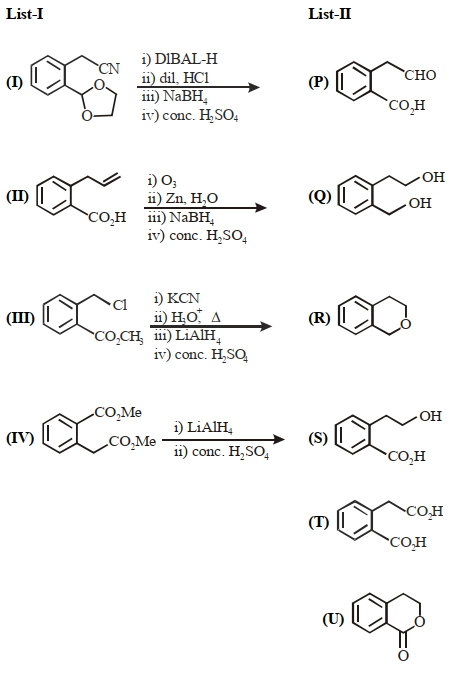
Answer the following by appropriately matching the lists based on the information given in the paragraph $List-I$ includess starting materials and reagents of selected chemical reactions. $List-II$ gives structures of compounds that may be formed as intermediate products and/or final products from the reactions of $List-I$

($1$) Which of the following options has correct combination considering $List-I$ and $List-II$?

$(1) (III), (S), (R)$ $(2) (IV), (Q), (R)$ $(3) (III), (T), (U)$ $(4) (IV), (Q), (U)$

($2$) Which of the following options has correct combination considering $List-I$ and $List-II$?

$(1) (I), (Q), (T), (U)$ $(2) (II), (P), (S), (U)$ $(3) (II), (P), (S), (T)$ $(4) (I), (S), (Q), (R)$

Give the answer quetion ($1$) and ($2$)
Match the interhalogen compounds of  $column-I$ with the geometry in $column-II$ and assign the correct code.
Column $I$      Column $II$
$(A) \,XX '$ $(i)$ $T-$shape
$(B)\,XX'_3$ $(ii)$ Pentagonal bipyramidal
$(C)\,XX '_5$ $(iii)$ Linear
$(D)\,XX '_7$ $(iv)$ Square pyramidal
  $(v)$ Tetrahedral