MCQ
Among the following, which has the maximum hydration energy?
- A$OH^-$
- B$NH^+_4$
- C$F^-$
- ✓$H^+$
Hydration energy depends on the charge of the ion and the ionic radius. Higher the charge and smaller the size, greater the hydration energy. $H ^{+}$has the smallest size and hence has the maximum hydration energy among the four.
Generate a complete, print-ready paper with questions like this in minutes — across 16+ boards, with answer keys.
$Cr _{2} O _{7}^{2-}+14 H ^{+}+6 e ^{-} \rightarrow 2 Cr ^{3+}+7 H _{2} O$
The amount of $Cr ^{3+}$ obtained was $0.104\, g$. The
efficiency of the process(in\%) is
(Take : $F =96000\, C$, At. mass of chromium $=52$ )
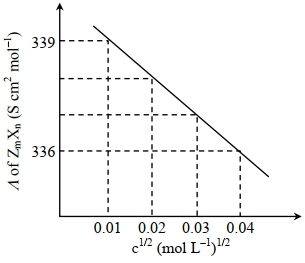
| $Ion$ | $Z ^{ n +}$ | $Z ^{ P +}$ | $Z ^{ n +}$ | $Z ^{ m +}$ | $Z ^{ m +}$ |
| $\lambda^0\left( S cm ^2 mol ^{-1}\right)$ | $50.0$ | $25.0$ | $100.0$ | $80.0$ | $100.0$ |
$\lambda^0$ is the limiting molar conductivity of ions
The plot of molar conductivity $(4)$ of $Z _{ m } X _{ n } v s c ^{1 / 2}$ is given below.