Question
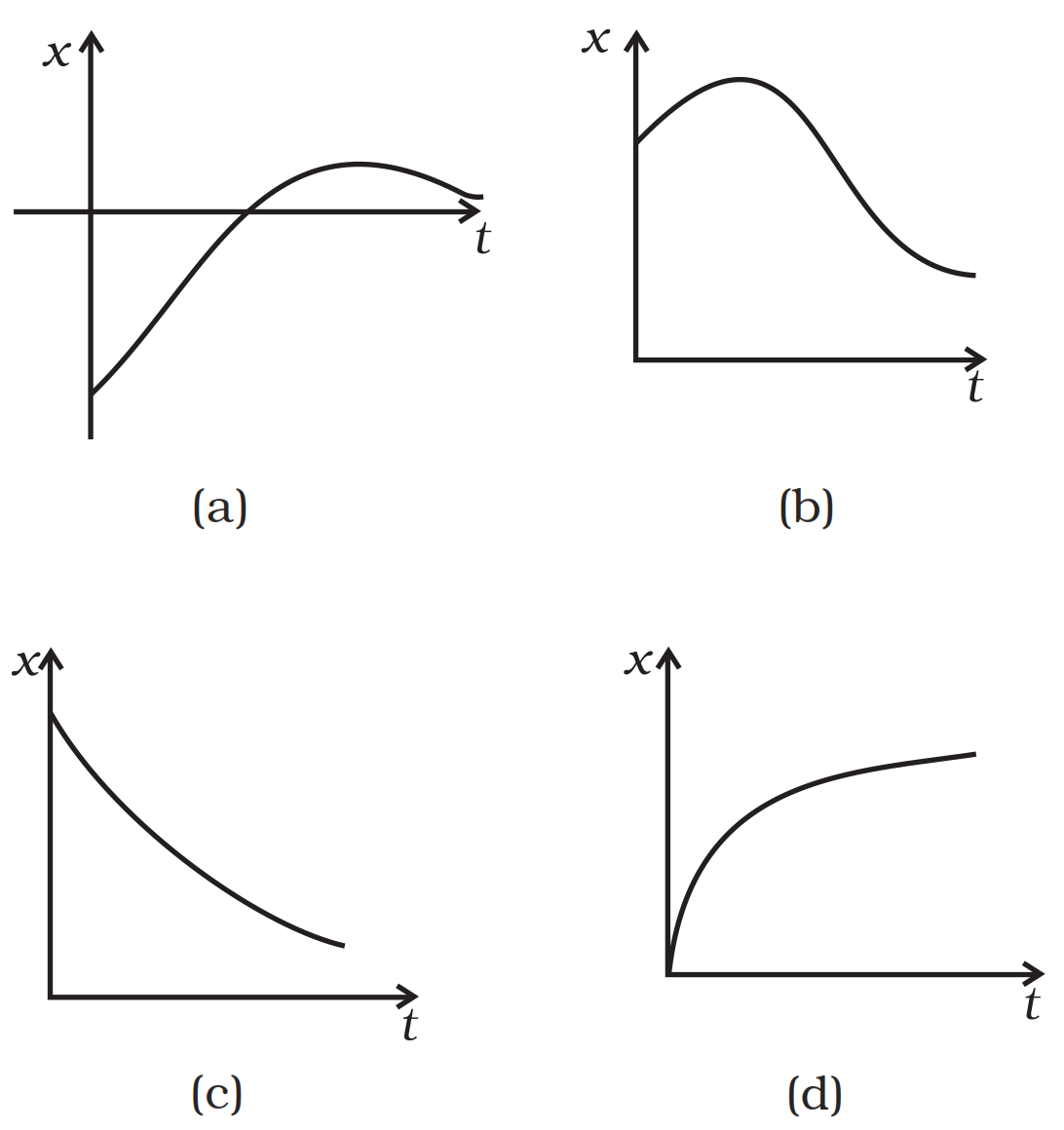
Among the four graphs Fig. there is only one graph for which average velocity over the time intervel (0, T ) can vanish for a suitably chosen T. Which one is it?
Answer

  1. ​​​​​​

Explanation:

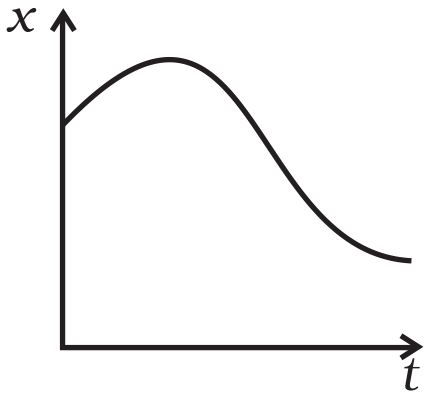
We need to identify the graph in which there is one displacement for different timings. it means that these displacements would be in opposite directions and when we add these opposite displacements, net displacement would be zero or average velocity would be zero. This thing is only possible in the graph (b).
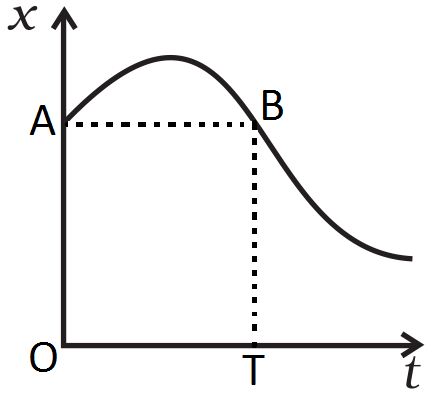
If we draw a line parallel to time axis from the point (A) on the graph at t = 0 sec. This line can intersect graph again at B. At this point, the change in displacement (O - T) time is zero i.e., displacement at A and B are equal so as the change in displacement is zero so the average velocity of body vanishes to zero.

Need a full question paper?

Generate a complete, print-ready paper with questions like this in minutes — across 16+ boards, with answer keys.

Start Generating Free

Similar questions

When $\vec A.\vec B = - |A||B|,$ then
A particle of mass $m$ moving with velocity $\left( {3\hat i + 2\hat j} \right)\,m/s,$ collides with another body of mass $M$ and finally moves with velocity $\left( {-2\hat i + \hat j} \right)\,m/s,$ then during the collision
If the unit of length and force be increased four times, then the unit of energy is
Two forces of magnitude $8 \,N$ and $15 \,N$ respectively act at a point. If the resultant force is $17 \,N$, the angle between the forces has to be .......
Consider a vector $\overrightarrow F = 4\hat i - 3\hat j.$ Another vector that is perpendicular to $\overrightarrow F $ is
Two particles are projected from a tower in opposite directions horizontally with speed $10\,m / s$ each. At $t=1\,s$ match the following two columns.
Column $I$ Column $II$
$(A)$ Relative acceleration between two $(p)$ $0$ SI unit
$(B)$ Relative velocity between two $(q)$ $5$ SI unit
$(C)$ Horizontal distance between two $(r)$ $10$ SI unit
$(D)$ Vertical distance between two $(s)$ $20$ SI unit
A ball is dropped from a bridge of $122.5$ metre above a river. After the ball has been falling for two seconds, a second ball is thrown straight down after it. Initial velocity of second ball so that both hit the water at the same time is ...... $m / s$
A vector $\overrightarrow{ A }$ points vertically upward and $\overrightarrow{ B }$ points towards north. The vector product $\overrightarrow{ A } \times \overrightarrow{ B }$ is
The moments of inertia of a non-uniform circular disc (of mass $M$ and radius $R$ ) about four mutually perpendicular tangents $A B, B C, C D, D A$ are $I_1, I_2, I_3$ and $I_4$, respectively (the square $A B C D$ circumscribes the circle). The distance of the centre of mass of the disc from its geometrical centre is given by
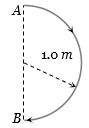
In $1.0\, s$ a particle goes from point $A$ to point $B$, moving in a semicircle of radius $1.0\, m$ (see figure). The magnitude of the average velocity is ......... $m/s$