MCQ
Among the particles moving with the same velocity, the de Broglle wavelength will be maximum of :
- ✓electron
- Bproton
- Cneutron
- Dphoton.
Generate a complete, print-ready paper with questions like this in minutes — across 16+ boards, with answer keys.
If a rod has resistance 4 W and if rod is turned as half cycle then the resistance along diameter
|
(a) 1.56 W |
(b) 2.44 W |
(c) 4 W |
(d) 2 W |
The dual nature of light is exhibited by
|
(a) Photoelectric effect |
(b) Refraction and interference |
|
(c) Diffraction and reflection |
(d) Diffraction and photoelectric effect |
White light may be considered to be a mixture of waves with l ranging between 3900 Å and 7800 Å. An oil film of thickness 10,000 Å is examined normally by reflected light. If m = 1.4, then the film appears bright for
|
(a) 4308 Å, 5091 Å, 6222 Å |
(b) 4000 Å, 5091 Å, 5600 Å |
|
(c) 4667 Å, 6222 Å, 7000 Å |
(d) 4000 Å, 4667 Å, 5600 Å, 7000Å |
In the disintegration series  the values of Z and A respectively will be
|
(a) 92, 236 |
(b) 88, 230 |
(c) 90, 234 |
(d) 91, 234 |
The graph gives the magnitude B(t) of a uniform magnetic field that exists throughout a conducting loop, perpendicular to the plane of the loop. Rank the five regions of the graph according to the magnitude of the emf induced in the loop, greatest first
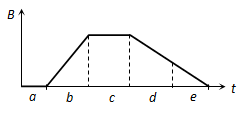
|
(a) b > (d = e) < (a = c) |
(b) b > (d = e) > (a = c) |
|
(c) b < d < e < c < a |
(d) b > (a = c) > (d = e) |
A metal rod moves at a constant velocity in a direction perpendicular to its length. A constant uniform magnetic field exists in space in a direction perpendicular to the rod as well as its velocity. Select the correct statement(s) from the following
|
(a) The entire rod is at the same electric potential |
|
(b) There is an electric field in the rod |
|
(c) The electric potential is highest at the centre of the rod and decreases towards its ends |
|
(d) The electric potential is lowest at the centre of the rod and increases towards its ends |