MCQ
Forward biasing is that in which applied voltage:
- AIncreases potential barrier.
- BCancels the potential barrier.
- CIs equal to 1.5volt.
- DNone of these.
Generate a complete, print-ready paper with questions like this in minutes — across 16+ boards, with answer keys.
A virtual image three times the size of the object is obtained with a concave mirror of radius of curvature 36 cm. The distance of the object from the mirror is
|
(a) 5 cm |
(b) 12 cm |
(c) 10 cm |
(d) 20 cm |
A proton is moving along Z-axis in a magnetic field. The magnetic field is along X-axis. The proton will experience a force along
|
(a) X-axis |
(b) Y-axis |
(c) Z-axis |
(d) Negative Z-axis |
A cell of negligible resistance and e.m.f. 2 volts is connected to series combination of 2, 3 and 5 ohm. The potential difference in volts between the terminals of 3 ohm resistance will be
|
(a) 0.6 |
(b) 2/3 |
(c) 3 |
(d) 6 |
Ohm's law is true
|
(a) For metallic conductors at low temperature |
|
(b) For metallic conductors at high temperature |
|
(c) For electrolytes when current passes through them |
|
(d) For diode when current flows |
Three capacitors of capacitances 3 μF, 9μF and 18 μF are connected once in series and another time in parallel. The ratio of equivalent capacitance in the two cases  will be
|
(a) 1 : 15 |
(b) 15 : 1 |
(c) 1 : 1 |
(d) 1 : 3 |
Assertion : Electric appliances with metallic body; e.g. heaters, presses etc, have three pin connections, whereas an electric bulb has a two pin connection.
Reason : Three pin connections reduce heating of connecting cables.
|
(a) If both assertion and reason are true and the reason is the correct explanation of the assertion. |
|
(b) If both assertion and reason are true but reason is not the correct explanation of the assertion. |
|
(c) If assertion is true but reason is false. |
|
(d) If the assertion and reason both are false. |
The stopping potential V for photoelectric emission from a metal surface is plotted along Y-axis and frequency n of incident light along X-axis. A straight line is obtained as shown. Planck's constant is given by
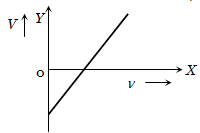
|
(a) Slope of the line |
|
(b) Product of slope on the line and charge on the electron |
|
(c) Product of intercept along Y-axis and mass of the electron |
|
(d) Product of Slope and mass of electron |