MCQ
$Ampere - hour$ is a unit of
  • Quantity of electricity
  • B
    Strength of electric current
  • C
    Power
  • D
    Energy

Answer

Correct option: A.
Quantity of electricity
a
(a) Charge = current $ \times $ time

Need a full question paper?

Generate a complete, print-ready paper with questions like this in minutes — across 16+ boards, with answer keys.

Start Generating Free

Similar questions

A uniform meter scale is supported from its $20\ cm$ mark. A body suspended from $10\ cm$ mark keeps the scale horizontal. However, the scale gets unbalanced if the body is completely immersed in water. To regain the balance the body is shifted to the $8\ cm$ mark. Therefore, the specific gravity of the material of the body is
A particle moves in a circle of radius $25\, cm$ at two revolutions per second. The acceleration of the particle in $meter/second^2$ is
The energy of a given sample of an ideal gas depends only on its:
A $U-$tube contains water and methylated spirit separated by mercury. The mercury columns in the two arms are in level with $10.0\; cm$ of water in one arm and $12.5\; cm $ of spirit in the other. if $15.0\; cm$ of water and spirit each are further poured into the respective arms of the tube, what is the difference in the levels  (in $cm$) of mercury in the two arms?

(the specific gravity of spirit is $0.8.)$
An object with uniform density $\rho$ is attached to a spring that is known to stretch linearly with applied force as shown below.When the spring object system is immersed in a liquid of density $\rho_1$ as shown in the above figure, the spring stretches by an amount $x_1\left(\rho > \rho_1\right)$. When the experiment is repeated in a liquid of density $\left(\rho_2 < \rho_1\right)$, the spring stretches by an amount $x_2$. Neglecting any buoyant force on the spring, the density of the object is
A $0.5 \,kg$ block moving at a speed of $12 \,ms ^{-1}$ compresses a spring through a distance $30\, cm$ when its speed is halved. The spring constant of the spring will be $Nm ^{-1}$.
$Assertion$ : If a body is thrown upwards, the distance covered by it in the last second of upward motion is about $5\, m$ irrespective of its initial speed
$Reason$ : The distance covered in the last second of upward motion is equal to that covered in the first second of downward motion when the particle is dropped.
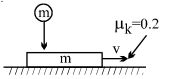
$A$ ball of mass $m$ falls vertically from a height $h$ and collides with $a$ block of equal mass $m$ moving horizontally with $a$ velocity $v$ on $a$ surface. The coefficient of kinetic friction between the block and the surface is $0.2$, while the coefficient of restitution $e$ between the ball and the block is $0.5.$ There is no friction acting between the ball and the block. The velocity of the block decreases by
Two heavenly bodies ${S_1}$ and ${S_2}$, not far off from each other are seen to revolve in orbits
A motor drives a body along a straight line with a constant force. The power $P$ developed by the motor must vary with time $t$ according to