MCQ
An object with uniform density $\rho$ is attached to a spring that is known to stretch linearly with applied force as shown below.When the spring object system is immersed in a liquid of density $\rho_1$ as shown in the above figure, the spring stretches by an amount $x_1\left(\rho > \rho_1\right)$. When the experiment is repeated in a liquid of density $\left(\rho_2 < \rho_1\right)$, the spring stretches by an amount $x_2$. Neglecting any buoyant force on the spring, the density of the object is
  • A
    $\rho=\frac{\rho_1 x_1-\rho_2 x_2}{x_1-x_2}$
  • $\rho=\frac{\rho_1 x_2-\rho_2 x_1}{x_2-x_1}$
  • C
    $\rho=\frac{\rho_1 x_2+\rho_2 x_1}{x_1+x_2}$
  • D
    $\rho=\frac{\rho_1 x_1+\rho_2 x_2}{x_1+x_2}$
Answer

Correct option: B.
$\rho=\frac{\rho_1 x_2-\rho_2 x_1}{x_2-x_1}$
b
(b)

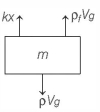
For equilibrium of block hung from string, Spring force + Buoyant force $=$ Weight of block

So, we have

$k x_1+\rho_1 V g=\rho V g\quad \dots(i)$

$\text { and }$ $k x_2+\rho_2 V g=\rho V g \quad \dots(ii)$

Eliminating $k$, we get

$\rho=\frac{\rho_1 x_2-\rho_2 x_1}{x_2-x_1}$

Need a full question paper?

Generate a complete, print-ready paper with questions like this in minutes — across 16+ boards, with answer keys.

Start Generating Free

Similar questions

A particle is performing $S.H.M.$ with energy of vibration $90 \,J$ and amplitude $6 \,cm$. When the particle reaches at distance $4 \,cm$ from mean position, it is stopped for a moment and then released. The new energy of vibration will be ........... $J$
Two blocks $A$ and $B$ of equal masses are sliding down along straight parallel lines on an inclined plane of $45^o$ . Their coefficients of kinetic friction are $\mu _A = 0.2$ and $\mu _B = 0.3$ respectively. At $t = 0$ , both the blocks are at rest and block $A$ is $\sqrt 2$ metre behind block $B$ . The time and distance from the initial position where the front faces of the blocks come in line on the inclined plane as shown in figure. (Use $g = 10\, ms^{-2}$ )
A block of mass $M_1$ is hanged by a light spring of force constant $k$ to the top bar of a reverse $U$ -frame of mass $M_2$ on the floor. The block is pulled down from its equilibrium position by a distance $x$ and then released. The minimum value of $x$ such that the reverse $U$ -frame will leave the floor momentarily, is :-
The acceleration of $10\, kg$ block when $F = 30\,N$ ........ $m/s^2$
The velocity of the centre of mass of a rigid rod with respect to an observer $O$ is $\vec v = \left( {2\hat i + 3\hat j} \right) ms^{-1}$ . The rod has an angular velocity about its centre of mass given by $\vec \omega$  =$\left( {3\hat j + 4\hat k} \right) s^{-1}$ . Let A be a point on the rod with position vector $2\left( {\hat i + \hat k} \right) m$ with respect to the centre of mass. The velocity of the point $A$ with respect to $O$ is
The vernier scale used for measurement has a positive zero error of $0.2\, mm$. If while taking a measurement it was noted that $'0'$ on the vernier scale lies between $8.5\, cm$ and $8.6\, cm$ vernier coincidence is $6,$ then the correct value of measurement is ............. $cm$. (least count $=0.01\, cm )$
A large spherical mass $M$ is fixed at one position and two identical point masses $m$ are kept on a line passing through the centre of $M$ (see figure). The point masses are connected by a rigid massless rod of length $\ell$ and this assembly is free to move along the line connecting them. All three masses interact only through their mutual gravitational interaction. When the point mass nearer to $M$ is at a distance $r =3 \ell$ from $M$, the tension in the rod is zero for $m=k\left(\frac{M}{288}\right)$. The value of $k$ is
The temperature of a hypothetical gas increases to $\sqrt 2 $ times when compressed adiabatically to half the volume. Its equation can be written as
The gases carbon monoxide (CO) and nitrogen (N2) at the same temperature have kinetic energies E1 and E2, respectively. Then,
A rocket can go vertically upwards in earth's atmosphere because