Question
An accelerating train is passing over a high bridge. A stone is dropped from the train at an instant when its speed is $10m/ s$ and acceleration is $1m/ s^2$. Find the horizontal and vertical components of the velocity and acceleration of the stone one second after it is dropped. Take $g = 10m/ s^2​​​​​​​$.

Answer

Horizontal acceleration of the train is not carried by the stone. Horizontal velocity of the stone will remain constant, during the fall of the stone.
 
Horizontal component
Vertical component
Velocity
$10m/ s$
$10m/ s$
Acceleration
$0m/ s^2$
$10m/ s^2$

Need a full question paper?

Generate a complete, print-ready paper with questions like this in minutes — across 16+ boards, with answer keys.

Start Generating Free

Similar questions

The wavelength 1 associated with a moving particle depends upon its mass m, its velocity v and Planck's constant h. Show dimensional relation between them.
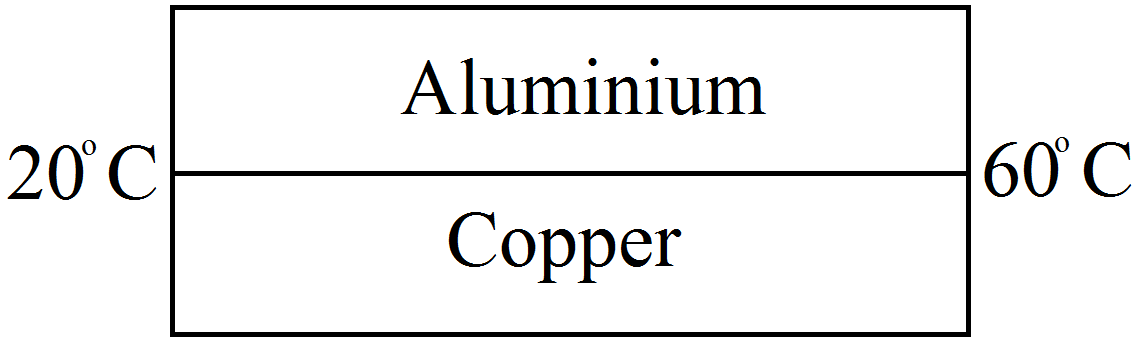
An aluminium rod and a copper rod of equal length 1.0m and cross-sectional area $1cm^2$ are welded together as shown in figure. One end is kept at a temperature of 20°C and the other at 60°C. Calculate the amount of heat taken out per second from the hot end. Thermal conductivity of aluminium = $200Wm^{-1^\circ}C^{-1}$ and of copper = $390Wm^{-1^\circ}C^{-1}$.
A lawyer alleges in court that the police has forced his client to issue a statement of confession. What kind of force is this?
A shell bursts on contact with the ground and the fragments fly in all directions with speeds upto $39.2m/ s$. Show that a man $78.4m$ away is in danger for $4\sqrt{2}$ seconds.
A ball is dropped from a balloon going up at a speed of $7m/s$. If the balloon was at a height $60m$ at the time of dropping the ball, how long will the ball take in reaching the ground?
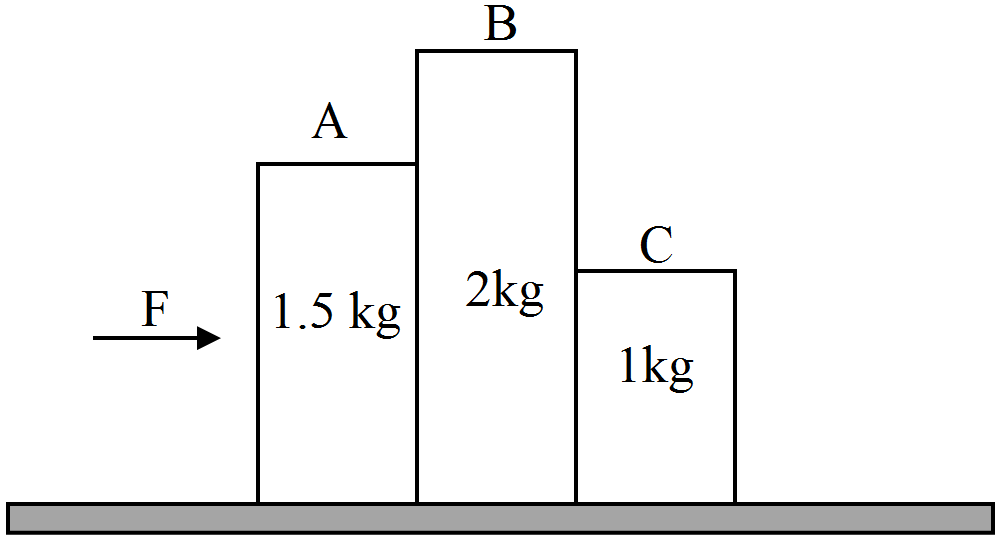
In the system of three blocks $A , B$ and C shown in figure,
(i) how large a force $F$ is needed to give the blocks an acceleration of $3 m / s ^2$, if the coefficient of friction between blocks and table is $0.27$
(ii) how large a force does the block $A$ exert on the block $B$ ?
A train approaching a platform at a speed of 54km/h sounds a whistle. An observer on the platform finds its frequency to be 1620Hz. The train passes the platform keeping the whistle on and without slowing down. What frequency will the observer hear after the train has crossed the platfrom? The speed of sound in air = 332m/s.
What are reversible and irreversible processes? Explain giving one example of each.
A force of $(2500 \pm 5)$ N is applied over an area of $(0.32 \pm 0.02) \text{m}^2.$ Calculate the pressure exerted over the area.
The planet Mars has two moons, phobos and delmos.
$(i)$ phobos has a period $7$ hours$, 39$ minutes and an orbital radius of $9.4 \times 10^3 \ km$. Calculate the mass of mars.
$(ii)$ Assume that earth and mars move in circular orbits around the sun, with the martian orbit being $1.52$ times the orbital radius of the earth. What is the length of the martian year in days?