Question
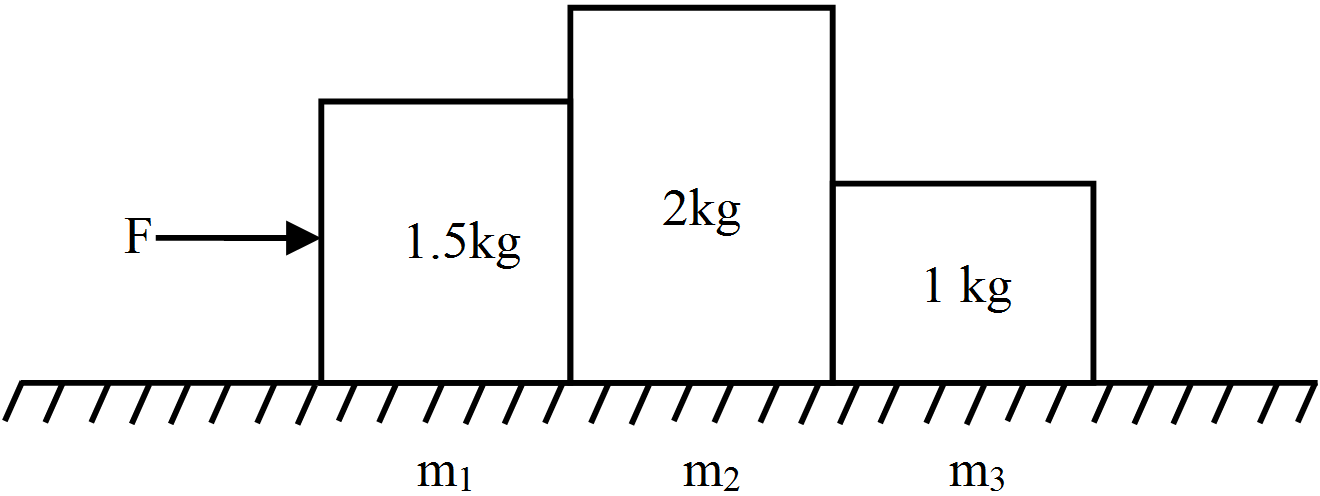
In the system of three blocks $A , B$ and C shown in figure,
(i) how large a force $F$ is needed to give the blocks an acceleration of $3 m / s ^2$, if the coefficient of friction between blocks and table is $0.27$
(ii) how large a force does the block $A$ exert on the block $B$ ?
Answer

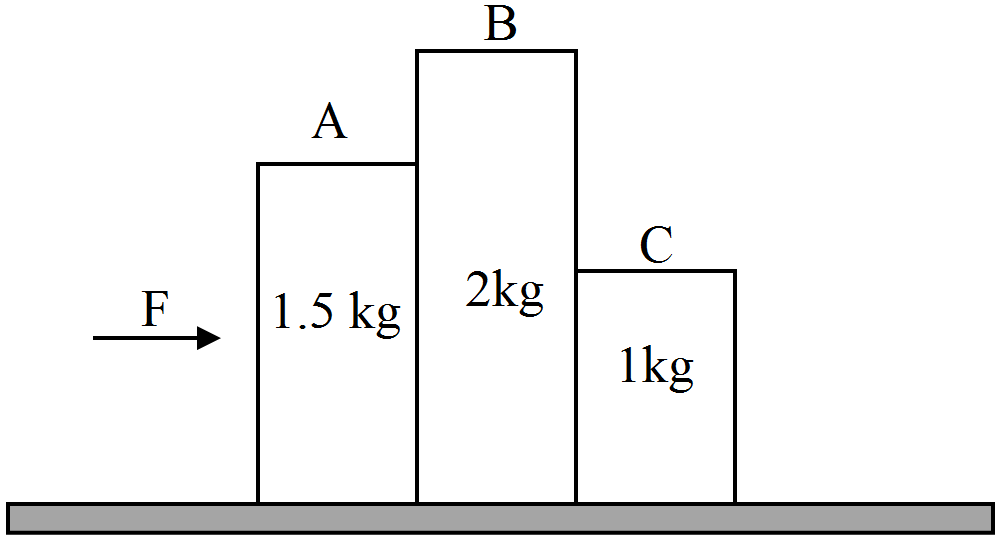
Irt a be the acceleration of the system to right. All the three frictional forces $f_1 = \mu \text{m}_1\text{g}, f_2 = \mu \text{m}_2\text{g} \text{ and }f_3 = \mu \text{m}_3\text{g}$ will be directed to the left as the motion of bodies is to the right.
Hence, for the whole system

​​​​​​​ $\text{F} - \mu \text{m}_1\text{g} - \mu \text{m}_2\text{g} - \mu \text{m}_3\text{g} = (\text{m}_1 + \text{m}_2 + \text{m}_3) \text{a}$
$\text{F} = (\text{m}_1 + \text{m}_2 + \text{m}_3) (\text{a} + \mu \text{g}) $
$= (7.5 + 2 + 1)(3 + 0.2 \times 9.8) = 22.3N $
The force exerted by the 1.5kg block on the 2kg block = $\text{F} - \text{m}_1(\text{a} + \mu \text{g})$
$= 22.3 - 1.5 (3 + 0.2 \times 9.8) = 22.3 - 7.44 = 14N$

Need a full question paper?

Generate a complete, print-ready paper with questions like this in minutes — across 16+ boards, with answer keys.

Start Generating Free

Similar questions

Define dot product of two vectors and give its geometrical interpretation.
The period of oscillation of the pendulum of a steel clock at $20^{\circ} C$ is 2 seconds. If the temperature of the clock increases by $30^{\circ} C$, what will be the gain or loss in measuring time every day? The coefficient of linear expansion of steel is $1.2 \times$ $10^{-5}{ }^{\circ} C ^{-1}$.
A physical quantity P is related to four observables a, b, c and d as follows: $\text{P}=\text{a}^3\text{b}^3/\big(\sqrt{\text{c}}\text{ d}\big)$ The percentage errors of measurement in a, b, c and d are 1%, 3%, 4% and 2%, respectively. What is the percentage error in the quantity P ? If the value of P calculated using the above relation turns out to be 3.763, to what value should you round off the result ?
Define impulse. A cricket ball of mass $150gm$ moving with speed of $12m/ s$ is hit by a bat so that the ball is turned back with a velocity of $20m/ s$. Calculate the impulse received by the ball.
In an elastic collision of two billiard balls, which of the following quantities remain conserved during the short time of collision of the balls (i.e., when they are in contact).
  1. Kinetic energy.
  2. Total linear momentum?
Give reason for your answer in each case.
An ideal diode should pass a current freely in one direction and should stop it completely in the opposite direction. Which is closer to ideal-vacuum diode or a p-n junction diode?
One mole of an ideal gas at standard temperature and pressure occupies $22.4$ L (molar volume). What is the ratio of molar volume to the atomic volume of a mole of hydrogen? (Take the size of hydrogen molecule to be about $1\mathring{\text{A}}$). Why is this ratio so large?
How much fraction of the K.E. of rolling is purely (i) translational (ii) rotational?
A uniform disc of mass m and radius r is suspended through a wire attached to its centre. If the time period of the torsional oscillations be T, what is the torsional constant of the wire.
Find the acceleration of a particle placed on the surface of the earth at the equator due to earth's rotation. The diameter of earth = 12800km and it takes 24 hours for the earth to complete one revolution about its axis.