MCQ
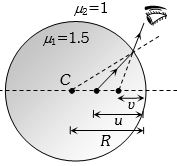
An air bubble in sphere having $4 \,cm$ diameter appears $1 \,cm$ from surface nearest to eye when looked along diameter. If $_a\mu_g = 1.5$, the distance of bubble from refracting surface is.....$cm$
  • $1.2$
  • B
    $3.2$
  • C
    $2.8 $
  • D
    $1.6$

Answer

Correct option: A.
$1.2$
a
(a) $v = 1 \,cm, R = 2 \,cm$
By using
$\frac{{{\mu _2}}}{v} - \frac{{{\mu _1}}}{u} = \frac{{{\mu _2} - {\mu _1}}}{R}$
$\frac{1}{{ - 1}} - \frac{{1.5}}{u} = \frac{{1 - 1.5}}{{ - 2}}$
$ \Rightarrow u = - 1.2\,cm$

Need a full question paper?

Generate a complete, print-ready paper with questions like this in minutes — across 16+ boards, with answer keys.
Start Generating Free

Similar questions

Assertion : Photosensitivity of a metal is high if its work function is small.
Reason : Work function $= hf_0$ where $f_0$ is the threshold frequency.
The kinetic energy of one gm-mole of a gas at normal temperature and pressure is $(R = 8.31 J/Mole-K)$
A particle is constrained to move on a straight line path. It returns to the starting point after $10\, sec$. The total distance covered by the particle during this time is $30\, m$. Which of the following statements about the motion of the particle is false
The relationship between Young's modulus $Y,$ Bulk modulus $K$ and modulus of rigidity $\eta $ is
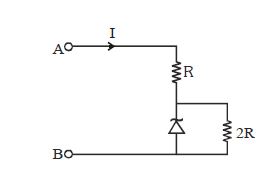
If the voltage between the terminals $A$ and $B$ is $17\ V$ and zener breakdown voltage is $9\ V$ , then the potential voltage across $R$ is.......$V$
A doubly ionised $Li$ atom is excited from its ground state $(n = 1)$ to $n = 3$ state. The wavelengths of the spectral lines are given by ${\lambda _{32}},{\lambda _{31}}$ and ${\lambda _{21}}$. The ratio ${\lambda _{32}}/{\lambda _{31}}$ and ${\lambda _{21}}/{\lambda _{31}}$ are, respectively
There are $n$ similar conductors each of resistance $R$. The resultant resistance comes out to be $x$ when connected in parallel. If they are connected in series, the resistance comes out to be
The radius of fifth orbit of the $L ^{++}$is $.........\times 10^{-12}\,m$. Take : radius of hydrogen atom $=0.51 \mathring A$
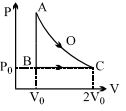
An ideal gas is taken from point $A$ to point $C$ on $P-V$ diagram through two process $AOC$ and $ABC$ as shown in the figure. Process $AOC$ is isothermal
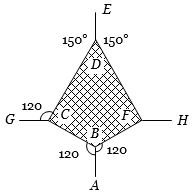
The adjacent figure is the part of a horizontally stretched net. section $AB$ is stretched with a force of $10 \,N$. The tensions in the sections $BC$ and $BF$ are