An air bubble of volume $1\,cm ^3$ rises from the bottom of a lake $40\,m$ deep to the surface at a temperature of $12^{\circ}\,C$. The atmospheric pressure is $1 \times 10^5 Pa$, the density of water is $1000\,kg / m ^3$ and $g =10\,m / s ^2$. There is no difference of the temperature of water at the depth of $40\,m$ and on the surface. The volume of air bubble when it reaches the surface will be $..........\,cm^{3}$
JEE MAIN 2023, Medium
Download our app for free and get started
$P = P _0+\rho gh =10^5\,Pa +10^3 \times 10 \times 40=5 \times 10^5\,Pa$
At $T$ is constant
$PV = P _0 V _0$
$\Rightarrow 5 \times 10^5\,Pa \times 1\,cm ^3=10^5 Pa \times V _0 \Rightarrow V _0=5\,cm ^3$

Download our appand get started for free
Experience the future of education. Simply download our apps or reach out to us for more information. Let's shape the future of learning together!No signup needed.*
Similar Questions
- 1View SolutionA cork is submerged in water by a spring attached to the bottom of a pail. When the pail is kept in a elevator moving with an acceleration downwards, the spring length
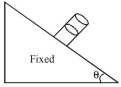
- 2A cylindrical vessel filled with water is released on an inclined surface of angle $\theta$ as shown in figure.The friction coefficient of surface with vessel is $\mu( < \tan \theta)$.Then the contact angle made by the surface of water with the incline will beView Solution
- 3Air streams horizontally past an air plane. The speed over the top surface is $60 \,m / s$ and that under the bottom surface is $45 \,m / s$. The density of air is $1.293 \,kg / m ^3$, then the difference in pressure is ....... $N / m ^2$View Solution
- 4View SolutionThe lift of an air plane is based on
- 5A barometer kept in a stationary elevator reads $76 cm$. If the elevator starts accelerating up the reading will beView Solution
- 6A hydraulic automobile lift is designed to lift vehicles of mass $5000\,kg$. The area of cross section of the cylinder carrying the load is $250\,cm ^2$. The maximum pressure the smaller piston would have to bear is [Assume $g=10\,m / s ^2$]View Solution
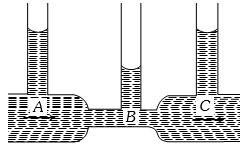
- 7In the following fig. is shown the flow of liquid through a horizontal pipe. Three tubes $A, B$ and $ C$ are connected to the pipe. The radii of the tubes $A, B $ and $C$ at the junction are respectively $ 2 cm, 1 cm$ and $2 cm.$ It can be said that theView Solution
- 8If $W$ be the weight of a body of density $\rho $ in vacuum then its apparent weight in air of density $\sigma $ isView Solution
- 9The weight of an empty balloon on a spring balance is $w_1$. The weight becomes $w_2$ when the balloon is filled with air. Let the weight of the air itself be $w$ .Neglect the thickness of the balloon when it is filled with air. Also neglect the difference in the densities of air inside $\&$ outside the balloon. Then :View Solution
- 10A body of density $\rho'$ is dropped from rest at a height $h$ into a lake of density $\rho$ , where $\rho > \rho '$ . Neglecting all dissipative forces, calculate the maximum depth to which the body sinks before returning to float on the surface.View Solution