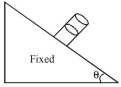
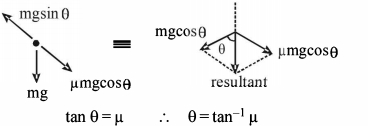
A cylindrical vessel filled with water is released on an inclined surface of angle $\theta$ as shown in figure.The friction coefficient of surface with vessel is $\mu( < \tan \theta)$.Then the contact angle made by the surface of water with the incline will be
Medium


Download our appand get started for free
Experience the future of education. Simply download our apps or reach out to us for more information. Let's shape the future of learning together!No signup needed.*
Similar Questions
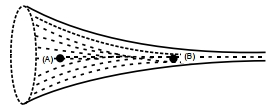
- 1The figure shows a liquid of given density flowing steadily in horizontal tube of varying cross-section. Cross sectional areas at $A$ is $1.5\,cm ^2$, and $B$ is $25\,mm ^2$, if the speed of liquid at $B$ is $60\,cm / s$ then $\left( P _{ A }- P _{ B }\right)$ is :(Given $P _{ A }$ and $P _{ B }$ are liquid pressures at $A$ and $B$ points.Density $\rho=1000\,kg\,m ^{-3}$View Solution
$A$ and $B$ are on the axis of tube $............\,Pa$
- 2Assertion $(A):$ The stream of water flowing at high speed from a garden hose, pipe tends to spread like a fountain when held vertically up but tends to narrow down when held vertically down.View Solution
Reason $(R):$ In any steady flow of an incompressible fluid, the volume flow rate of the fluid remains constant.
- 3A cylindrical tank of height $0.4\,m$ is open at the top and has a diameter $0.16\,m$ . Water is filled in it up to a height of $0.16\,m$ . How long it will take to empty the tank through a hole of radius $5 \times 10^{-3}\,m$ in its bottom .......... $\sec$View Solution
- 4Asphere of radius $R$ and made of material of relative density $\sigma$ has a concentric cavity of radius $r$. It just floats when placed in a tank full of water. The value of the ratio $R/r$ will beView Solution
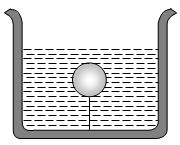
- 5A solid sphere of density $\eta$ $( > 1)$ times lighter than water is suspended in a water tank by a string tied to its base as shown in fig. If the mass of the sphere is m then the tension in the string is given byView Solution
- 6A flat plate of area $10\,cm^2$ is separated from a large plate by a layer of glycerine $1\, mm$ thick. If the coefficient of viscosity of glycerine is $20$ poise, the force required to keep the plate moving with a velocity of $1\,cm/sec$ is .......... $dyne$View Solution
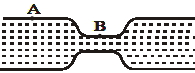
- 7Water flows in a horizontal tube (see figure). The pressure of water changes by $700\; \mathrm{Nm}^{-2}$ between $\mathrm{A}$ and $\mathrm{B}$ where the area of cross section are $40\; \mathrm{cm}^{2}$ and $20\; \mathrm{cm}^{2},$ respectively. Find the rate of flow of water through the tube. ........ $\mathrm{cm}^{3} / \mathrm{s}$View Solution
(density of water $=1000\; \mathrm{kgm}^{-3}$ )
- 8The area of cross-section of a large tank is $0.5 \; m ^{2}$. It has a narrow opening near the bottom having area of cross-section $1 \; cm ^{2}$. A load of $25 \; kg$ is applied on the water at the top in the tank. Neglecting the speed of water in the tank, the velocity of the water, coming out of the opening at the time when the height of water level in the tank is $40 \; cm$ above the bottom, will be $\dots \; cms ^{-1}$. $\left[\right.$ Take $\left.g =10 \; ms ^{-2}\right]$View Solution
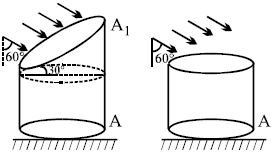
- 9A vertical cylindrical container of base area $A$ and upper cross-section area $A_1$ making an angle $30^o $ with the horizontal is placed in an open rainy field as shown near another cylindrical container having same base area $A$. The ratio of rates of collection of water in the two containers will beView Solution
- 10A healthy adult of height $1.7 \,m$ has an average blood pressure $( BP )$ of $100 \,mm$ of $Hg$. The heart is typically at a height of $1.3 \,m$ from the foot. Take, the density of blood to be $10^3 \,kg / m ^3$ and note that $100 \,mm$ of $Hg$ is equivalent to $13.3 \,kPa$ (kilo pascals). The ratio of $BP$ in the foot region to that in the head region is close toView Solution