Question
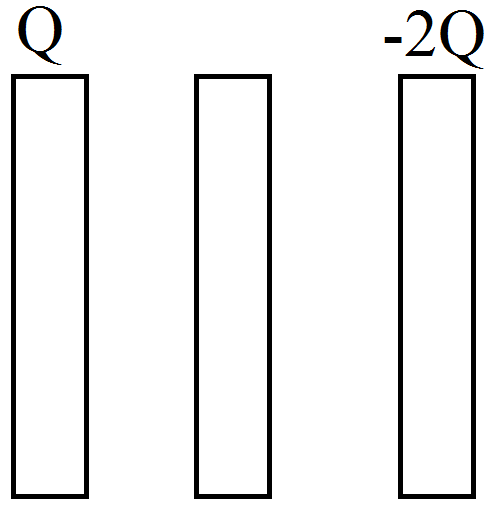
Three identical metal plates with large surface areas are kept parallel to each other as shown in figure. The leftmost plate is given a charge Q, the rightmost a charge -2Q and the middle one remains neutral. Find the charge appearing on the outer surface of the rightmost plate.

Answer


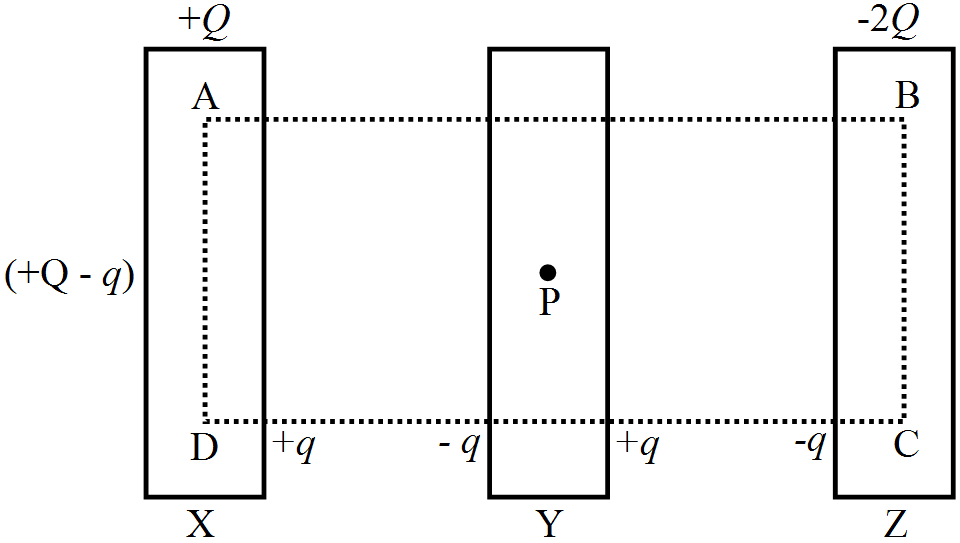
Consider the Gaussian surface as shown in the figure.

Let the charge on the outer surface of the left-most plate be q. Thus, the charges on the plates are distributed as shown in the diagram.

The net field at point P due to all the induced charges must be zero, as it is lying inside the metal surface.

Let the surface area of the plates be A.

Electric field at point P due to the charges on plate X:

Due to charge (+Q - q) is $\frac{\text{Q}-\text{q}}{2\text{A}\in_0}$ in the right direction

Due to charge (+q) is $\frac{\text{q}}{2\text{A}\in_0}$ in the right direction

Electric field at point P due to charges on plate Y:

Due to charge (-q) is $\frac{\text{q}}{2\text{A}\in_0}$ in the right direction

Due to charge (+q) is $\frac{\text{q}}{2\text{A}\in_0}$ in the left direction

Electric field at point P due to charges on plate Z:

Due to charge (-q) is $\frac{\text{q}}{2\text{A}\in_0}$ in the right direction

Due to charge (-2Q + q) is $\frac{\text{2Q}-\text{q}}{2\text{A}\in_0}$ in the right direction

The net electric field at point P:

$\frac{\text{Q}-\text{q}}{2\text{a}\in_0}+\frac{\text{q}}{2\text{A}\in_0}-\frac{\text{q}}{2\text{A}\in_0}-\frac{\text{q}}{2\text{A}\in_0}+\frac{\text{q}}{2\text{A}\in_0}+\frac{\text{2Q}-\text{q}}{2\text{A}\in_0}=0$

$\frac{\text{Q}-\text{q}}{2\text{A}\in_0}+\frac{\text{2Q}-\text{q}}{2\text{A}\in_0}=0$

$\text{Q}-\text{q}+\text{2Q}-\text{q}=0$

$\text{3Q}-2\text{q}=0$

$\text{q}=\frac{\text{3Q}}{2}$

Thus, the charge on the outer plate of the right-most plate

$-2\text{Q}+\text{q}=-2\text{Q}+\frac{3\text{Q}}{2}=-\frac{\text{Q}}{2}$
Need a full question paper?

Generate a complete, print-ready paper with questions like this in minutes — across 16+ boards, with answer keys.

Start Generating Free

Similar questions

Find the energy, the frequency and the momentum of an X-ray photon of wavelength 0.10nm.
A particle is subjected to two simple harmonic motions, one along the X-axis and the other on a line making an angle of 45° with the X-axis, The two motions are given by,

$\text{x}=\text{x}_0\sin\omega\text{t}$ and $\text{s}=\text{s}_0\sin\omega\text{t}$

Find the amplitude of the resultant motion.

A short bar magnet of magnetic moment 5.25 × 10⁻²J T–1 is placed with its axis perpendicular to the earth’s field direction. At what distance from the centre of the magnet, the resultant field is inclined at 45° with earth’s field on (a) its normal bisector and (b) its axis. Magnitude of the earth’s field at the place is given to be 0.42 G. Ignore the length of the magnet in comparison to the distances involved.
Which wavelengths will be emitted by a sample of atomic hydrogen gas (in ground state) if electrons of energy 12.2eV collide with the atoms of the gas?
In a Geiger-Marsden experiment, what is the distance of closest approach to the nucleus of a $7.7 MeV \alpha$-particle before it comes momentarily to rest and reverse its direction?
A lens forms a real image of an object. The distance from the object to the lens is u cm and the distance of the image from the lens is v cm. The given graphs shows variation of v with u.
  1. What is the nature of the lens?
  2. Using the graph, find the focal length of this lens.
Is $\text{p}=\frac{\text{E}}{\text{c}}$ valid for electrons?
Write Einstein's Photoelectric equation and mention which important features in photoelectric effect can be explained with the help of this equation.
The maximum kinetic energy of the photoelectrons gets doubled when the wavelength of light incident on the surface changes from $\lambda_{1}$to $\lambda_{2}$. Derive the expressions for the threshold wavelength $\lambda_{\circ}$ and work function for the metal surface.
If the horizontal force needed for the turn in the previous problem is to be supplied by the normal force by the road, what should be the proper angle of banking?
A laser beam has intensity 2.5 × 10¹⁴Wm-2. Find amplitudes of electric and magnetic fields in the beam.