- AZero.
- BXg.
- C-Xg.
- DRg.
Solution:
For maximum power to be delivered from the generator (or internal reactance Xg) to the load (of reactance, XL),
⇒ XL + Xg = 0 (the total reactance must vanish)
⇒ XL= -Xg.
Generate a complete, print-ready paper with questions like this in minutes — across 16+ boards, with answer keys.
Light is incident normally on a diffraction grating through which the first order diffraction is seen at 32o. The second order diffraction will be seen at
|
(a) 48o |
|
(b) 64o |
|
(c) 80o
|
|
(d) There is no second order diffraction in this case |
Which one of the following is not electromagnetic in nature
|
(a) X-rays |
(b) Gamma rays |
(c) Cathode rays |
(d) Infrared rays |
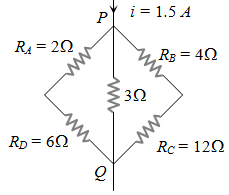
Potential difference between the points P and Q in the electric circuit shown is

|
(a) 4.5 V |
(b) 1.2 V |
(c) 2.4 V |
(d) 2.88 V |
In vacuum the speed of light depends upon
|
(a) Frequency |
(b) Wave length |
|
(c) Velocity of the source of light |
(d) None of these |
Assertion : A pulsor is a source of radio waves which change in terms of intensity at regular interval of time
Reason : A pulsor is a rotating neutron star
|
(a) If both assertion and reason are true and the reason is the correct explanation of the assertion. |
|
(b) If both assertion and reason are true but reason is not the correct explanation of the assertion. |
|
(c) If assertion is true but reason is false. |
|
(d) If the assertion and reason both are false. |
The logic behind ‘NOR’ gate is that it gives
|
(a) High output when both the inputs are low |
|
(b) Low output when both the inputs are low |
|
(c) High output when both the inputs are high |
|
(d) None of these |