MCQ
An alternating voltage $\text{E}=50\sqrt{2}\sin(100\text{t})$ V is connected to a $1\mu\text{F}$ capacitor through an ac ammeter. What will be the reading of the ammeter?
  • A
    $10\text{mA}$
  • B
    $5\text{mA}$
  • C
    $5\sqrt{2}\text{mA}$
  • D
    $10\sqrt{2}\text{mA}$

Answer

  1. $5\text{mA}$

Explanation:

$\text{X}_\text{C}=\frac{1}{\text{C}\omega}=10000\Omega$

ammeater reading $=\text{I}_\text{rms}=\frac{\text{V}_\text{rms}}{\mid\text{jX}_\text{c}\mid}=\frac{50}{10000}=5\text{mA}$

Need a full question paper?

Generate a complete, print-ready paper with questions like this in minutes — across 16+ boards, with answer keys.

Start Generating Free

Similar questions

The ratio of the longest to shortest wavelengths in Brackett series of hydrogen spectra is

(a)  

(b)  

(c)   

(d)  

Substances in which the magnetic moment of a single atom is not zero, is known as

(a) Diamagnetism

(b) Ferromagnetism

(c) Paramagnetism

(d) Ferrimagnetism

At breakdown voltage, the rate of creation of hole-electron pairs is _____ leading to the _______ in current. 
Which resistor is difficult to make of having a value less than about 2 Ohms?
The change in frequency due to Doppler effect does not depend on:
  1. The speed of the source.
  2. The speed of the observer.
  3. The frequency of the source.
  4. Separation between the source and the observer.

The depletion layer in the P-N junction region is caused by

(a) Drift of holes

(b) Diffusion of charge carriers

(c) Migration of impurity ions

(d) Drift of electrons

A metal wire of specific resistance 64   and length 198 cm has a resistance of  7 ohm, the radius of the wire will be

(a) 2.4 cm

(b) 0.24 cm

(c) 0.024 cm

(d) 24 cm

A lens of power +2 diopters is placed in contact with a lens of power – 1 diopter. The combination will behave like

(a) A convergent lens of focal length 50 cm

(b) A divergent lens of focal length 100 cm

(c) A convergent lens of focal length 100 cm

(d) A convergent lens of focal length 200 cm

Which of the following contains a covalent bond?

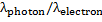
A photon and an electron have equal energy E.  is proportional to

(a)  

(b) 1/ 

(c) 1/E     

(d) Does not depend upon E