Question

An ammeter whose resistance is 180 Ω gives full scale deflection when current is 2 mA. The shunt required to convert it into an ammeter reading 20 mA (in ohms) is

(a) 18

(b) 20

(c) 0.1

(d) 10

Answer

(b) 20

Need a full question paper?

Generate a complete, print-ready paper with questions like this in minutes — across 16+ boards, with answer keys.

Start Generating Free

Similar questions

Raman effect shows:
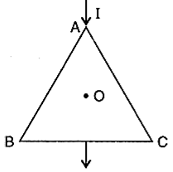
An equilateral triangle is made by uniform wires AB, BC, CA. A current I enteres at A and leaves from the midpoint of BC. If the lengths of each side of the triangle is L, the magnetic field B at the centroid O of the triangle is:
Image

Einstein's photoelectric equation states that . In this equation  refers to

(a) Kinetic energy of all the emitted electrons

(b) Mean kinetic energy of the emitted electrons

(c) Maximum kinetic energy of the emitted electrons

(d) Minimum kinetic energy of the emitted electrons

If an electron enters a magnetic field with its velocity pointing in the same direction as the magnetic field, then

(a) The electron will turn to its right

(b) The electron will turn to its left

(c) The velocity of the electron will increase

(d) The velocity of the electron will remain unchanged

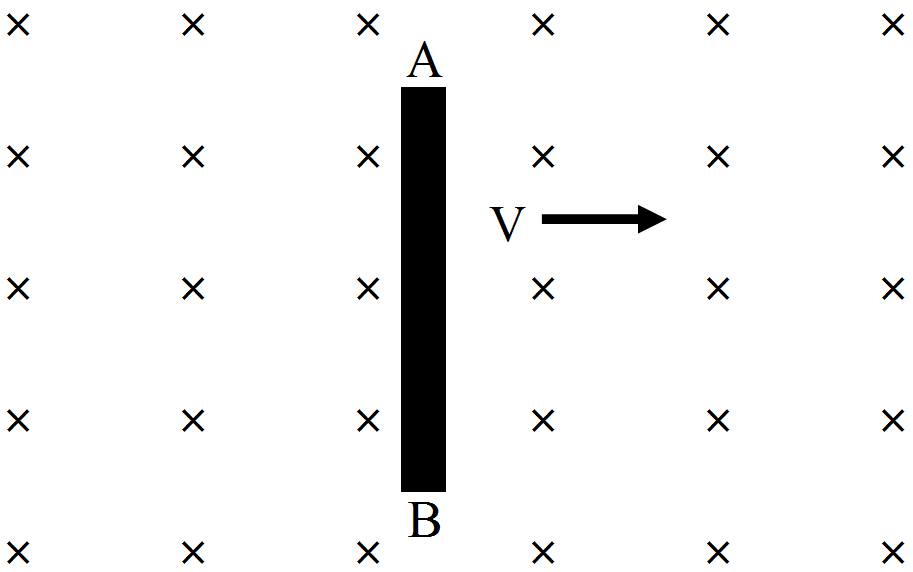
A rod AB moves with a uniform velocity v in a uniform magnetic field as shown in figure.
  1. The rod becomes electrically charged.
  2. The end A becomes positively charged.
  3. The end B becomes positively charged.
  4. The rod becomes hot because of Joule heating.

The tangent at any point of  field line gives the direction of:
An electric field $\overrightarrow{\text{E}}$ and a magnetic field $\overrightarrow{\text{B}}$ exist in a region. The fields are not perpendicular to each other.
  1. This is not possible.
  2. No electromagnetic wave is passing through the region.
  3. An electromagnetic wave may be passing through the region.
  4. An electromagnetic wave is certainly passing through the region.
The value of angle of dip at the earth's magnetic pole is :
The angle between magnetic meridian and geographical meridian is called :

Which of the following relation is correct in magnetism

(a)  

(b) I = V + H

(c) 

(d)