MCQ
Raman effect shows:
- APolarisation
- BQuantum nature
- CWave nature of light
- DNone of the above
Explanation:
Raman effect deals with inelastic scattering of photon particles by interaction with vibrational and rotational transitions in the bonds( Raman scattering can occur with a change in energy of a molecule due to a transition) it has nothing to do with polarisation, quantum nature, wave nature (photon scattering ) and Brillouin zone scattering.
Generate a complete, print-ready paper with questions like this in minutes — across 16+ boards, with answer keys.
The retarding potential for having zero photo-electron current
|
(a) Is proportional to the wavelength of incident light |
|
(b) Increases uniformly with the increase in the wavelength of incident light |
|
(c) Is proportional to the frequency of incident light |
|
(d) Increases uniformly with the increase in the frequency of incident light wave |
$1:1$
$1:2$
$\pi:2$
$2:\pi$

An endoscope is employed by a physician to view the internal parts of a body organ. It is based on the principle of
|
(a) Refraction |
(b) Reflection |
|
(c) Total internal reflectionn |
(d) Dispersion |
If  in the given figure, then resistance X will be

|
(a) 5Ω |
(b) 10 Ω |
(c) 15 Ω |
(d) 20 Ω |
The path executed by a charged particle whose motion is perpendicular to magnetic field i
|
(a) A straight line |
(b) An ellipse |
(c) A circle |
(d) A helix |
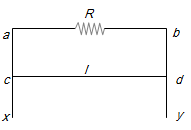
A wire cd of length l and mass m is sliding without friction on conducting rails ax and by as shown. The vertical rails are connected to each other with a resistance R between a and b. A uniform magnetic field B is applied perpendicular to the plane abcd such that cd moves with a constant velocity of
|
(a) |
(b) |
(c) |
(d) |


