MCQ
An application of Bernoulli's equation for fluid flow is found in
  • Dynamic lift of an aeroplane
  • B
    Viscosity meter
  • C
    Capillary rise
  • D
    Hydraulic press

Answer

Correct option: A.
Dynamic lift of an aeroplane
(a)

Need a full question paper?

Generate a complete, print-ready paper with questions like this in minutes — across 16+ boards, with answer keys.
Start Generating Free

Similar questions

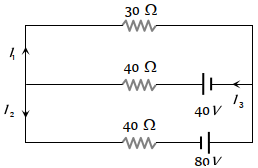
In the given circuit the current $l$ is

Image

Two metallic plates $A$ and $B$, each of area $5 \times 10 \mathrm{~m}$ are placed parallel to each other at a separation of $1 \mathrm{~cm}$. Plate $B$ carries a positive charge of $33.7 \mathrm{pc}$. A monochromatic beam of light, with photons of energy $5 \mathrm{eV}$ each, starts falling on plate $A$ at $t=0$, so that $10\ -$ photons fall on it per square meter per second. Assume that one photoelectron is emitted for every $10$ incident photons. Also assume that all the emitted photoelectrons are collected by plate $B$ and the work function of plate $A$ remains constant at the value $2 \mathrm{eV}$. Electric field between the plates at the end of $10$ seconds is
A source of sound $S$ of frequency $500 \mathrm{~Hz}$ situated between a stationary observer $O$ and a wall $W$, moves towards the wall with a speed of $2 \mathrm{~m} / \mathrm{s}$. If the velocity of sound is $332 \mathrm{~m} / \mathrm{s}$, then the number of beats per second heard by the observer is (approximately)
The equation of motion of a projectile are given by $x=36 t$ metre and $2 y=96 t-9.8 t$ metre. The angle of projection is
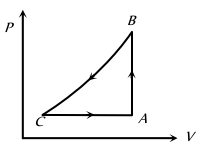
A sample of an ideal gas is taken through a cycle a shown in figure. It absorbs 50 / of energy during the process $A B$, no heat during $B C$, rejects $70 \mathrm{~J}$ during $C A .40 \mathrm{~J}$ of work is done on the gas during $B C$. Internal energy of gas at $A$ is 1500 /, the internal energy at $C$ would be
Image
The pressure and density of a diatomic gas $(\gamma=7 / 5)$ change adiabatically from $(P, d)$ to $(P, d)$. If $\frac{d^{\prime}}{d}=32$, then $\frac{P^{\prime}}{P}$ should be
A concave and convex lens have the same focal length of $20 \mathrm{~cm}$ and are put into contact to form a lens combination. The combination is used to view an object of $5 \mathrm{~cm}$ length kept at $20 \mathrm{~cm}$ from the lens combination. As compared to the object, the image will be
At a certain instant of time the mass of a rocket going up vertically is $100\ kg$. If it is ejecting $5\ kg$ of gas per second at a speed of $400\ m / s$, the acceleration of the rocket would be (taking $g=10 \ m / s ^2$ )
The work per unit volume to stretch the length by $1 \%$ of a wire with cross sectional area of $1 mm ^2$ will be. $\left[Y=9 \times 10^{11} N / m ^2\right]$
Small liquid drops assume spherical shape because