MCQ
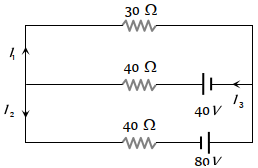
In the given circuit the current $l$ is

Image

  • A
    $0.4 \mathrm{~A}$
  • B
    $-0.4 \mathrm{~A}$
  • $0.8 \mathrm{~A}$
  • D
    $-0.8 \mathrm{~A}$

Answer

Correct option: C.
$0.8 \mathrm{~A}$
(c) $\quad R_{\max }=n R$ and $R_{\min }=R / n \Rightarrow \frac{R_{\max }}{R_{\min }}=n^2$

Need a full question paper?

Generate a complete, print-ready paper with questions like this in minutes — across 16+ boards, with answer keys.

Start Generating Free

Similar questions

In a room where the temperature is $30^{\circ} \mathrm{C}$, a body cools from $61^{\circ} \mathrm{C}$ to $59^{\circ} \mathrm{C}$ in 4 minutes. The time (in min.) taken by the body to cool from $51^0 C$ to $49^{\circ} \mathrm{C}$ will be
Work done in raising a box depends on
A container of volume $1 \mathrm{~m}^3$ is divided into two equal compartments by a partition. One of these compartments contains an ideal gas at $300 K$. The other compartment is vacuum. The whole system is thermally isolated from its surroundings. The partition is removed and the gas expands to occupy the whole volume of the container. lts temperature now would be
On increasing the number of electrons striking the anode of an $X$ ray tube, which one of the following parameters of the resulting $X$ rays would increase
Entropy of a thermodynamic system does not change when this system is used for
An object with a mass $10\ kg$ moves at a constant velocity of $10\ m / sec$. A constant force then acts for $4$ second on the object and gives it a speed of $2\ m / sec$ in opposite direction. The acceleration produced in it, is
An electron starting from rest has a velocity that increases linearly with the time that is $v=k t$, where $k=2 m / sec ^2$. The distance travelled in the first 3 seconds will be
A laser beam can be focussed on an area equal to the square of its wavelength $A He - Ne$ laser radiates energy at the rate of $1 mW$ and its wavelength is $632.8\  nm$. The intensity of focussed beam will be
Consider a compound slab consisting of two different materials having equal thickness and thermal conductivities $K$ and $2 K$ respectively. The equivalent thermal conductivity of the slab is
There are two bodies of masses $100 \mathrm{~kg}$ and $10000 \mathrm{~kg}$ separated by a distance $1 \mathrm{~m}$. At what distance from the smaller body, the intensity of gravitational field will be zero