An arc of a circle of radius $R$ subtends an angle $\frac{\pi }{2}$ at the centre. It carries a current $i$. The magnetic field at the centre will be
Easy
Download our app for free and get started
(b) $B = \frac{{{\mu _0}}}{{4\pi }}\frac{{\theta i}}{r} = \frac{{{\mu _0}}}{{4\pi }} \times \frac{\pi }{2} \times \frac{i}{R} = \frac{{{\mu _0}i}}{{8R}}$

Download our appand get started for free
Experience the future of education. Simply download our apps or reach out to us for more information. Let's shape the future of learning together!No signup needed.*
Similar Questions
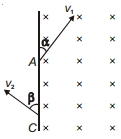
- 1A particle of charge $-q$ and mass $m$ enters a uniform magnetic field $\vec{B}$ at $A$ with speed $v_1$ at an angle $\alpha$ and leaves the field at $C$ with speed $v_2$ at an angle $\beta$ as shown. ThenView Solution
- 2A proton and an alpha particle both enter a region of uniform magnetic field $B,$ moving at right angles to the field $B.$ If the radius of circular orbits for both the particles is equal and the kinetic energy acquired by proton is $1\,\, MeV,$ the energy acquired by the alpha particle will be......$MeV$View Solution
- 3The resistance of a galvanometer is $50\, ohm$ and the maximum current which can be passed through it is $0.002\, A$. What resistance must be connected to it in order to convert it into an ammeter of range $0 -0.5\, A$ ?....$ohm$View Solution
- 4The radius of a circular loop is $r$ and a current $i$ is flowing in it. The equivalent magnetic moment will beView Solution
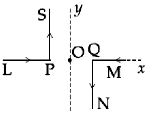
- 5As shown in the figure, two infinitely long, identical wires are bent by $90^o$ and placed in such a way that the segments $LP$ and $QM$ are along the $x-$ axis, while segments $PS$ and $QN$ are parallel to the $y-$ axis. If $OP = OQ = 4\, cm$, and the magnitude of the magnetic field at $O$ is $10^{-4}\, T$, and the two wires carry equal current (see figure), the magnitude of the current in each wire and the direction of the magnetic field at $O$ will be $(\mu_ 0 = 4\pi \times10^{-7}\, NA^{-2})$View Solution
- 6The current sensitivity of moving coil galvanometer is increased by $25 \%$. This increase is achieved only by changing in the number of turns of coils and area of cross section of the wire while keeping the resistance of galvanometer coil constant. The percentage change in the voltage sensitivity will be $...........\%$View Solution
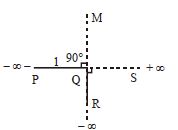
- 7An infinitely long conductor $PQR$ is bent to from a right angle as shown. A current $I$ flows through $PQR$ . The magnetic field due to this current at the point $M$ is $H_1$ . Now, another infinitely long straight conductor $QS$ is connected at $Q$ so that the current in $PQ$ remaining unchanged. The magnetic field at $M$ is now $H_2$ . The ratio $H_1/H_2$ is given byView Solution
- 8In a uniform magnetic field of $0.049 \mathrm{~T}$, a magnetic needle performs $20$ complete oscillations in $5$ seconds as shown. The moment of inertia of the needle is $9.8 \times 10^{-5} \mathrm{~kg} \mathrm{~m}^2$. If the magnitude of magnetic moment of the needle is $x \times 10^{-5} \mathrm{Am}^2$, then the value of ' $x$ ' is :View Solution
- 9A long solenoid has $n$ turns per meter and current $I\, A$ is flowing through it. The magnetic field at the ends of the solenoid isView Solution
- 10A non-planar loop of conducting wire carrying a current $I$ is placed as shown in the figure. Each of the straight sections of the loop is of length $2a$. The magnetic field due to this loop at the point $P$ $(a,0,a)$ points in the directionView Solution