MCQ
An artificial radioactive decay series begins with unstable $_{94}^{241} {Pu}$. The stable nuclide obtained after eight α - decays and five β- decays is
 
  •  $_{83}^{209} {Bi}$
     
  • B
    $_{82}^{209}{~Pb}$
  • C
    $_{82}^{205}{Ti}$
  • D
    $_{82}^{201}{Hg}$

Answer

Correct option: A.
 $_{83}^{209} {Bi}$
 
(a)  $_{83}^{209} {Bi}$

Need a full question paper?

Generate a complete, print-ready paper with questions like this in minutes — across 16+ boards, with answer keys.

Start Generating Free

Similar questions

The refractive index of a particular material is $1.67 $ for blue light, $1.65$ for yellow light and $1.63$ for red light. The dispersive power of the material is .........
Due to the flow of current in a circular loop of radius $R$, the magnetic induction produced at the centre of the loop is $B$. The magnetic moment of the loop is $({\mu _0} = {\rm{permeability}}\,{\rm{constant)}}$
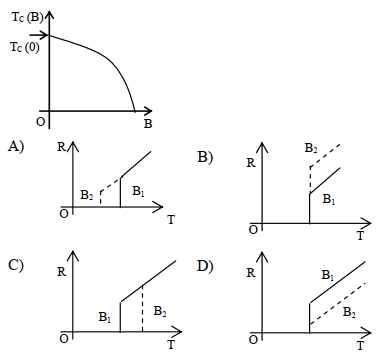
Electrical resistance of certain materials, known as superconductors, changes abruptly from a nonzero value to zero as their temperature is lowered below a critical temperature $T_c(0)$. An interesting property of superconductors is that their critical temperature becomes smaller than $T_c(0)$ if they are placed in a magnetic field, i.e., the critical temperature $T_c(B)$ is a function of the magnetic field strength $B$. The dependence of $T_c(B)$ on $B$ is shown in the figure. $Image$

$1.$ In the graphs below, the resistance $\mathrm{R}$ of a superconductor is shown as a function of its temperature $\mathrm{T}$ for two different magnetic fields $\mathrm{B}_1$ (solid line) and $\mathrm{B}_2$ (dashed line). If $\mathrm{B}_2$ is larger than $\mathrm{B}_1$ which of the following graphs shows the correct variation of $\mathrm{R}$ with $\mathrm{T}$ in these fields?

MCQ $Image$

$2.$ A superconductor has $T_C(0)=100 \mathrm{~K}$. When a magnetic field of 7.5 Tesla is applied, its $\mathrm{T}_{\mathrm{c}}$ decreases to $75 \mathrm{~K}$. For this material one can definitely say that when

$(A)$ $\mathrm{B}=5$ Tesla, $\mathrm{T}_{\mathrm{c}}(\mathrm{B})=80 \mathrm{~K}$

$(B)$ $\mathrm{B}=5$ Tesla, $75 \mathrm{~K}<\mathrm{T}_{\mathrm{c}}(\mathrm{B})<100 \mathrm{~K}$

$(C)$ $\mathrm{B}=10 \mathrm{Tesla}, 75 \mathrm{~K}<\mathrm{T}_{\mathrm{c}}<100 \mathrm{~K}$

$(D)$ $\mathrm{B}=10$ Tesla, $\mathrm{T}_{\mathrm{c}}=70 \mathrm{~K}$

Give the answer question $1, 2$
At any instant, two elements $X _1$ and $X _2$ have same number of radioactive atoms. If the decay constant of $X _1$ and $X _2$ are $10 \lambda$ and $\lambda$ respectively. then the time when the ratio of their atoms becomes $\frac{1}{e}$ respectively will be
Three resistors each of $2\, ohm$ are connected together in a triangular shape. The resistance between any two vertices will be
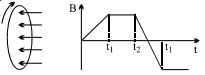
$A$ wire loop is placed in a region of time varying magnetic field which is oriented orthogonally to the plane of the loop as shown in the figure. The graph shows the magnetic field variation as the function of time. Assume the positive $emf$ is the one which drives a current in the clockwise direction and seen by the observer in the direction of $B$. Which of the following graphs best represents the induced emf as a function of time.
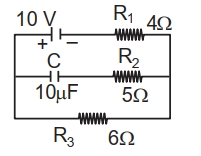
In an electrical circuit drawn below the amount of charge stored in the capacitor is___ $\mu \mathrm{C}$.
What describe the Einsteins equation for the relativity of mass and energy?
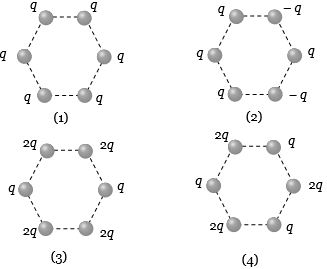
Figures below show regular hexagons, with charges at the vertices. In which of the following cases the electric field at the centre is not zero
A current-carrying, straight wire is kept along the axis of a circular loop carrying a current. The straight wire: