MCQ
Electrical resistance of certain materials, known as superconductors, changes abruptly from a nonzero value to zero as their temperature is lowered below a critical temperature $T_c(0)$. An interesting property of superconductors is that their critical temperature becomes smaller than $T_c(0)$ if they are placed in a magnetic field, i.e., the critical temperature $T_c(B)$ is a function of the magnetic field strength $B$. The dependence of $T_c(B)$ on $B$ is shown in the figure. $Image$

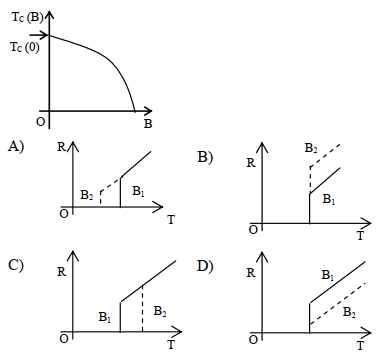
$1.$ In the graphs below, the resistance $\mathrm{R}$ of a superconductor is shown as a function of its temperature $\mathrm{T}$ for two different magnetic fields $\mathrm{B}_1$ (solid line) and $\mathrm{B}_2$ (dashed line). If $\mathrm{B}_2$ is larger than $\mathrm{B}_1$ which of the following graphs shows the correct variation of $\mathrm{R}$ with $\mathrm{T}$ in these fields?

MCQ $Image$

$2.$ A superconductor has $T_C(0)=100 \mathrm{~K}$. When a magnetic field of 7.5 Tesla is applied, its $\mathrm{T}_{\mathrm{c}}$ decreases to $75 \mathrm{~K}$. For this material one can definitely say that when

$(A)$ $\mathrm{B}=5$ Tesla, $\mathrm{T}_{\mathrm{c}}(\mathrm{B})=80 \mathrm{~K}$

$(B)$ $\mathrm{B}=5$ Tesla, $75 \mathrm{~K}<\mathrm{T}_{\mathrm{c}}(\mathrm{B})<100 \mathrm{~K}$

$(C)$ $\mathrm{B}=10 \mathrm{Tesla}, 75 \mathrm{~K}<\mathrm{T}_{\mathrm{c}}<100 \mathrm{~K}$

$(D)$ $\mathrm{B}=10$ Tesla, $\mathrm{T}_{\mathrm{c}}=70 \mathrm{~K}$

Give the answer question $1, 2$
  • $(A,B)$
  • B
    $(B,C)$
  • C
    $(A,D)$
  • D
    $(B,D)$

Answer

Correct option: A.
$(A,B)$
a
$1.$ Larger the magnetic field smaller the critical temperature.

Need a full question paper?

Generate a complete, print-ready paper with questions like this in minutes — across 16+ boards, with answer keys.

Start Generating Free

Similar questions

Two charges $e$ and $3 e$ are placed at a distance $r$. The distance of the point where the electric field intensity will be zero is .........
We consider the Thomson model of the hydrogen atom in which the proton charge is distributed uniformly over a spherical volume of radius $0.25 \,\mathring A$. Applying the Bohr condition in this model, the ground state energy (in $eV$ ) of the electron will be close to
The energy levels of the hydrogen spectrum is shown in figure. There are some transitions $A, B, C, D$ and $E.$ Transition $A, B$ and $C$ respectively represent
Assertion : Moon is seen as it partly reflects the sun light falling on it
Reason : Moon is a satellite of earth. It does not emit light of its own
The average kinetic energy of the thermal neutrons is of the order of

(Boltzmann's constant ${K_B} = 8 \times {10^{ - 5}}\,eV/Kelvin$)

A thin circular wire carrying a current $I$ has a magnetic moment $M$. The shape of the wire is changed to a square and it carries the same current. It will have a magnetic moment
Five charges $+q,+5 q,-2 q,+3 q$ and $-4 q$ are situated as shown in the figure.

The electric flux due to this configuration through the surface $S$ is

Glass has refractive index $\mu $ with respect to air and the critical angle for a ray of light going from glass to air is $\theta$. If a ray of light is incident from air on the glass with angle of incidence $\theta$, the corresponding angle of refraction is
${\sigma _1}$ and ${\sigma _2}$ are the electrical conductivities of $Ge $ and $Na$ respectively. If these substances are heated, then
A small bar magnet has a magnetic moment $1.2 A-m^2$. The magnetic field at a distance $0.1 m$ on its axis will be : $(m_0= 4p \times 10^{-7}\ T-m/A)$