Question
An astronomical telescope is to be designed to have a magnifying power of $50$ in normal adjustment. If the length of the tube is $102cm$, find the powers of the objective and the eyepiece.
Answer

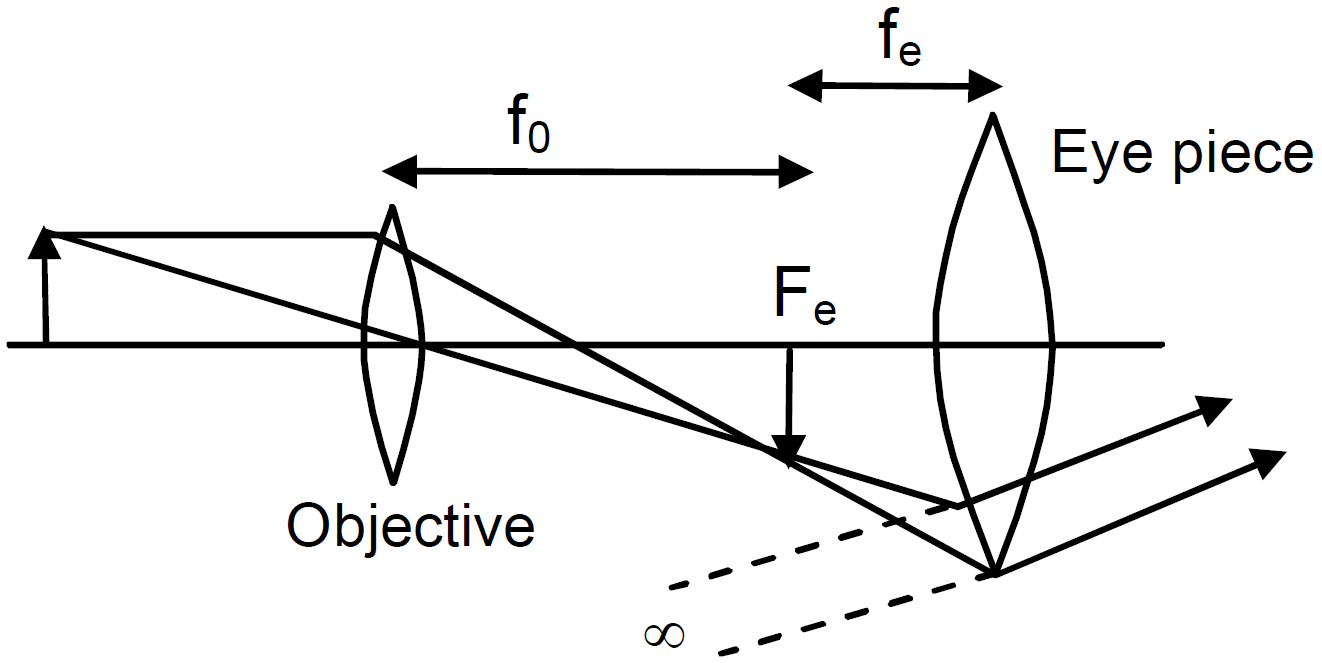
For the astronomical telescope in normal adjustment.Magnifying power = m = 50, length of the tube = L = 102cm
Let $f_0$ and fe be the focal length of objective and eye piece respectively.
$\text{m}=\frac{\text{f}_0}{\text{f}_\text{e}}=50\Rightarrow\text{f}_0=50\text{f}_\text{e}\dots(1)$
and, $\text{L}=\text{f}_0+\text{f}_\text{e}=102\text{cm}\dots(2)$
Putting the value of f0 from equation (1) in (2), we get,
$f_0 + f_e= 102 \Rightarrow 51f_e = 102 \Rightarrow f_e= 2cm = 0.02m$
So, $f_0 = 100cm = 1m$
$\therefore$ Power of the objective lens$=\frac{1}{\text{f}_0}=1\text{D}$
And Power of the eye piece lens$=\frac{1}{\text{f}_\text{e}}=\frac{1}{0.02}=50\text{D}$

Need a full question paper?

Generate a complete, print-ready paper with questions like this in minutes — across 16+ boards, with answer keys.

Start Generating Free

Similar questions

A car of mass $1000\ kg$ accelerstes uniformly from rest to $I$ veloclty of $54\ km/ h$ in $5$ seconds. Calculate:
  1. Its acceleration.
  2. Its gain in $K.E$.
  3. Average power of the engine during this period Neglect friction.
The coefficient of volume expansion of glycerine is $49 \times 10^{–5} K^{–1}$. What is the fractional change in its density for a $30°C$ rise in temperature?
A thin circular loop of radius R rotates about its vertical diameter with an angular frequency $\omega.$ Show that a small bead on the wire loop remains at its lowermost point for $\omega\le\sqrt{\frac{\text{g}}{\text{R}}}.$ What is the angle made by the radius vector joining the centre to the bead with the vertical downward direction for $\omega=\sqrt{\frac{2\text{g}}{\text{R}}}?$ Neglect friction.
  1. Define mean free path.
  2. Derive an expression for mean free path of a gas molecule.
Though the law gives women equal status in India, many people hold unscientific views on a woman’s innate nature, capacity and intelligence, and in practice give them a secondary status and role. Demolish this view using scientific arguments, and by quoting examples of great women in science and other spheres; and persuade yourself and others that, given equal opportunity, women are on par with men.
A rocket is fired ‘vertically’ from the surface of mars with a speed of $2km\ s^{-1}$. If $20\%$ of its initial energy is lost due to martian atmospheric resistance, how far will the rocket go from the surface of mars before returning to it? Mass of mars $= 6.4 \times 10^{23}kg;$ radius of mars $= 3395km;\ G = 6.67 \times 10^{-11}N\ m^2\ kg^{-2}.$
A steel wire of cross-sectional area $0.5 \mathrm{~mm}^2$ is held between two fixed supports. If the tension in the wire is negligible and it is just taut at a temperature of $20^{\circ} \mathrm{C}$, determine the tension when the temperature falls to $0^{\circ} \mathrm{C}$. Young's modulus of steel is $21 \times 10^{11}$ dyne $\mathrm{cm}^{-2}$ and the coefficient of linear expansion of steel is $12 \times 10^{-6}$ per ${ }^{\circ} \mathrm{C}$. Assume that the distance between the supports remains unchanged.
In a Young's double slit experiment using monochromatic light, the fringe pattern shifts by a certain distance on the screen when a mica sheet of refractive index $1.6$ and thickness $1.964$ micron ($1\ micron = 10^{-6}m$) is introduced in the path of one of the interfering waves. The mica sheet is then removed and the distance between the screen and the slits is doubled. It is found that the distance between the successive maxima now is the same as the observed fringe-shift upon the introduction of the mica sheet. Calculate the wavelength of the monochromatic light used in the experiment.
A uniform chain of mass M and length L is held vertically in such a way that its lower end just touches the horizontal floor. The chain is released from rest in this position. Any portion that strikes the floor comes to rest. Assuming that the chain does not form a heap on the floor, calculate the force exerted by it on the floor when a length x has reached the floor.
A mass attached to a spring is free to oscillate, with angular velocity $\omega,$ in a horizontal plane without friction or damping. It is pulled to a distance $x_0$ and pushed towards the centre with a velocity $\upsilon_0$ at time $t = 0$. Determine the amplitude of the resulting oscillations in terms of the parameters $\omega, x_0$ and $\upsilon_0.$ [Hint: Start with the equation $\text{x}=\text{a}\cos(\omega\text{t}+\theta)$ and note that the initial velocity is negative.]