Question
  1. Define mean free path.
  2. Derive an expression for mean free path of a gas molecule.

Answer

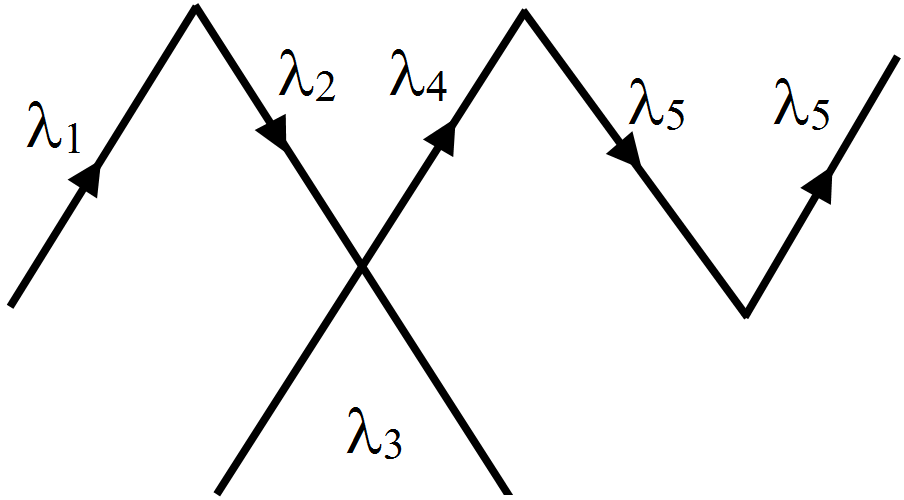
  1. The mean free path of a gas molecule is defined as the average distance travelled by a molecule between two successive collisions.

According to figure, if a molecule covers free path $\lambda_1,\lambda_2,\lambda_3, \ ....$ after successive collisions, then its mean free path is given by
$\lambda=\frac{\lambda_1+\lambda_2+\lambda_3...}{\text{(total number of collisions)}}$
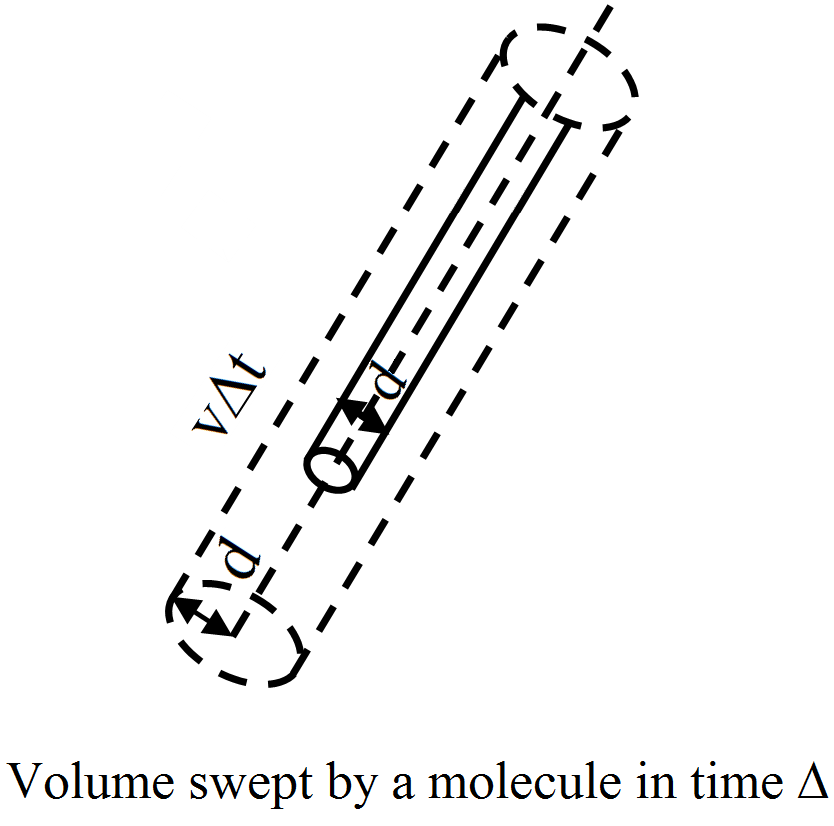
  1. Expression for mean free path: Let d be the diameter of each molecule of the gas, then a particular molecule will suffer collision with any molecule that comes within a distance d between centers of two molecules.

If $\bar{\text{v}}$ is average speed of molecule, then from figure, the volume swept by the molecule in small time $\Delta\text{t}$ in which any molecule will collide with it
$=\pi\text{d}^2\langle\text{v}\rangle\Delta\text{t}$
If n is number of molecules per unit volume of the gas, then number of collision suffered by the molecule in time $\Delta\text{t}$
$=\pi\text{d}^2\langle\text{v}\rangle\Delta\text{t}\times\text{n}$
So, number of collisions per second
$=\frac{\pi\text{d}^2\langle\text{v}\rangle\Delta\text{t}\times\text{n}}{\Delta\text{t}}=\text{n}\pi\text{d}^2\langle\text{v}\rangle$
$\therefore$ Average time between two successive collisions
i.e. $\tau=\frac{1}{\text{n}\pi\text{d}^2\langle\text{v}\rangle}$
$\therefore$ Mean free path = average distance between two successive collision
$\Rightarrow\lambda=\tau\times\text{mean velocity}$
$=\frac{1}{\text{n}\pi\text{d}^2\langle\text{v}\rangle}\times\bar{\text{v}}=\frac{1}{\text{n}\pi\text{d}^2}$
Mean free path, $\lambda=\frac{1}{\text{n}\pi\text{d}^2}$
where, d = diameter of each molecule
and n = number of molecules per unit volume

Need a full question paper?

Generate a complete, print-ready paper with questions like this in minutes — across 16+ boards, with answer keys.
Start Generating Free

Similar questions

A narrow beam of singly charged potassium ions of kinetic energy 32keV is injected into a region of width 1.00cm with a magnetic field of strength 0.500T, as shown in the figure. The ions are collected at a screen 95.5cm away from the field region. If the beam contains isotopes of atomic weights 39 and 41, find the separation between the points where these isotopes strike the screen. Take the mass of a potassium ion $= A (1.6 \times 10^{-27})kg,$ where A is the mass number.
In the following two exercises, choose the correct answer from among the given ones: The gravitational intensity at the centre of a hemispherical shell of uniform mass density has the direction indicated by the arrow (see Fig.) (i) a, (ii) b, (iii) c, (iv) 0.
A metre stick is balanced on a knife edge at its centre. When two coins, each of mass 5g are put one on top of the other at the 12.0cm mark, the stick is found to be balanced at 45.0cm. What is the mass of the metre stick?
Write Stefan's law and with the help of it establish a relation between the rate of fall in temperature and rate of emission of radiation.
Two small spheres, each having a mass of 20g, are suspended from a common point by two insulating strings of length 40cm each. The spheres are identically charged and the separation between the balls at equilibrium is found to be 4cm. Find the charge on each sphere.
$0.32g$ of oxygen is kept in a rigid container and is heated. Find the amount of heat needed to raise the temperature from $25°C$ to $35°C$. The molar heat capacity of oxygen at constant volume is $20J\ mole^{-1}K^{-1}$.
A block of weight 100N is slowly slid up on a smooth incline of inclination 37° by a person. Calculate the work done by the person in moving the block through a distance of 2.0m, if the driving force is:
  1. Parallel to the incline.
  2. In the horizontal direction.
Two stationary particles of masses $M_1$ and $M_2$ are a distance d' apart. A third particle lying on the line joining the particles, experiences no resultant gravitational force. What is the distance of this particle from $M_1$?
In a gamma decay process, the internal energy of a nucleus of mass M decreases, a gamma photon of energy E and linear momentum $\frac{\text{E}}{\text{c}}$ is emitted and the nucleus recoils. Find the decrease in internal energy.
For the motion of a body due to external force, prove that its entire mass can be considered concentrated at the center of mass.