Question
An atomic mass unit (amu) will be equal to :

Answer

(a) - 12th part of the mass of carbon atom

Need a full question paper?

Generate a complete, print-ready paper with questions like this in minutes — across 16+ boards, with answer keys.
Start Generating Free

Similar questions

Assertion :   X-rays cannot be diffracted by means of grating.
Reason     : X-rays does not obey Bragg's law.(a) If both assertion and reason are true and the reason is the correct explanation of the assertion.(b) If both assertion and reason are true but reason is not the correct explanation of the assertion.(c) If assertion is true but reason is false.(d) If the assertion and reason both are false.


Two coherent sources $S_1$ and $S_2$ are separated by a distance four times the wavelength $l$ of the source. The sources lie along $y$ axis whereas a detector moves along $+ x$ axis. Leaving the origin and far off points the number of points where maxima are observed is
A lamp whose resistance is $280 \Omega$ is joined with an ac source of 200 V . The peak value of current flowing in the lamp is :
An electric current i enters and leaves a uniform circular wire of radius a through diametrically opposite points. A charged particle q moving along the axis of the circular wire passes through its centre at speed v. The magnetic force acting on the particle when it passes through the centre has a magnitude:
  1. $\text{qv}\frac{\mu_0\text{i}}{2\text{a}}$
  2. $\text{qv}\frac{\mu_0\text{i}}{2\pi\text{a}}$
  3. $\text{qv}\frac{\mu_0\text{i}}{\text{a}}$
  4. $\text{Zero}$
Quantity that remains unchanged in a transformer is(a) Voltage(b) Current(c) Frequency(d) None of the above
       
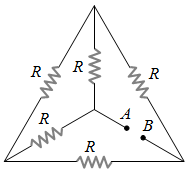
If each of the resistance of the network shown in the figure is $R,$ the equivalent resistance between $A$ and $B$ is
The plates of a parallel plate capacitor of capacity $50\ \mu C$ are charged to a potential of $100$  volts and then separated from each other so that the distance between them is doubled. How much is the energy spent in doing so
If cathode rays are projected at right angles to a magnetic field, their trajectory is (a) Ellipse(b) Circle(c) Parabola(d) None of these
       
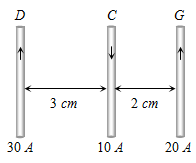
Three long, straight parallel wires carrying current, are arranged as shown in figure. The force experienced by a $25 \ cm$ length of wire $C$ is
A small rod of bismuth is suspended freely between the poles of a strong electromagnet. It is found to arrange itself at right angles to the magnetic field. This observation establishes that bismuth is(a) Diamagnetic(b) Paramagnetic(c) Ferri-magnetic(d) Antiferro-magnetic