An electric current is passed through a circuit containing two wires of the same material, connected in parallel. If the lengths and radii of the wires are in the ratio of $4/3$ and $2/3$, then the ratio of the currents passing through the wire will be
AIEEE 2004, Easy
Download our app for free and get started
(b) $\frac{{{i_1}}}{{{i_2}}} = \frac{{{R_2}}}{{{R_1}}} = \frac{{{l_2}}}{{{l_1}}} \times {\left( {\frac{{{r_1}}}{{{r_2}}}} \right)^2} = \frac{3}{4}{\left( {\frac{2}{3}} \right)^2} = \frac{1}{3}$

Download our appand get started for free
Experience the future of education. Simply download our apps or reach out to us for more information. Let's shape the future of learning together!No signup needed.*
Similar Questions
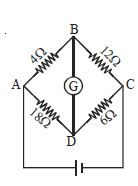
- 1View SolutionIn the following diagram the wheat stone bridge is balanced when we interchange the resistances of
- 2$1.6\, mA$ current is flowing in conducting wire then the number of electrons flowing per second isView Solution
- 3A potentiometer wire has length $10\, m$ and resistance $20\,\Omega $. A $2. 5\, V$ battery of negligible internal resistance is connected across the wire with an $80\,\Omega $ series resistance. The potential gradient on the wire will beView Solution
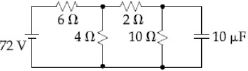
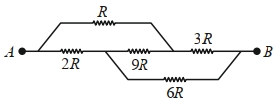
- 4The equivalent resistance between $A$ and $B$ of the network shown in figureView Solution
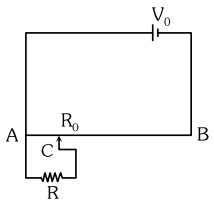
- 5The sliding contact $C$ is at one fourth of the length of the potentiometer wire $( AB )$ from $A$ as shown in the circuit diagram. If the resistance of the wire $AB$ is $R _0$, then the potential drop $( V )$ across the resistor $R$ isView Solution
- 6A storage cell is charged by $5\, amp$ $D.C.$ for $18$ hours. Its strength after charging will be .............. $AH$View Solution
- 7There is a current of $40$ ampere in a wire of ${10^{ - 6}}\,{m^2}$ area of cross-section. If the number of free electron per ${m^3}$ is ${10^{29}}$, then the drift velocity will beView Solution
- 8A battery consists of a variable number $n$ of identical cells (having internal resistance reach) which are connected in series. The terminals of the battery are short-circuited and the current $I$ is measured. Which of the graphs shows the correct relationship between $I$ and $n \,?$View Solution
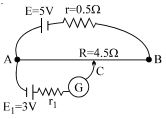
- 9In the given potentiometer circuit length of the wire $AB$ is $3\, m$ and resistance is $R = 4.5 \, \Omega$ . The length $AC$ for no deflection in galvanometer isView Solution
- 10Determine the charge on the capacitor in the following circuit ................ $\mu C$View Solution