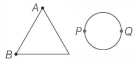
$1.6\, mA$ current is flowing in conducting wire then the number of electrons flowing per second is
Easy
Download our app for free and get started
(b) $i = \frac{{ne}}{t}$==> $n = \frac{{it}}{e} = \frac{{1.6 \times {{10}^{ - 3}} \times 1}}{{1.6 \times {{10}^{ - 19}}}} = {10^{16}}$.

Download our appand get started for free
Experience the future of education. Simply download our apps or reach out to us for more information. Let's shape the future of learning together!No signup needed.*
Similar Questions
- 1View SolutionCorrect set up to verify Ohm's law is
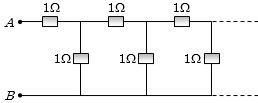
- 2The equivalent resistance between points $A$ and $B$ of an infinite network of resistances each of $1\,\Omega $ connected as shown, isView Solution
- 3View SolutionWhich of the following quantities do not change when a resistor connected to a battery is heated due to the current?
- 4View SolutionThe brightness of a bulb will be reduced, if a resistance is connected in
- 5A cell of negligible resistance and $e.m.f.$ $2$ $volts$ is connected to series combination of $2$, $3$ and $5\, ohm$. The potential difference in volts between the terminals of $3\, ohm$ resistance will beView Solution
- 6A current of $1\, mA$ is flowing through a copper wire. How many electrons will pass a given point in one secondView Solution
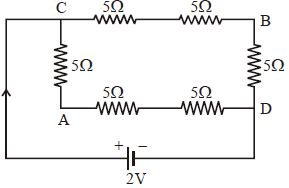
- 7In the adjoining circuit shown the potential difference between points $A$ and $B$ will beView Solution
- 8The electric resistance of a certain wire of iron is $R$. If its length and radius are both doubled, thenView Solution
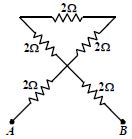
- 9For the circuit shown in the figure , the equivalent resistance between $A$ and $B$ is ............. $\Omega$View Solution
- 10A uniform metallic wire of length $L$ is mounted in two configurations. In configuration $1$ (triangle), it is an equilateral triangle and a voltage $V$ is applied to corners $A$ and $B$. In configuration $2$ (circle), it is bent in the form of a circle and the potential $V$ is applied at diametrically opposite points $P$ and $Q$. The ratio of the power dissipated in configuration $1$ to configuration $2$ isView Solution