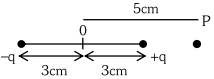
An electric dipole is placed as shown in the figure.The electric potential (in $10^2\,V$ ) at point $P$ due to the dipole is $\left(\epsilon_0=\right.$ permittivity of free space and $\left.\frac{1}{4 \pi \epsilon_0}=K\right)$ :
NEET 2023, Medium
Download our app for free and get started
$v =\frac{ Kq }{2 \times 10^{-2}}-\frac{ Kq }{8 \times 10^{-2}}$
$= Kq \left[\frac{3}{8}\right] \times 10^2$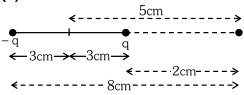

Download our appand get started for free
Experience the future of education. Simply download our apps or reach out to us for more information. Let's shape the future of learning together!No signup needed.*
Similar Questions
- 1The distance between ${H^ + }$ and $C{l^ - }$ ions in $HCl$ molecule is $1.28\,\mathop A\limits^o $. What will be the potential due to this dipole at a distance of $12\,\mathop A\limits^o $ on the axis of dipole......$V$View Solution
- 2The potentials of the two plates of capacitor are $+10\,V$ and $-10\, V$. The charge on one of the plates is $40 \,C$. The capacitance of the capacitor is........$F$View Solution
- 3A uniform electric field having a magnitude ${E_0}$ and direction along the positive $X - $ axis exists. If the potential $V$ is zero at $x = 0$, then its value at $X = + x$ will beView Solution
- 4A parallel plate capacitor having a plate separation of $2\, mm$ is charged by connecting it to a $300\, V$ supply. The energy density is.....$J/m^3$View Solution
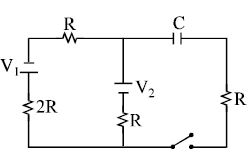
- 5View SolutionIn the transient current circuit shown, the time constant is
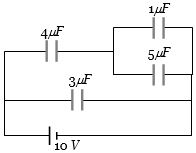
- 6The charge on $4\, \mu F$ capacitor in the given circuit is .... in $\mu C$View Solution
- 7If an $\alpha$-particle and a proton are accelerated from rest by a potential difference of 1 megavolt then the ratio of their kinetic energy will beView Solution
- 8If $Q$ is the charge on the plates of a capacitor of capacitance $C, V$ the potential difference between the plates, $A$ the area of each plate and $d $ the distance between the plates, the force of attraction between the plates isView Solution
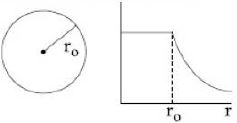
- 9The give graph shown variation (with distance $r$ from centre) ofView Solution
- 10Four identical charges $ + \,50\,\mu C$ each are placed, one at each corner of a square of side $2\,m$. How much external energy is required to bring another charge of $ + \,50\,\mu C$ from infinity to the centre of the square......$J$ $\left( {{\rm{Given}}\frac{{\rm{1}}}{{{\rm{4}}\pi {\varepsilon _{\rm{0}}}}} = 9 \times {{10}^9}\,\frac{{N{m^2}}}{{{C^2}}}} \right)$View Solution