MCQ
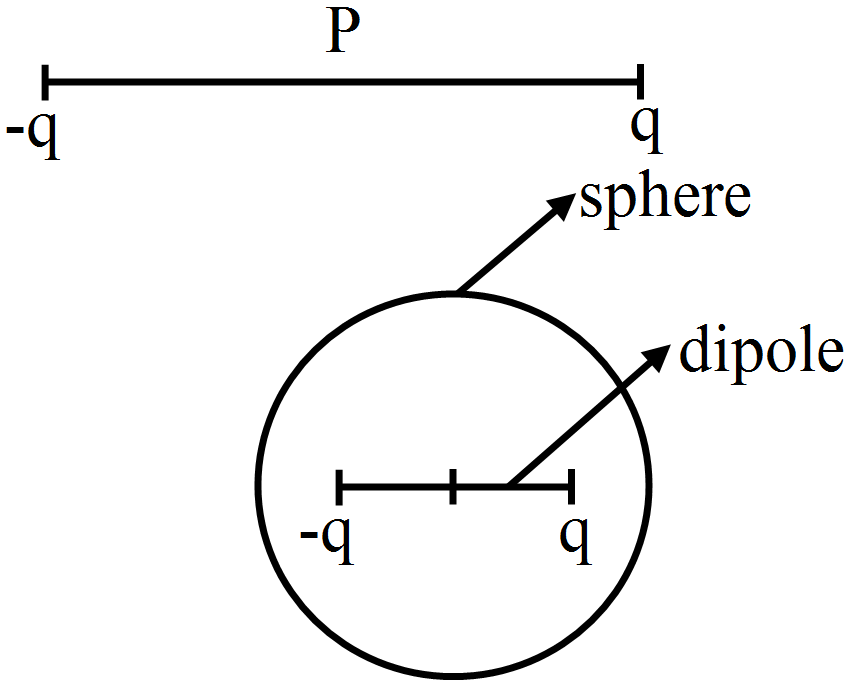
An electric dipole is placed at the centre of a sphere.
Mark the correct options:
  1. The flux of the electric field through the sphere is zero.
  2. The electric field is zero at every point of the sphere.
  3. The electric field is not zero anywhere on the sphere.
  4. The electric field is zero on a circle on the sphere.
  • A
    $A$ and $B$
  • $A$ and $C$
  • C
    $C$ and $D$
  • D
    $B$ and $D$

Answer

Correct option: B.
$A$ and $C$
$\therefore$ Net charge of electric dipole is always zero.

$\phi=\frac{\text{q}_{\text{inside}}}{\in_0}$ Here inside $= 0$
The flux of the electric field through the sphere is zero. But the electric field is not zero any where on the sphere. Take $'A\ '$ point any where on the sphere, and find the electric field on the surface. You will get non zero electric field on the sphere.

Need a full question paper?

Generate a complete, print-ready paper with questions like this in minutes — across 16+ boards, with answer keys.

Start Generating Free

Similar questions

At a given temperature the force between molecules of a gas as a function of intermolecular distance is:
A projectile is thrown with an initial velocity of $(a \hat{ i }+b \hat{ j }) ms ^{-1}$. If the range of the projectile is twice the maximum height reached by it, then
$N\,moles$ of a diatomic gas in a cylinder are at a temperature $T$. Heat is supplied to the cylinder such that the temperature remains constant but $n\,moles$ of the diatomic gas get converted into monoatomic gas. What is the change in the total kinetic energy of the gas ?
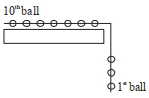
A system to $10$ balls each of mass $2 \; kg$ are connected via massless and unstretchable string. The system is allowed to slip over the edge of a smooth table as shown in figure. Tension on the string between the $7^{th}$ and $8^{th}$ ball is $N$ when $6^{th}$ ball just leaves the table.
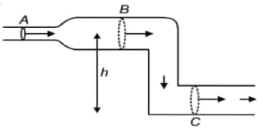
Water is flowing through a channel (lying in a vertical plane) as shown in the figure. Three sections $A, B$ and $C$ are shown. Sections $B$ and $C$ have equal area of cross section. If $P_A, P_B$ and $P_C$ are the pressures at $A, B$ and $C$ respectively then
An electric fan has blades of length $30\, cm$ as measured from the axis of rotation. If  the fan is rotating at $1200 \,r.p.m.$ The acceleration of a point on the tip of the blade is  approximately ........ $m/s^2$.
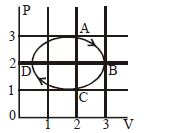
The figure shows the $P-V$ plot of an ideal gas taken through a cycle $ABCDA.$ The part $ABC$ is a semicircle and $CDA$ is half of an ellipse. Then,
Two springs have spring constants ${K_A}$ and ${K_B}$ and ${K_A} > {K_B}$. The work required to stretch them by same extension will be
Figure here shows the vertical cross section of a vessel filled with a liquid of density $\rho$. The normal thrust per unit area on the walls of the vessel at the point $P$, as shown, will be
Who proposed the wave theory of light?