MCQ
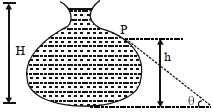
Figure here shows the vertical cross section of a vessel filled with a liquid of density $\rho$. The normal thrust per unit area on the walls of the vessel at the point $P$, as shown, will be
  • A
    $h\rho g$
  • $( H - h ) \rho g$
  • C
    $H\rho g$
  • D
    $( H - h ) \rho g \cos \theta$

Answer

Correct option: B.
$( H - h ) \rho g$
b
Since pressure is directly proportional to the depth below water surface and is same in all the directions.

At point $P$ depth of the water is $( H - h )$, so pressure i.e. normal thrust per unit area at $P$ is equal to $( H - h ) \rho g$

Need a full question paper?

Generate a complete, print-ready paper with questions like this in minutes — across 16+ boards, with answer keys.

Start Generating Free

Similar questions

The force required to take away a flat circular plate of radius $2\, cm$ from the surface of water, will be (the surface tension of water is $70\, dyne/cm$)
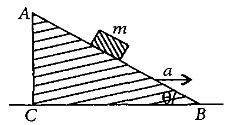
A block of mass $m$ is placed on a smooth inclined wedge $ABC$ of  inclination $\theta$ as shown in the figure. The wedge is given an acceleration $a$ towards the right. The relation between $a$ and $\theta$ for the block to remain stationary on the wedge is
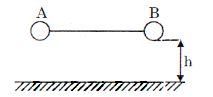
Two small balls are fixed at the ends of a light rigid rod of length $0.4\  m$.The system is released from height $h = 5\  m$ with rod horizontal. The balls collide with the horizontal surface and rebound . The coefficient of restitution between $A$ and ground is $0. 6$ and that between $B$ and ground is $0.4$ . Find angular speed (in $rad/s$) just after the collision. Taking acceleration of free fall $10\ m/s^2$
$50 \,cal$ of heat is required to raise the temperature of $1$ mole of an ideal gas from $20^{\circ} C$ to $25^{\circ} C$, while the pressure of the gas is kept constant. The amount of heat required to raise the temperature of the same gas through same temperature range at constant volume is ........ $cal$ $(R=2 \,cal / mol -K )$
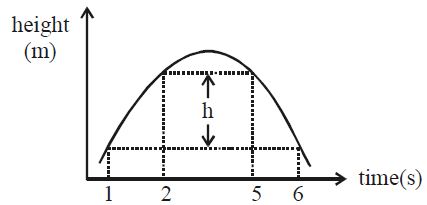
A ball is thrown upwards. Its height varies with time as follows If the acceleration due to gravity is $7.5\, m/s^2$, then the height $h$ is.........$m$
If two waves represented by $y_1 = 4\, \sin\, \omega t$  and ${y_2} = 3\sin \,\left( {\omega t + \frac{\pi }{3}} \right)$ interfere at a point, then amplitude of the resulting wave will be about
A heavy ball of mass $M$ is suspended from the ceiling of car by a light string of mass $m (m << M)$. When the car is at rest, the speed of transverse waves in the string is $60\, ms^{-1}$. When the car has acceleration $a$ , the wave-speed increases to $60.5\, ms^{-1}$. The value of $a$ , in terms of gravitational acceleration $g$ is closest to
Two particles $A$ and $B$ are projected simultaneously from a fixed point of the ground. Particle $A$ is projected on a smooth horizontal surface with speed $v$, while particle $B$ is projected in air with speed $\frac{2 v}{\sqrt{3}}$. If particle $B$ hits the particle $A$, the angle of projection of $B$ with the vertical is
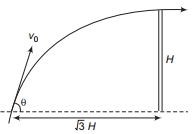
A projectile is thrown at an angle $\theta$ such that it is just able to cross a vertical wall at its highest point as shown in the figure.The angle $\theta$ at which the projectile is thrown is given by
A man of mass 60kg and a boy of mass 30kg are standing together on frictionless ice surface. If they push each other apart man moves away with a speed of 0.4m/ s relative to ice. After 5sec they will be away from each other at a distance of.