Question
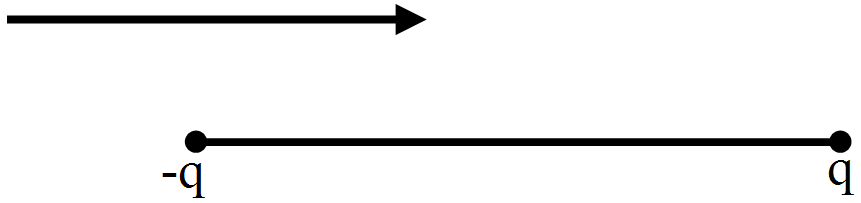
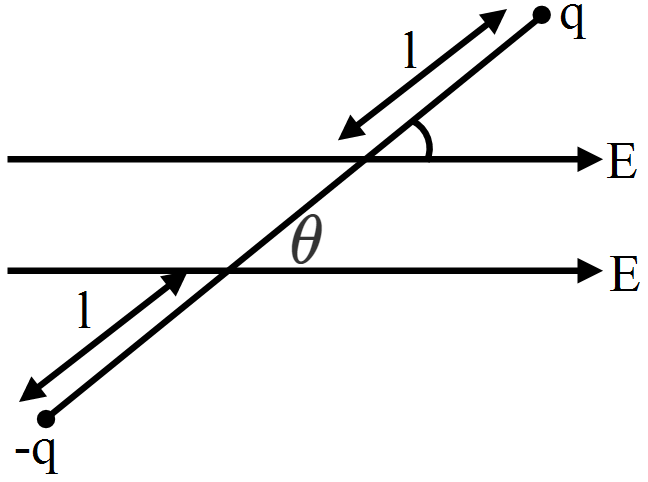
An electric dipole is placed in an electric field generated by a point charge.

Answer

  1. The torque on the dipole due to the field may be zero.
Explanation:
In the uniform Electric field the net electric force on the dipole is alwas zero.

In uniform Electric field the torque on the dipole due to field may be zero.

T = 0
Here t Þ Torque
$\text{T}=2\text{qEl}\sin\text{q }\otimes\neq0$

Need a full question paper?

Generate a complete, print-ready paper with questions like this in minutes — across 16+ boards, with answer keys.
Start Generating Free

Similar questions

Assertio  :   In the phenomenon of mutual induction, self induction of each of the coils persists.
Reason   : Self induction arises when strength of current in same coil changes. In mutual induction, current is changing in both the individual coils.(a) If both assertion and reason are true and the reason is the correct explanation of the assertion.(b) If both assertion and reason are true but reason is not the correct explanation of the assertion.(c) If assertion is true but reason is false.(d) If the assertion and reason both are false.


A very long bar magnet is placed with its north pole coinciding with the centre of a circular loop carrying as electric current i. The magnetic field due to the magnet at a point on the periphery of the wire is B. The radius of the loop is a. The force on the wire is:
  1. Very nearly $2\pi\text{aiB}$ perpendicular to the plane of the wire.
  2. $2\pi\text{aiB}$ in the plane of the wire.
  3. $\pi\text{aiB}$ along the magnet.
  4. Zero.
A metallic shell has a point charge $'q\ ’$ kept inside its cavity. Which one of the following diagrams correctly represents the electric lines of forces
A cable of resistance 10 Ω carries electric power from a generator producing 250 kW at 10000 volt. The current in the cable is(a) 25 A   (b) 250 A
 (c) 100 A (d) 1000 A
       
A pure semiconductor behaves slightly as a conductor at(a) Room temperature(b) Low temperature(c) High temperature(d) Both (b) and (c)
   
   
Consider a planet in some solar system which has a mass double the mass of the earth and density equal to the average density of the earth. An object weighing $W$ on the earth will weight.
The electrochemical equivalent Z of any element can be obtained by multiplying the electrochemical equivalent of hydrogen with(a) Atomic weight(b) Molecular weight(c) Chemical equivalent(d) A constant
       
The $\gamma\ \text{radiations}$ are:
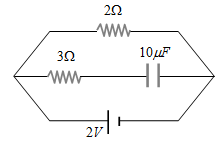
The charge on a capacitor of capacitance $10 \ \mu F$ connected as shown in the figure is         
If a diamagnetic substance is brought near north or south pole of a bar magnet, it is(a) Attracted by the poles(b) Repelled by the poles(c) Repelled by the north pole and attracted by the south pole  (d) Attracted by the north pole and repelled by the south pole