If the net electric flux through a closed surface is zero, then we can infer:
Question types
Electric Charges and Fields question types
600 questions across 7 question groups — pick any mix to generate a Physics paper with step-by-step answer keys.
600
Questions
7
Question groups
5
Question types
01
M.C.Q (1 Marks)
327 Q→02Assertion (A) & Reason (B) MCQ
19 Q→031 Marks Question
35 Q→042 Marks Questions
57 Q→053 Marks Question
86 Q→064 Marks Questions
12 Q→075 Marks Questions
64 Q→Sample Questions
Electric Charges and Fields questions
One sample from each question group in this chapter. Select any group above to see the full set with answer keys.
View full solution →
6 A particle of charge q and mass m moves rectilinearly under the action of electric field E = A – Bx, where A and B are positive constants and x is distance from the point where particle was initially at rest then the distance travelled by the particle before coming to rest and acceleration of particle at that moment are respectively:
The solid angle subtended by the total surface area of a sphere at the centre is:
The force of repulsion between two point charges is F, when these are 1m apart. Now the point charges are replaced by conducting spheres of radii 5cm having the charge same as that of point charges. The distance between their centres is 1m, then the force of repulsion will:
A force $'F\ ’$ is acting between two charges in air. If the space between them be completely filled with a medium $K = 4,$ the force will be:
View full solution →For two statements are given$-$one labelled Assertion $(A)$ and the other labelled Reason $(R).$ Select the correct answer to these questions from the codes $(a), (b), (c)$ and $(d)$ as given below.
Assertion $(A):$ Charge is quantized.
Reason $(R):$ Charge which is less than $I C$ is not possible.
Assertion $(A):$ Charge is quantized.
Reason $(R):$ Charge which is less than $I C$ is not possible.
- ABoth $A$ and $R$ are true, and $R$ is the correct explanation of $A.$
- BBoth $A$ and $R$ are true, but $R$ is not the correct explanation of $A.$
- ✓$A$ is true but $R$ is false.
- D$A$ is false and $R$ is also false.
Answer: C.
View full solution →For two statements are given$-$one labelled Assertion $(A)$ and the other labelled Reason $(R).$ Select the correct answer to these questions from the codes $(a), (b), (c)$ and $(d)$ as given below.
Reason $(A): A$ charged particle free to move in an electric field always move along an electric line of force.
View full solution →- Both $A$ and $R$ are true, and $R$ is the correct explanation of $A.$
- Both $A$ and $R$ are true, but $R$ is not the correct explanation of $A.$
- $A$ is true but $R$ is false.
- $A$ is false and $R$ is also false.
Reason $(A): A$ charged particle free to move in an electric field always move along an electric line of force.
For two statements are given$-$one labelled Assertion $(A)$ and the other labelled Reason $(R).$ Select the correct answer to these questions from the codes $(a), (b), (c)$ and $(d)$ as given below.
Assertion $(A)$: If there exists coulomb attraction between two bodies, both of them may not be charged.
Reason $(R):$ ln coulomb attraction two bodies are oppositely charged.
Assertion $(A)$: If there exists coulomb attraction between two bodies, both of them may not be charged.
Reason $(R):$ ln coulomb attraction two bodies are oppositely charged.
- ABoth $A$ and $R$ are true, and $R$ is the correct explanation of $A.$
- BBoth $A$ and $R$ are true, but $R$ is not the correct explanation of $A.$
- ✓$A$ is true but $R$ is false.
- D$A$ is false and $R$ is also false.
Answer: C.
View full solution →For two statements are given$-$one labelled Assertion $(A)$ and the other labelled Reason $(R).$ Select the correct answer to these questions from the codes $(a), (b), (c)$ and $(d)$ as given below.
Assertion $(A):$ If a conducting medium is placed between two charges, then electric force between them becomes zero.
Reason $(R):$ Reduction in a force due to introduced material is inversely proportional to its dielectric constant.
Assertion $(A):$ If a conducting medium is placed between two charges, then electric force between them becomes zero.
Reason $(R):$ Reduction in a force due to introduced material is inversely proportional to its dielectric constant.
- ABoth $A$ and $R $ are true, and $R$ is the correct explanation of $A.$
- BBoth $A$ and $R$ are true, but $R$ is not the correct explanation of $A.$
- C$A$ is true but $R$ is false.
- ✓$A$ is false and $R$ is also false.
Answer: D.
View full solution →For two statements are given-one labelled Assertion (A) and the other labelled Reason (R). Select the correct answer to these questions from the codes (a), (b), (c) and (d) as given below.
Reason (R): The electric field is independent of the nature of charge.
- Both A and R are true, and R is the correct explanation of A.
- Both A and R are true, but R is not the correct explanation of A.
- A is true but R is false.
- A is false and R is also false.
Reason (R): The electric field is independent of the nature of charge.
What is the net flux of the uniform electric field of Exercise 1.15 through a cube of side 20 cm oriented so that its faces are parallel to the coordinate planes?
Why do the electric field lines never cross each other?
Define dielectric constant of a medium. What is its S.I. unit?
Why do the electrostatic field lines not form closed loops?
Two equal balls having equal positive charge ‘q’ coulombs are suspended by two insulating strings of equal length. What would be the effect on the force when a plastic sheet is inserted between the two?
An infinite line charge produces a field of $9 \times 10^4 N/C$ at a distance of $2 \ cm.$ Calculate the linear charge density.
View full solution →A uniformly charged conducting sphere of $2.4\ m$ diameter has a surface charge density of $80.0 \mu C/m^2.$
View full solution →- Find the charge on the sphere.
- What is the total electric flux leaving the surface of the sphere?
When a glass rod is rubbed with a silk cloth, charges appear on both. A similar phenomenon is observed with many other pairs of bodies. Explain how this observation is consistent with the law of conservation of charge.
An oil drop of $12$ excess electrons is held stationary under a constant electric field of $2.55 \times 10^4 NC^{-1}$ in Millikan’s oil drop experiment. The density of the oil is $1.26 g \ cm^{-3}$. Estimate the radius of the drop. $(g = 9.81\ m\ s^{-2}; e = 1.60 \times 10^{-19} C).$
View full solution →- An electrostatic field line is a continuous curve. That is, a field line cannot have sudden breaks. Why not?
- Explain why two field lines never cross each other at any point?
- Drive the expression for electric field at a point on the equatorial line of an electric dipole.
- Depict the orientation of the dipole in (i) stable, (ii) unstable equilibrium in a uniform electric field.
A point charge of $2.0\ \mu\ C$ is at the centre of a cubic Gaussian surface $9.0 \ cm$ on edge. What is the net electric flux through the surface?
View full solution →Suppose that the particle in Exercise in $1.33$ is an electron projected with velocity $v_x= 2.0 \times 10^6 m s^{–1}.$ If $E$ between the plates separated by $0.5 \ cm$ is $9.1 \times 10^2N/C,$ where will the electron strike the upper plate? $(|e|=1.6 \times 10^{–19}C, m_e = 9.1 \times 10^{–31} \ kg.)$
View full solution →Figure 1.33 shows tracks of three charged particles in a uniform electrostatic field. Give the signs of the three charges. Which particle has the highest charge to mass ratio?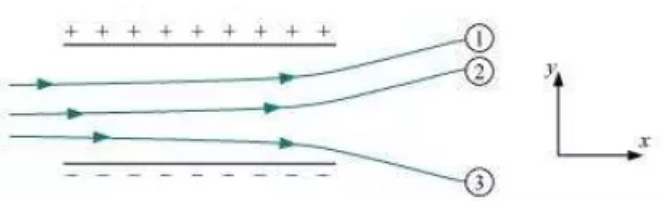
A conducting sphere of radius $10 \ cm$ has an unknown charge. If the electric field $20 \ cm$ from the centre of the sphere is $1.5 \times 10^3 N/C$ and points radially inward, what is the net charge on the sphere?
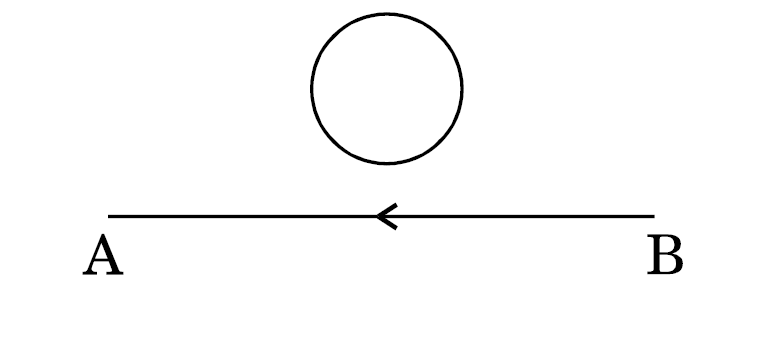
View full solution →The electric current flowing in a wire in the direction from B to A is decreasing. Find out the direction of the induced current in the metallic loop kept above the wire as shown.
Consider a coin of Example $1.20$. It is electrically neutral and contains equal amounts of positive and negative charge of magnitude 34.8kC. Suppose that these equal charges were concentrated in two point charges seperated by,
View full solution →- $1\ cm \Big(\sim\frac{1}{2}\times\text{diagonalof theone paisa coin}\Big)$,
- $100m (~$ length of a long building$)$, and
- $10^6m ($radius of the earth$)$. Find the force on each such point charge in each of the three cases. What do you conclude from these results?
Surface charge density is defined as charge per unit surface area of surface charge distribution. i.e., $\sigma=\frac{\text{dq}}{\text{dS}}.$ Two large, thin metal plates are parallel and close to each other. On their inner faces, the plates have surface charge densities of opposite signs having magnitude of $17.0 \times 10^{-22}Cm^{-2 }$ as shown. The intensity of electric field at a point is $\text{E}=\frac{\sigma}{\epsilon_0},$ where $\epsilon_0=$ permittivity of free space.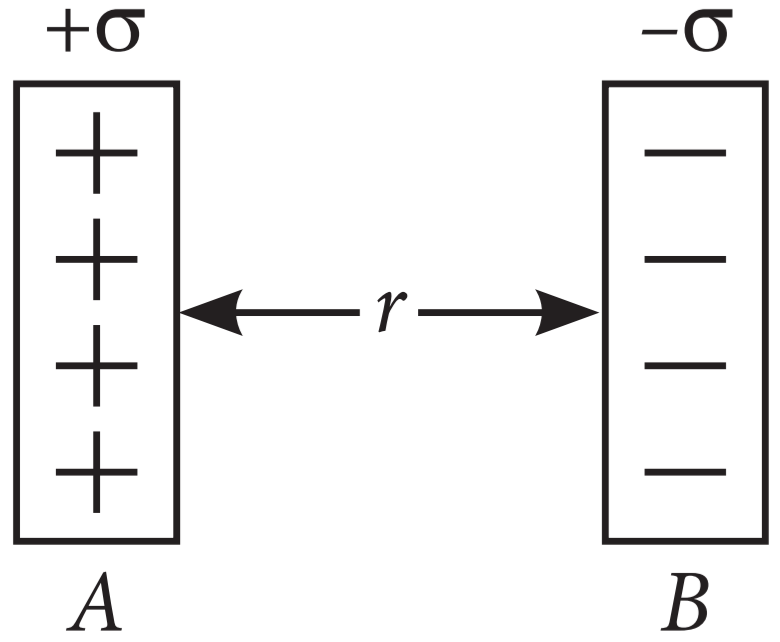
View full solution →
- $E$ in the outer region of the first plate is:
- $17 \times 10^{-22} N/C$
- $1.5 \times 10^{-25} N/C$
- $1.9 \times 10^{-10} N/C$
- Zero.
- $E$ in the outer region of the second plate is:
- $17 \times 10^{-22} N/C$
- $1.5 \times 10^{-15} N/C$
- $1.9 \times 10^{-10} N/C$
- Zero.
- $E$ between the plates is:
- $17 \times 10^{-22} N/C$
- $1.5 \times 10^{-15} N/C$
- $1.9 \times 10^{-10} N/C$
- Zero.
- The ratio of $E$ from right side of $B$ at distances $2\ cm$ and $4\ cm,$ respectively is:
- $1 : 2$
- $2 : 1$
- $1 : 1$
- $1:\sqrt{2}$
- ln order to estimate the electric field due to a thin finite plane metal plate, the Gaussian surface considered is:
- Spherical.
- Spherical.
- Straight line.
- None of these.
Coulomb's law states that the electrostatic force of attraction or repulsion acting between two stationary point charges is given by : $\text{F}=\frac{1}{4\pi\epsilon_0}\frac{\text{q}_1\text{q}_2}{\text{r}^2}$
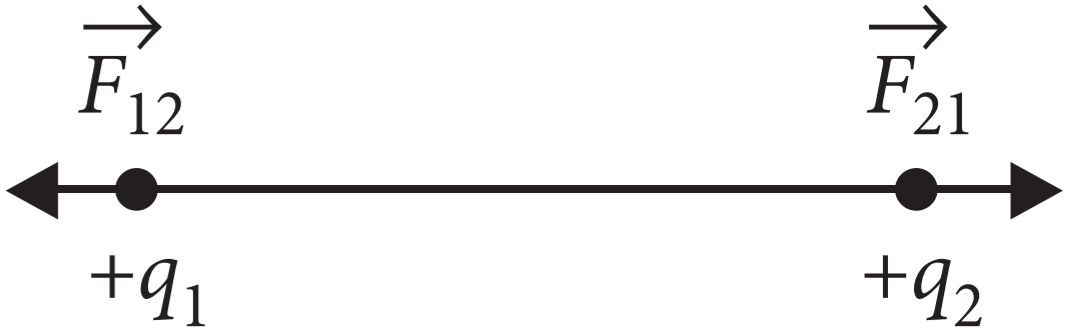
Where $F$ denotes the force between two charges $q_1$ and $q_2$ separated by a distance $r$ in free space, $\epsilon_0$ is a constant known as permittivity of free space. Free space is vacuum and may be taken to be air practically. If free space is replaced by a medium, then $\epsilon_0$ is replaced by $(\epsilon_0\text{k})$ or $(\epsilon_0\epsilon_\text{r})$ where $k$ is known as dielectric constant or relative permittivity.
View full solution →Where $F$ denotes the force between two charges $q_1$ and $q_2$ separated by a distance $r$ in free space, $\epsilon_0$ is a constant known as permittivity of free space. Free space is vacuum and may be taken to be air practically. If free space is replaced by a medium, then $\epsilon_0$ is replaced by $(\epsilon_0\text{k})$ or $(\epsilon_0\epsilon_\text{r})$ where $k$ is known as dielectric constant or relative permittivity.
- In coulomb's law, $\text{F}=\text{k}\frac{\text{q}_1\text{q}_2}{\text{r}^2}$ then on which of the following factors does the proportionality constant $k$ depends?
- Electrostatic force acting between the two charges.
- Nature of the medium between the two charges.
- Magnitude of the two charges.
- Distance between the two charges.
- Dimensional formula for the permittivity constant $\epsilon_0$ of free space is:
- $[ML^{-3 }T^4 A^2]$
- $[M^{-1} L^3 T^2 A^2]$
- $[M^{-1} L^{-3} T^4 A^2]$
- $ML^{-3} T^4 A^{-2}]$
- The force of repulsion between two charges of $1C$ each, kept $1m$ apart in vaccum is:
- $\frac{1}{9\times10^9}\text{N}$
- $9 \times 10^9N$
- $9 \times 10^7N$
- $\frac{1}{9\times10^{12}}\text{N}$
- Two identical charges repel each other with a force equal to $10$ mgwt when they are $0.6m$ apart in air.$(g = 10m s^{-2})$. The value of each charge is:
- $2mC$
- $2 \times 10^{-7}mC$
- $2 nC$
- $2\mu\text{C}$
- Coulomb's law for the force between electric charges most closely resembles with:
- Law of conservation of energy.
- Newton's law of gravitation.
- Newton's $2^{nd}$ law of motion.
- Law of conservation of charge.
Net electric flux through a cube is the sum of fluxes through its six faces. Consider a cube as shown in figure, having sides of length $L = 10.0\ cm$. The electric field is uniform, has a magnitude $E = 4.00 \times 10^3N C^{-1}$ and is parallel to the xy plane at an angle of $37^\circ$ measured from the $+ x - $ axis towards the $+ y -$ axis.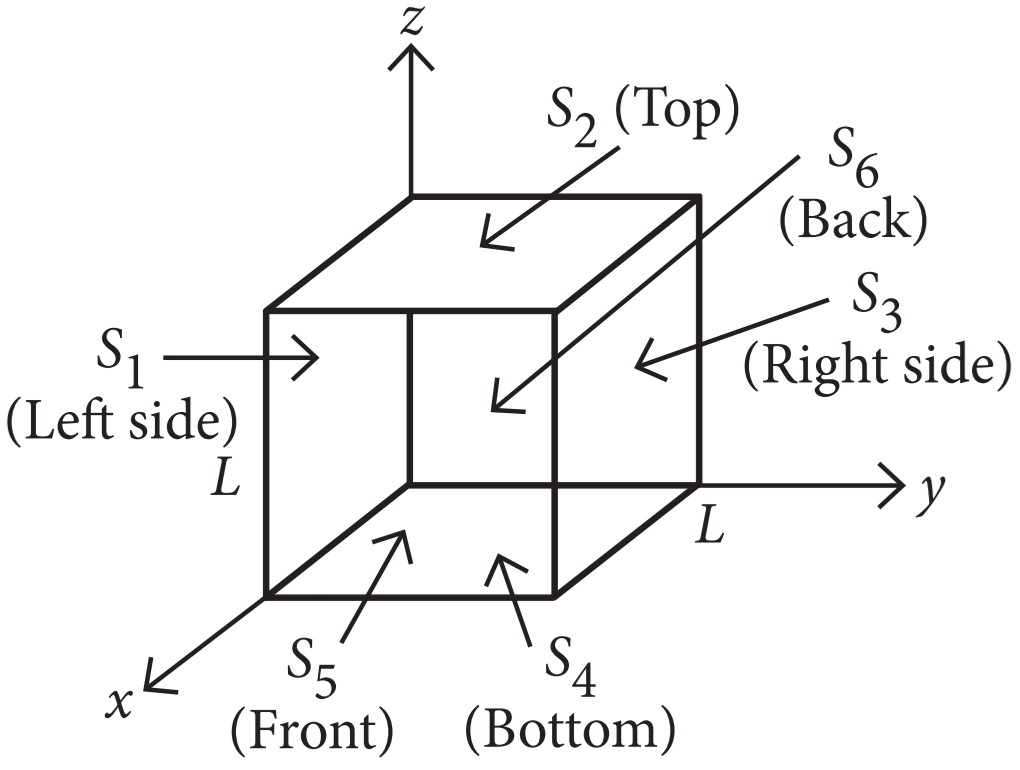
View full solution →
- Electric flux passing through surface $S_6 $ is:
- The surfaces that have zero flux are:
- $-24N m^{2 }C^{-1}$
- $24N m^2 C^{-1}$
- $32N m^2 C^{-1}$
- $-32N m^2 C^{-1}$
- Electric flux passing through surface $S_1$ is:
- $-24N m^{2 }C^{-1}$
- $24N m^{2 }C^{-1}$
- $32N m^{2 }C^{-1}$
- $-32N m^{2 }C^{-1}$
- $S_1$ and $S_3$
- $S_5$ and $S_6$
- $S_2$ and $S_4$
- $S_1$ and $S_2$
- The total net electric flux through all faces of the cube is:
- $8N m^2 C^{-1}$
- $-8N m^2 C^{-1}$
- $24N m^2 C^{-1}$
- Zero.
- The dimensional formula of surface integral $\oint\vec{\text{E}}\cdot\text{d}\vec{\text{S}}$ of an electric field is:
- $[M L^{2 }T^{-2} A^{-1}]$
- $[M L^{3 }T^{-3} A^{-1}]$
- $[M L^{-1 }T^3 A^{-3}]$
- $[M L^{-3 }T^{-3} A^{-1}]$
- Two insulated charged copper spheres $A$ and $B$ have their centres separated by a distance of $50 \ cm$. What is the mutual force of electrostatic repulsion if the charge on each is $6.5 \times 10^{-7} C?$ The radii of A and B are negligible compared to the distance of separation.
- What is the force of repulsion if each sphere is charged double the above amount, and the distance between them is halved?
It is now believed that protons and neutrons (which constitute nuclei of ordinary matter) are themselves built out of more elementary units called quarks. A proton and a neutron consist of three quarks each. Two types of quarks, the so called ‘up’ quark (denoted by u) of charge + (2/3) e, and the ‘down’ quark (denoted by d) of charge (–1/3) e, together with electrons build up ordinary matter. (Quarks of other types have also been found which give rise to different unusual varieties of matter.) Suggest a possible quark composition of a proton and neutron.
In a certain region of space, electric field is along the $z-$ direction throughout. The magnitude of electric field is, however, not constant but increases uniformly along the positive $z-$ direction, at the rate of $10^5 NC^{-1}$ per metre. What are the force and torque experienced by a system having a total dipole moment equal to $10^{-7} \ Cm$ in the negative $z-$ direction?
View full solution →A particle of mass $m$ and charge $(–q)$ enters the region between the two charged plates initially moving along $x-$ axis with speed $vx ($like particle $1$ in Fig. $1.33)$. The length of plate is $L$ and an uniform electric field $E$ is maintained between the plates. Show that the vertical deflection of the particle at the far edge of the plate is $qEL^2/(2m v^2 x)$.
Compare this motion with motion of a projectile in gravitational field discussed in Section $4.10$ of Class $XI$ Textbook of Physics.
View full solution →Compare this motion with motion of a projectile in gravitational field discussed in Section $4.10$ of Class $XI$ Textbook of Physics.
Check that the ratio $\ce{ke^2/G m_em_p}$ is dimensionless. Look up a Table of Physical Constants and determine the value of this ratio. What does the ratio signify?
View full solution →Generate a Electric Charges and Fields paper free
Pick question groups from the list above, set marks and difficulty, and export a branded PDF with step-by-step answer keys. First 3 chapters free — no signup.