An electric dipole of moment $\vec p$ is lying along a uniform electric field $\vec E.$ The work done in rotating the dipole by $90^o $ is
AIPMT 2006, Easy
Download our app for free and get started
work done in deflecting a diapole through an angle $\theta $ is given by
$W{\text{ = }}\int\limits_0^\theta {pE} \sin \,\theta \,d\theta = pE(1 - \cos \,\theta )$
Since $\theta =90^o$
$\therefore \,W = pE(1 - cos\,{90^o})$ or, $W=pE$

Download our appand get started for free
Experience the future of education. Simply download our apps or reach out to us for more information. Let's shape the future of learning together!No signup needed.*
Similar Questions
- 1View SolutionOn increasing the plate separation of a charged condenser, the energy
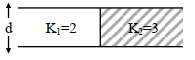
- 2A capacitor of $10 \mu \mathrm{F}$ capacitance whose plates are separated by $10 \mathrm{~mm}$ through air and each plate has area $4 \mathrm{~cm}^2$ is now filled equally with two dielectric media of $\mathrm{K}_1=2, \mathrm{~K}_2=3$ respectively as shown in figure. If new force between the plates is $8 \mathrm{~N}$. The supply voltage is . . . .. . .V.View Solution
- 3After the switch shown in figure $A$ is closed, there is current $i$ through resistance $R$. Figure $B$ indicates current variation curves $a, b, c$ and $d$ for four sets of values of $R$ and capacitance $C$:View Solution
$(i)$ $R_0$ and $C_0$, $(ii)$ $2R_0$ and $C_0$,
$(iii)$ $R_0$ and $2C_0$, $(iv)$ $2R_0$ and $2C_0$.
Which set goes with which curve?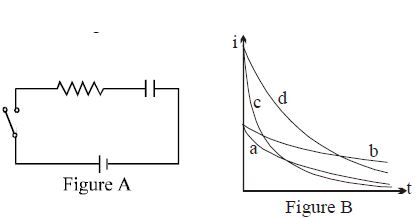
- 4An air filled parallel plate capacitor has capacity $C$. If distance between plates is doubled and it is immersed in a liquid then capacity becomes twice. Dielectric constant of the liquid isView Solution
- 5Three capacitors of $2.0,\;3.0$ and $6.0\;\mu F$ are connected in series to a $10\,V$ source. The charge on the $3.0\,\mu F$ capacitor is........$\mu C$View Solution
- 6An infinite number of charges each numerically equal to q and of the same sign are placed along the $x-$ axis at $x = 1,2,4,8.... \,metres$. Then the electric potential at $x = 0$ due to this set of charges isView Solution
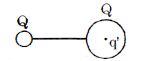
- 7Two conducting hollow sphere of radius $R$ and $3R$ are found to have $Q$ charge on outer surface when both are connected with a long wire and $q'$ charge is kept at the centre of bigger sphere. Then which one is trueView Solution
- 8A condenser having a capacity $2.0$ micro farad is charged to $200\;volts$ and then the plates of the capacitor are connected to a resistance wire. The heat produced in joules will beView Solution
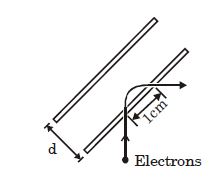
- 9A problem of practical interest is to make a beam of electrons turn at $90^o$ corner. This can be done with the electric field present between the parallel plates as shown in the figure. An electron with kinetic energy $8.0 × 10^{-17}\ J$ enters through a small hole in the bottom plate. The strength of electric field that is needed if the electron is to emerge from an exit hole $1.0\ cm$ away from the entrance hole, traveling at right angles to its original direction is $y × 10^5\ N/C$ . The value of $y$ isView Solution
- 10A $4\,\mu F$ condenser is connected in parallel to another condenser of $8\,\mu F$. Both the condensers are then connected in series with a $12\,\mu F$ condenser and charged to $20\;volts$. The charge on the plate of $4\,\mu F$ condenser is......$\mu C$View Solution