MCQ
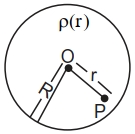
A spherically symmetric charge distribution is considered with charge density varying as

$\rho(r)=\left\{\begin{array}{ll}\rho_{0}\left(\frac{3}{4}-\frac{r}{R}\right) & \text { for } r \leq R \\ \text { Zero } & \text { for } r>R\end{array}\right.$

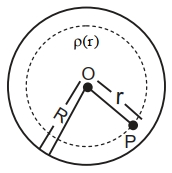
Where, $r ( r < R )$ is the distance from the centre $O$ (as shown in figure). The electric field at point $P$ will be.
  • A
    $\frac{\rho_{0} r}{4 \varepsilon_{0}}\left(\frac{3}{4}-\frac{r}{R}\right)$
  • B
    $\frac{\rho_{0} r}{3 \varepsilon_{0}}\left(\frac{3}{4}-\frac{r}{R}\right)$
  • $\frac{\rho_{0} r}{4 \varepsilon_{0}}\left(1-\frac{r}{R}\right)$
  • D
    $\frac{\rho_{0} r}{5 \varepsilon_{0}}\left(1-\frac{r}{R}\right)$
Answer

Correct option: C.
$\frac{\rho_{0} r}{4 \varepsilon_{0}}\left(1-\frac{r}{R}\right)$
c
$\oint \overrightarrow{ E } \cdot d \overrightarrow{ s }=\frac{ Q _{\text {in }}}{\varepsilon_{ o }}$

$E .4 \pi r ^{2}=\frac{\int_{0}^{ r } \rho_{ o }\left(\frac{3}{4}-\frac{ r }{ R }\right) 4 \pi r ^{2} dr }{\varepsilon_{0}}$

$E 4 \pi r ^{2}=\frac{\rho_{ o } 4 \pi}{\varepsilon_{ o }}\left(\frac{3}{4} \frac{ r ^{3}}{3}-\frac{ r ^{4}}{4 R }\right)$

$Er { }^{2}=\frac{\rho_{ o } r ^{3}}{4 \varepsilon_{ o }}\left\{1-\frac{ r }{ R }\right\}$

$E =\frac{\rho_{0} r }{4 \varepsilon_{ o }}\left\{1-\frac{ r }{ R }\right\}$

Need a full question paper?

Generate a complete, print-ready paper with questions like this in minutes — across 16+ boards, with answer keys.

Start Generating Free

Similar questions

The current sensitivity of a moving coil galvanometer can be increased by
In the forward bias arrangement of a PN-junction diode
Why does a straight rod appear bent in water?
The muon has the same charge as an electron but a mass that is $207$ times greater. The negatively charged muon can bind to a proton to form a new type of hydrogen atom. How does the binding energy $E_{Bμ}$ of the muon in the ground state of a muonic hydrogen atom  compare with the binding energy $E_{Be}$ of an electron in the ground state of a conventional hydrogen atom ?
A very long solenoid of radius $R$ is carrying current $I\left( t \right) = kt{e^{ - \alpha t}}\,\left( {k > 0} \right)$ , as a function of time $(t  \geq  0)$. counter clockwise current is taken to be positive. A circular conducting coil of radius $2R$ is placed in the equatorial plane of the solenoid and concentric with the solenoid. The current induced in the outer coil is correctly depicted, as a function of time, by
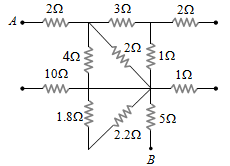
What is the equivalent resistance between the points A and B of the network
$v_1$ is the frequency of the series limit of Lyman series, $v_2$  is the frequency of the first line of Lyman series and  $v_3$ is the frequency of the series limit of the Balmer series. Then
If $13.6\; eV$ energy is required to ionize the hydrogen atom, then the energy required to remove an electron from $n=2$ is
The ratio of heat dissipated per second through the resistance $5 \Omega$ and $10 \Omega$ in the circuit given below is: :
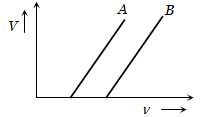
The stopping potential as a function of the frequency of the incident radiation is plotted for two different photoelectric surfaces A and B. The graphs show that work function of A is