An electric fan and a heater are marked as $100\, watt$, $220\, volt$ and $1000\, watt$, $220\, volt$ respectively. The resistance of the heater is
Easy
Download our app for free and get started
For constant voltage, we know that $P \propto \frac{1}{R}$
So higher the power, lower will be the resistance.

Download our appand get started for free
Experience the future of education. Simply download our apps or reach out to us for more information. Let's shape the future of learning together!No signup needed.*
Similar Questions
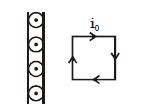
- 1Figure shows a cross-section of a large-section of an infinite metal sheet carrying an electric current along its surface. The current per unit length is $J$ . A current carrying square loop is placed nearby the metal sheet such that the plane of square is perpendicular to the plane of sheet thenView Solution
- 2View SolutionExpress which of the following setups can be used to verify Ohm’s law
- 3A fuse wire with radius $1\, mm$ blows at $1.5\, amp$. The radius of the fuse wire of the same material to blow at $3\,A$ will beView Solution
- 4A student is provided with a variable voltage source $V$, a test resistor $R_T=10\,\Omega$, two identical galvanometers $G_1$ and $G_2$ and two additional resistors, $R _1=10\,M\,\Omega$ and $R _2=0.001\,\Omega$. For conducting an experiment to verify ohms law, the most suitable circuit is:View Solution
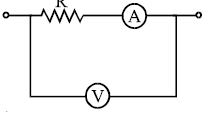
- 5In the circuit shown the resistance of voltmeter is $10,000\, ohm$ and that of ammeter is $20\,ohm$. The ammeter reading is $0.10\,Amp$ and voltmeter reading is $12$ $\mathrm{volt}.$ Then $R$ is equal to .............. $\Omega$View Solution
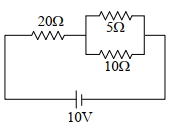
- 6The ratio of heat dissipated per second through the resistance $5 \Omega$ and $10 \Omega$ in the circuit given below is: :View Solution
- 7You are given three bulbs of $25$, $40$ and $60\, watt$. Which of them has lowest resistanceView Solution
- 8Two wires of the same dimensions but resistivities ${\rho _1}$ and ${\rho _2}$ are connected in series. The equivalent resistivity of the combination isView Solution
- 9Current measured by the ammeter $(A)$ in the reported circuit when no current flows through $10\,\Omega$ resistance. will be________$A$View Solution
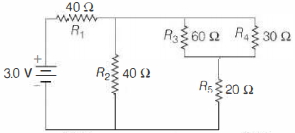
- 10In the circuit shown below, the resistances are given (in $\Omega$ ) and the battery is assumed ideal with emf equal to $3.0 \,V$. The resistor that dissipates the most power isView Solution