MCQ
An electric field converges at the origin whose magnitude is given by the expression $E = 100\,r\,Nt/Coul$, where $r$ is the distance measured from the origin.
  • A
    total charge contained in any spherical volume with its centre at origin is negative.
  • B
    total charge contained at any spherical volume, irrespective of the location of its centre, is negative.
  • C
    total charge contained in a spherical volume of radius $3\, \,cm$ with its centre at origin has magnitude $3 \times 10^{-13}\ C.$
  • all of the above

Answer

Correct option: D.
all of the above
d
As the electric field converges at the origin so total charge contained in any spherical volume, irrespective of the location, is negative.

By Gauss theorem $\int \vec{E} \cdot d \vec{s}=\frac{q}{\in_{0}}$

We have $-E\left(4 \pi r^{2}\right)=\frac{q}{\in_{0}} \Rightarrow q=-3 \times 10^{-13} C$

Need a full question paper?

Generate a complete, print-ready paper with questions like this in minutes — across 16+ boards, with answer keys.

Start Generating Free

Similar questions

An electron (charge $= 1.6 × 10^{-19}$ coulomb) is moving in a circle of radius $5.1 × 10^{-11}\,m$ at a frequency of $6.8 × 10^{15} $ revolutions/sec. The equivalent current is approximately
When an ac generator of $120\,V$ is connected in series with a capacitor and a resistor of $30\,\Omega $, the circuit carries a current $1·5\,A$. The potential difference across the capacitor will be.....$V$
A circular coil of diameter $7\,cm$ has $24$ $turns$ of wire carrying current of $ 0.75\,A$. The magnetic moment of the coil is
A man can see upto $100 \,cm$ of the distant object. The power of the lens required to see far objects will be
A combination of two thin convex lenses of focal length 0.3 m and 0.1 m will have minimum spherical and chromatic aberrations if the distance between them is
Number of electrons in the valence shell of a pure semiconductor is:
A heater of $220\, V$ heats a volume of water in $5\,\min$ time. A heater of $110\, V$ heats the same volume of water in ............... $min$
The electric potential at the centre of a charged spherical conductor in comparison with the potential at the surface of the conductor:
Assertion : Lenz’s law violates the principle of conservation of energy.
Reason : Induced e.m.f., opposes always the change in magnetic flux responsible for its production.
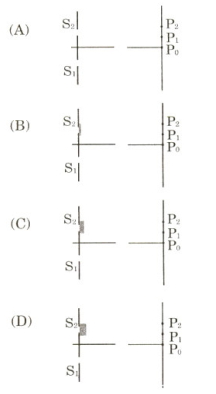
Column $I$ shows four situations of standard Young's double slit arrangement with the screen placed far away from the slits $S_1$ and $S_2$. In each of these cases $\mathrm{S}_1 \mathrm{P}_0=\mathrm{S}_2 \mathrm{P}_0, \mathrm{~S}_1 \mathrm{P}_1-\mathrm{S}_2 \mathrm{P}_1=\lambda / 4$ and $\mathrm{S}_1 \mathrm{P}_2-\mathrm{S}_2 \mathrm{P}_2=\lambda / 3$, where $\lambda$ is the wavelength of the light used. In the cases $\mathrm{B}, \mathrm{C}$ and $\mathrm{D}$, a transparent sheet of refractive index $\mu$ and thickness $t$ is pasted on slit $\mathrm{S}_2$. The thicknesses of the sheets are different in different cases. The phase difference between the light waves reaching a point $\mathrm{P}$ on the screen from the two slits is denoted by $\delta(\mathrm{P})$ and the intensity by $I(\mathrm{P})$. Match each situation given in Column $I$ with the statement$(s)$ in Column $II$ valid for that situation.

Column $I$ Column $II$
$(A)$ $Image$ $(p)$ $\delta\left(\mathrm{P}_0\right)=0$
$(B)$ $(\mu-1) t=\lambda / 4$ $Image$ $(q)$ $\delta\left(\mathrm{P}_1\right)=0$

$(C)$ $(\mu-1) t=\lambda / 2$ $Image$

$(r)$ $I\left(\mathrm{P}_1\right)=0$
$(D)$ $(\mu-1) t=3 \lambda / 4$ $Image$ $(s)$ $\left(\mathrm{P}_0\right)>I\left(\mathrm{P}_1\right)$
  $(t)$ $I\left(\mathrm{P}_2\right)>I\left(\mathrm{P}_1\right)$