Question
An electric kettle has a heating element which is rated at 2 kW when connected to a 250 V electric supply. Calculate the
(a) Current which flows in the element when it is connected to a 250 V supply,
(b) Resistance of the filament,
(c) Heat produced in 1 minute by the element,
(d) Cost of running the kettle for 10 minutes a day for 30 days of the month, at the rate of Rs. 3.00 per unit.
Answer

Given power P = 2k W = 2000 W, Voltage = 250 V
(a) Current $I=\frac{P}{V}=\frac{2000}{250}=8 \mathrm{~A}$
(b) Resistance R = $\frac{\mathrm{V}^2}{\mathrm{R}} \mathrm{t}=\frac{(250)^2}{31.25} \times 60=1.2 \times 10^5$ Joules
(d)Energyconsumedperday=$=P \times t=2 \times\left(\frac{10}{60}\right)=0.33 \mathrm{kWh}$
Energy consumed in 30 days= 0.33 x 30 = 10 kWh
Cost of running it @Rs3 per unit = 10 x 3 =Rs 30

Need a full question paper?

Generate a complete, print-ready paper with questions like this in minutes — across 16+ boards, with answer keys.

Start Generating Free

Similar questions

(i) What is potential energy. Discuss about two types of potential energy.
(ii) (a) State law of conservation of energy.
(b) Write two examples of interconversion of energy.
(iii) A body A of mass 20 kg is moving with a velocity of $1 ms^{-1}$. Another body B of mass 1 kg is moving with a velocity of $20 ms^{-1}$. Find the ratio of kinetic energy of $A$ and $B$.
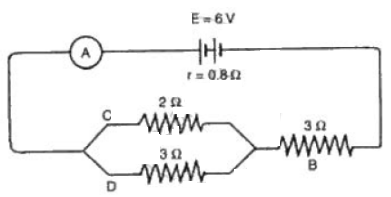
The circuit diagram (Fig.) shows a battery of e.m.f. 6 volts and internal
resistance of 0.8 Ω oonnected in series. Find the
(a) Current reoorded by the ammeter,
(b) P.d. across the terminals of the resistor B,
( c) Current passing through each of the resistors B, C and D, and
( d) P.d. across the terminals of the battery.

Image

Describe a set up for plotting the magnetic lines of force in: (i) A straight wire, (ii) A circular coil and (iii) A straight solenoid.
What should be the characteristic of a source of energy?
Explain briefly what causes the twinkling of stars at night.
A force of $1$ kgf displaces a body by a distance of $10 \ cm$
(i) in direction of force,
(ii) normal to the force
(iii) at an angle of $60^\circ $ to the direction of the force.
Calculate the amount of work done in each case. (Take: $g = 9.8 ms^{−2}$ )
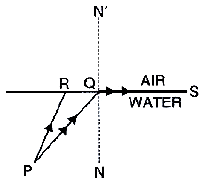
In the given figure $PQ$ and $PR$ are the two light rays emerging from an object $P.$ The ray $PQ$ is refracted as $QS.$

(a) state the special name given to the angle of incidence $\angle PQN$ of the ray $PQ.$
$$(b) what is the angle of refraction for the refracted ray $QS?$
(c) name the phenomenon that occurs if the angle of incidence $\angle PQN$ is increased.
(d) The ray PR suffers partial reflection and refraction on the water-air surface. Give reason. Draw in the diagram the refracted ray for the incident ray PR and hence show the position of image of the object $P$ by the letter $P^{\prime}$ when seen vertically from above.
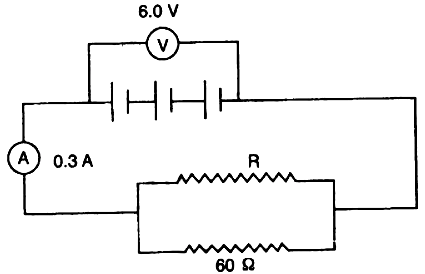
In the figure below, the ammeter A reads $0.3 A$. Calculate:
(i) the total resistance of the circuit
(ii) the value of $R$
(iii) the current flowing through$ R.$
What do you understand by forced vibrations?
Two unlike forces (parallel) of 10 N and 25 N act at a distance of 12 cm. from each other. Find the point about which the body balance.